Lakin in the early years

John O’Loughlin’s arrival in the spring of 1873 signaled the beginning of a new town, but Lakin’s growth was relatively slow until 1879. Lakin’s first newspaper, the Lakin Eagle, arrived on the scene in May of that year. Four Lakin businesses advertised in the Eagle’s inaugural issue – O’Loughlin’s general merchandise; Harrison Burtch’s saloon; Gray & Jones groceries, hardware and lumber; and Potter Cason & Co. land agents. O’Loughlin had outgrown his dug-out trading post by this time, and carpenters were at work on a 30×50 two-story store building for Lakin’s founding father. The store sat next to his dug-out on the railroad right-of-way which became Lakin’s first business district. This strip of land, originally referred to as Main Street, began near Buffalo Street and ran about three blocks west. The Harvey House and railroad section house had been built here, and they were joined in the summer of 1879 by Joseph Dillon’s hardware store, George Bandall’s blacksmith shop and W.P. Loucks’ boarding house. In time, the strip became known as Front Street.

Cattle ranching was already a thriving business here, but the Eagle encouraged homesteaders to come here by promoting the agricultural possibilities. Pioneers were lured here by cheap land and the construction of irrigation ditches. In an area lacking in trees, the Eagle touted our natural building materials of sand stone, blue lime stone and potters clay. The Eagle predicted that Lakin would be the largest town in western Kansas in less than five years and claimed that the only thing holding Lakin back was the refusal of the Arkansas Valley Town Company to lay off the townsite into lots.

By the end of 1879, other businesses had set up shop in Lakin, but the Eagle had ceased operation. In the 1880 U.S. census, Kearney Township of Ford County had a population of 159, most of whom were living at Lakin either in the Harvey House, section house, shanties, dugouts or one of the few private residences that had been built. Aside of railroad and Harvey House employees, other occupations listed in the census included music teacher, grocer, carpenter, store clerk, druggist, harness maker, wild horse catcher, stone mason, lawyer, printer, cattlemen and laborers.

On March 7, 1882, Gilbert Bedell, an engineer from Larned, assisted by F.L. Pierce and Dayton Loucks, commenced a survey on Sec. 27, Twp. 24, Range 36 preparatory to the platting of Lakin. The original plat consisted of Blocks 1 through 20 with all east-west streets called avenues, and north-south roads called streets. Named for James Waterman who had come to Lakin in 1880 in the employ of the railroad, Waterman Avenue was the only street on the original plat dubbed for a local. Proprietors began moving their businesses from Front Street to the “new” Main Street, and O’Loughlin began digging a cellar on the northwest corner of Main and Waterman preparatory to moving his general store building there. Lakin’s new depot was completed in the spring of 1882 and sat back a small distance off South Main. In June, the Arkansas Valley Town Company requested that all those who hadn’t moved off the railroad right-of-way be removed at once.
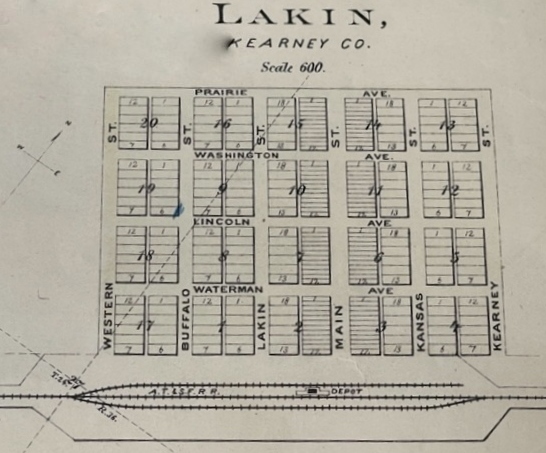
The Lakin Herald reported steady growth, “Our town is fast building up, every week adds another new house to our young city.” Businesses were also being erected on Waterman Avenue which was the main thoroughfare through Lakin prior to the construction of Highway 50. Lakin was becoming “civilized” with literary societies and a town orchestra. Herald Editor Joseph Dillon encouraged citizens to plant trees to beautify the town. “The planting of trees shows taste and refinement.”

This area which was once labeled as the Great American Desert was promoted as the Garden of the West by land speculators. The extensive advertising campaign by the A,T&SF and the passing of the Homestead and Tree Claim Acts brought in settlers in ever-increasing numbers from 1883 to 1888. In 1883, construction began on Lakin’s town hall which was used not only for activities and meetings but also as a school and church. A $10,000 schoolhouse was opened in November 1886, and Lakin was designated as the temporary county seat of the newly organized Kearney County in March of 1888.

Lakin lost the county seat to neighboring Hartland in 1889. This loss, coupled with drought and nation-wide economic depression, led to a large number of settlers leaving the area.  Portions of the supplemental plats that had been completed in 1885 and 1887 were vacated and returned to acreage to relieve the owners of paying city tax. Lakin’s boom had broke.
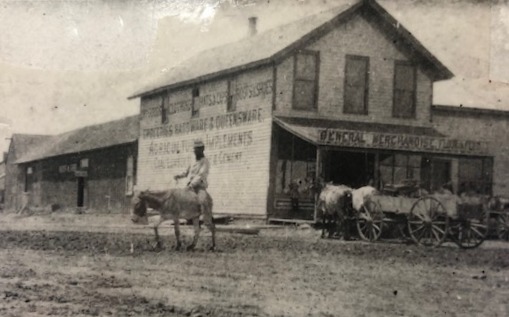
John O’Loughlin’s general store on the corner of Main and Waterman.

Sources: The Lakin Eagle from May 20, 1879 through Oct. 10, 1879; The Lakin Herald from June 24, 1881 through Dec. 28, 1883; Kansas State Historical Society; History of Kearny County Vol. I, and museum archives.
Lakin’s Harvey House


The Atchison, Topeka & Santa Fe Railroad constructed a two-story dining hall in Lakin in 1876 west of John O’Loughlin’s trading post near present-day Hamilton Street. The wooden structure was built at a cost of little more than $5,000, and announcements of the eating house’s opening appeared in papers across the state in May of that year.

About that same time, Fred Harvey struck a deal with Santa Fe superintendent Charlie Morse to take over a lunchroom on the second floor of the Topeka depot. Harvey got the space rent-free. In addition, the Santa Fe covered all the utilities and provided free transportation for Harvey’s eating house provisions and employees. As landlord, the railroad also covered the major equipment expenses, but food, labor and any upgrades were Harvey’s responsibilities. Harvey hired Guy Potter, a friend and former proprietor of the Planter’s House livery stable at Leavenworth, to run the lunchroom. The venture proved successful for both Harvey and the railroad, and thus began a chain of events that would ultimately earn Harvey the distinction as creator of America’s first restaurant chain.

By the end of 1876, Guy Potter had made his way to Lakin and was managing the railroad’s eating house which was often referred to as the Lakin House. Potter had a reputation for being good-natured and hospitable, and for serving square meals. “No one need go hungry who patronizes him, and we should judge that it was pretty well-known from the number that register with him,” proclaimed a Kansas editor who ate there in 1877. Potter and Harvey remained friends, and when the Potters’ 19-year-old daughter, Frankie, passed away that summer, her remains were taken back to Leavenworth and the funeral held at the Harvey home.

In January of 1878, Topeka’s Daily Commonwealth reported that Harvey had entered into the hotel business at Florence, Ks. Both the hotel and restaurant were upgraded. A top chef was brought in, and a revised menu featuring fish and local game cooked European-style was created. The tables were set with Irish linens, china and stemware from London, and silver plates from Sheffield.  Matthew Fisher was hired to manage the establishment. Like Potter, Fisher had also previously been with the Planter’s House where he served as steward of what was considered one of the finest hotels in the west. Florence’s Harvey House quickly became so successful that its rooms were constantly sold out.

In March of 1878, the Leavenworth Times reported that Harvey was the new proprietor of Lakin’s eating house. Guy Potter and his wife were still managing the facility and providing service “seasoned with smiles and hearty good humor.” Although Lakin’s depot hotel was not as extravagant as the one at Florence, excellent service, imported linens and consistently good fresh food were always on the menu. “The best place to eat and sleep in the Wild West,” the hotel quickly became Harvey’s home away from home.

It wasn’t long before Mr. Fisher was called up to manage Lakin’s eating house while Potter eventually became manager of Harvey’s cattle ranch at Granada, Colo. Among other employees in Lakin’s eating house were Florence and Charles Beauman, Harvey’s niece and nephew from England. In November of 1878, Carrie E. Davies and her two children arrived from Chicago to make their home at the hotel with her then-husband and chef, Samuel Phillips, who had moved to Lakin earlier. When the family moved to their claim west of Lakin, Carrie ordered a dozen trees, part cottonwood and part elm. When she received them, the ground was so hard at her homestead that it was impossible to dig holes, but manager Fisher offered to buy the trees. They were then planted in front of the eating house around a fountain. The water supply was sufficient to keep the elms alive, but the cottonwoods died.

Because this was early on in Harvey’s career, the dining hall was not yet being referred to as a Harvey House in the papers. By August of 1879, rumors were circulating that the railroad was going to move the eating station. The dining hall was moved in December 1880 to Sargent (Coolidge) which became the division point of the A,T&SF in 1881. This same Harvey House was later moved to Syracuse where it was destroyed by fire in 1906.

There are no known pictures of the eating house when it was at Lakin. Mrs. Davies’s elms served as the only visible evidence of its location for years.  Davies once wrote, “As I look at those trees with their strong bodies and lovely leaves, I think how fittingly they represent the early settlers. Storms of life may come, winds of affliction may blow, the scorching suns of adversity may shine but through it all, the old settlers rejoice in the rainbow promise and receive the rain that causes sweet memories to be ever green and refreshing.”

By 1962, only one elm remained. When the tree died, part of the elm was brought to the museum where it is on display in the annex.

Sources: A,T& SF Railroad Annual Report for the year ending December 31, 1876; May 17, 1876 Harvey County News; Feb. 5, 1871 June 21, 1877, Aug. 1, 1877 and  March 7, 1878 Leavenworth Times; May 27, 1879 Dodge City Globe; Aug. 12, 1879 Lakin Eagle; Dec. 19, 1876 and Jan.3, 1878 The Daily Commonwealth; June 8, 1888 Hutchinson News; Appetite for America by Stephen Fried; History of Kearny County Vol. 1, and museum archives.

Pioneer ingenuity: famous photo taken in Kearny County

When temperatures drop and you reach for another log to throw on the fire, just remember it could be worse. You could be grabbing a cow chip.

Keeping warm in the winter was a real problem in the 1800s on the treeless Kansas prairie. Called “bois de vache” or “wood of the buffalo” by French explorers, dried buffalo dung or “chips” became the main fuel source. Buffalo chips were nearly odorless and clean to handle after drying in the hot sun for a few weeks. Because they burned with little flame, “bois de vache” were perfect for heating and cooking, and they were readily available to travelers on the Santa Fe Trail who would fill the underbelly of their wagons with the precious commodity. This fuel supply was soon depleted when the buffalo were killed off. Settlers then began using cow chips.

Quirky as it may sound, there was a science to picking out the better quality chips. A chip from cattle on lush, tender grass was almost worthless as it burned fast and didn’t last long. Those that had been exposed to wind and rain gave off very little heat and produced a great deal of ash. Good, mature buffalo grass in the fall made the ideal chips. The chips held their shape, burnt well but not fast, and furnished the maximum B.T.U.’s.

Cow chips were gathered and stored for the winter as autumn set in, and it was not uncommon to see a huge pile stacked outside of a prairie home. Cooking with the chips did not change the taste of the food, but many women had quite the aversion to bringing cow manure into their homes to cook with. They became adept at cooking with the fuel, learning to stir with one hand and tossing another chip on the fire with the other.

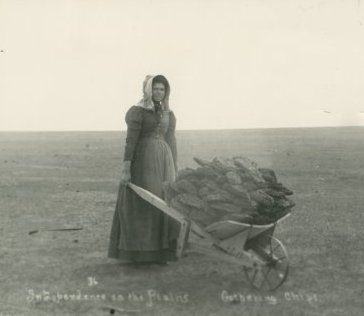
The famous photograph of Ada McColl steering a wheelbarrow full of chips was taken around 1893 near her Lakin home.  Entitled “Independence on the Plains. Gathering Chips,” the image is well known in historical circles and has appeared in a number of publications and on the front cover of Joanna Stratton’s Pioneer Women. The Finney County Historical Society even used the image as the official FCHS logo for a time.

Ada moved from Medicine Lodge in 1886 to Lakin where her family homesteaded. She had not planned on being one of the most well-known pioneer women models but instead wanted to learn how to operate a camera. She began serving as an apprentice at H.L. Wolf’s photography shop in Garden City. Wolf gave Ada a few pointers on using the camera her parents had bought her, and she went on to create family portraits and to document the Kansas prairie. She kept records of photography expenses and numbered and/or named all of her photographs. “Gathering Chips” was taken by Ada’s mother, Polly McColl. Polly also took a turn posing behind the wheelbarrow of prairie woodfire in a lesser known photo. Wolf processed Ada’s photographs from her glass negatives in his studio and may have received credit for some of her work as dozens of copies of the “Cow Chip Lady” were printed in the 1890s.

While visiting relatives in Iowa in 1893, Ada met her future husband. She moved to Iowa in 1895, leaving her negatives and photograph collection behind with Wolf. In a letter dated March 30, 1895, Wolf told Ada that he would send them to her at any time should she want them. Apparently, she never asked him to send them to her. When Wolf sold out, he left the plates in his studio, and the new owner took possession of them.

After nearly 100 years of obscurity and speculating who the woman in the photograph was, Ada McColl was finally identified as the “Cow Chip Lady” in 1984 when her great-granddaughter presented several pieces of evidence to the Kansas State Historical Society, completing a quest that had been started in 1964 by Ada’s daughter, Erma Pryor. Ada Catherine McColl Thiles died in Iowa in 1956 at the age of 85, but her iconic photo has made the “Cow Chip Lady” a lasting figure in American (and Lakin) history.

Sources: Kansas State Historical Society; The Sequoyan Volume 6 Number 2; nebraskastudies.org; ancestry.com; and museum archives.

Railroads spelled doom for the Buffalo

Anthropologists estimate that between 30 and 60 million buffalo roamed the Great Plains prior to the arrival of white settlers and the railroads. The animals were essential to the survival of the Native Americans who utilized every part of the mammal for food, clothing, housing, tools and more.
The building of the railroads divided the original great body of bison into southern and northern herds with the southern herd containing an estimated 3,000,000 bison in 1871. The large herds were menacing and impeded work during the construction of the rails besides causing train delays once the roads were completed. In the fall of 1874 came the report of thousands of buffalo coming into the Arkansas Valley and crossing the A,T&SF going north. The herd reportedly stretched from Kinsley to Lakin with two thousand bison crossing just a few miles east of Lakin. Guy Potter, a manager for the railroad dining hall and hotel in Lakin, recalled being aboard a train which was delayed for one hour and forty minutes waiting for buffalo to cross the track. He witnessed the brakeman shooting 13 bison that day from the caboose.
Buffalo hunting became a profitable business for some and a sport for others, promoted not only by the railroads but also the U.S. government which sought to control the Native Americans by eliminating their food supply. The killing was vast and relentless. Hunters were known to kill hundreds of bison in a matter of days and thousands in a matter of months. Some of the meat and robes were harvested; often they were left to rot where they dropped. In December of 1872, J.B. Edwards and George Smith set up a temporary trading post at Lakin to supply the railroad construction crews. Edwards recalled that they did not sell much merchandise in their near month-long stay here, but they did buy and ship a carload of buffalo hides. After John O’Loughlin’s arrival here, the sight of buffalo hams curing in the sun on the roof of his dug-out was a common occurrence.
One of the picturesque figures of the southwest and subject of the book, “A Mighty Hunter”, Charles Youngblood lived in Lakin for a short time. Most of the meat from Youngblood’s hunts was sold to the local dining house or shipped to hotels in the Harvey House chain. He also supplied trainmen, emigrants and others with buffalo and antelope meat. Landlord Potter arranged with Youngblood to act as a guide for parties who paid the hunter $3 to $5 a day to participate in buffalo hunting excursions. These parties were made up of adventurous Easterners, railroad men and officials, land speculators, and even curious Englishmen who had crossed the great Atlantic just for a chance to shoot an American bison.
The killing of the buffalo gave rise to yet another money-making enterprise for Lakin and other sidings along the railroad. Bison bones were the first crop gathered by many penniless homesteaders on the plains. The bones were shipped east to factories where they were ground and used in the manufacture of fertilizer, bone china, buttons, umbrella handles, glue and more. Billy Russell recalled seeing huge piles of bones stacked along the railroad track when he first arrived here in 1881. In 1885, the going rate for bones gathered and delivered to Lakin was $10 per ton.
In 1882, the Lakin Herald reported that the only remaining buffalo in this vicinity had been sold to Fred Harvey and taken to New Mexico where the cow was to be kept as a curiosity for eastern tourists. Captured by Alonzo Boylan when but a calf, the buffalo had spent four years running with Boylan’s cattle.
By 1890, the American bison was on the verge of extinction with estimated figures of 300 to 1,000 head in the continental United States. The senseless slaughter is considered one of the greatest wildlife tragedies in the history of modern man.
SOURCES: The Coming Back of the Bison by C. Gordon Hewitt; The Buffalo Bone Commerce On The Northern Plains by LeRoy Barnett; Where the Buffalo No Longer Roamed by Gilbert King; Kansas State Historical Society; History of Kearny County Kansas Vol. 1; Oct. 20, 1874 Daily Commonwealth; Oct. 29, 1874 Emporia Ledger; June 24, 1881 and April 8, 1882 Lakin Herald; Dec. 5, 1885 Advocate; and museum archives. Picture of C.L. Youngblood from the book, “A Mighty Hunter: the Adventures of Charles L. Youngblood” by C.L. Youngblood and E.H. Peck.