Happy Birthday, Kansas!

The U.S. House of Representatives voted to admit Kansas as a state in April of 1860, but the Senate was under the influence of pro-slavery leaders and refused. The failure to admit Kansas became a national political issue. At the Republican’s national convention the following month, Abraham Lincoln was nominated as the Republican candidate for president. A strong proponent for Kansas, Honest Abe had visited the territory and spoke at several sites in December of 1859. When he won the presidency, news of his election caused 11 southern states to withdraw from the Union and set up a separate government. As each state withdrew, their senators and representatives resigned their seats in Congress, vastly reducing the number of those in the Senate who opposed Kansas’s admission.  The Senate passed the Kansas Bill, and President Buchanan signed the bill officially admitting Kansas to the Union on January 29, 1861. While on his way to Washington for his inauguration in 1861, President-elect Lincoln had a stop off at Philadelphia’s Independence Hall where he hoisted the first United States flag bearing the Kansas star on February 22 (George Washington’s birthday).

The difficulties that Kansas faced in gaining statehood led John J. Ingalls, secretary of the first Kansas state senate, to suggest the state motto of “Ad Astra per Aspera” which is Latin for “To the Stars Through Difficulties.” The motto was placed at the top of the state seal, and below it 34 stars, representing Kansas as the 34th state to join the union, are boldly arranged. Pictured in the right-hand corner of the seal is a rising sun for the east. Commerce is represented on the seal by a river and a steamboat, and agriculture as the basis of Kansas’s future prosperity is represented by a settler’s cabin and a man plowing with a team of horses. Also depicted are a wagon headed west and pulled by oxen, as well as a herd of retreating buffalo being pursued by two Native Americans on horseback.

In 1903, the sunflower was adopted as the state flower by the Kansas Legislature, and on Kansas Day in 1925, the western meadowlark was announced as the state bird of Kansas. In an election coordinated by the Kansas Audubon Society, nearly 50,000 of 121,000 votes were cast by Kansas school children for the meadowlark; however, the Kansas Legislature did not officially make it the state bird until 1937. Adopted in 1927, the Kansas state flag was designed by Lincoln, Kansas seamstress Hazel Avery. The flag was modified in 1961 by adding the word, “Kansas,” in gold block letters below the seal.

The cottonwood was adopted as the state tree in 1937, and in 1947, “Home on the Range” became the official state song.” In his cabin on Beaver Creek near Smith Center in 1871 or 1872, Dr. Brewster Higley wrote the lyrics to the song which was originally entitled, “My Western Home.” Druggist Dan Kelly composed the music. In 1955, the American buffalo was named as the state animal, and the honey bee was adopted as the state insect in 1976. It was not until 1986 that the ornate box turtle was established as the state reptile. These are but a few of Kansas’s more well-known state symbols, but did you know that our state soil, established in 1990, is harney loam silt, , and the barred tiger salamander was named state amphibian in 1994? In 2010,  little bluestem was named the state grass, and the tylosaurus and pteranodon became the state fossils in 2014. In 2018, limestone was established as the state rock, galena the state mineral, jelinite the state gemstone, and channel catfish the state fish. In 2019, chambourcin was named the state’s red wine grape while vignoles, the state white wine grape. In 2022, the sandhill plum was recognized as the state fruit, and silvisarus condravi, the woodland lizard that lived from the Early to Late Cretaceous Period, has been the state land fossil since 2023.

Alexander Le Grande Copley, a teacher in the Paola school system, is credited with the origination of Kansas Day. On January 29, 1877 after spending two weeks gathering information on the geography, history and resources of Kansas, Copley’s students presented their maps, drawings, songs and speeches to their community. The event was so well attended that there was not room for everyone in the small school. Copley later became the superintendent of Wichita schools and implemented Kansas Day there. Copley attended county teachers’ institutes and state teachers’ association meetings where he encouraged teachers to celebrate Kansas Day. In 1882, at the first meeting of the Northwestern Teachers Association, a decision was made to publish a small pamphlet which included information about Kansas, its songs and sample speeches suitable for the observance of Kansas Day. The 32-page booklet was simply called, “Kansas Day.” At the next State Teachers Association meeting in Topeka, every teacher took home one or more copies. For a short time, the booklet was used as a textbook in the state normal school at Emporia.

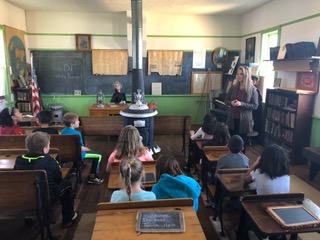
The popularity of Kansas Day continued to grow and is celebrated by teachers and students across the state. For the past several years, Lakin Grade School students have enjoyed Kansas Day tours at the museum where they learn about Kansas, the Santa Fe Trail, one-room schools, pioneer life and local history. Today, January 29, we welcome Lakin’s third graders and celebrate the 164th birthday of our grand state. Happy Birthday, Kansas!
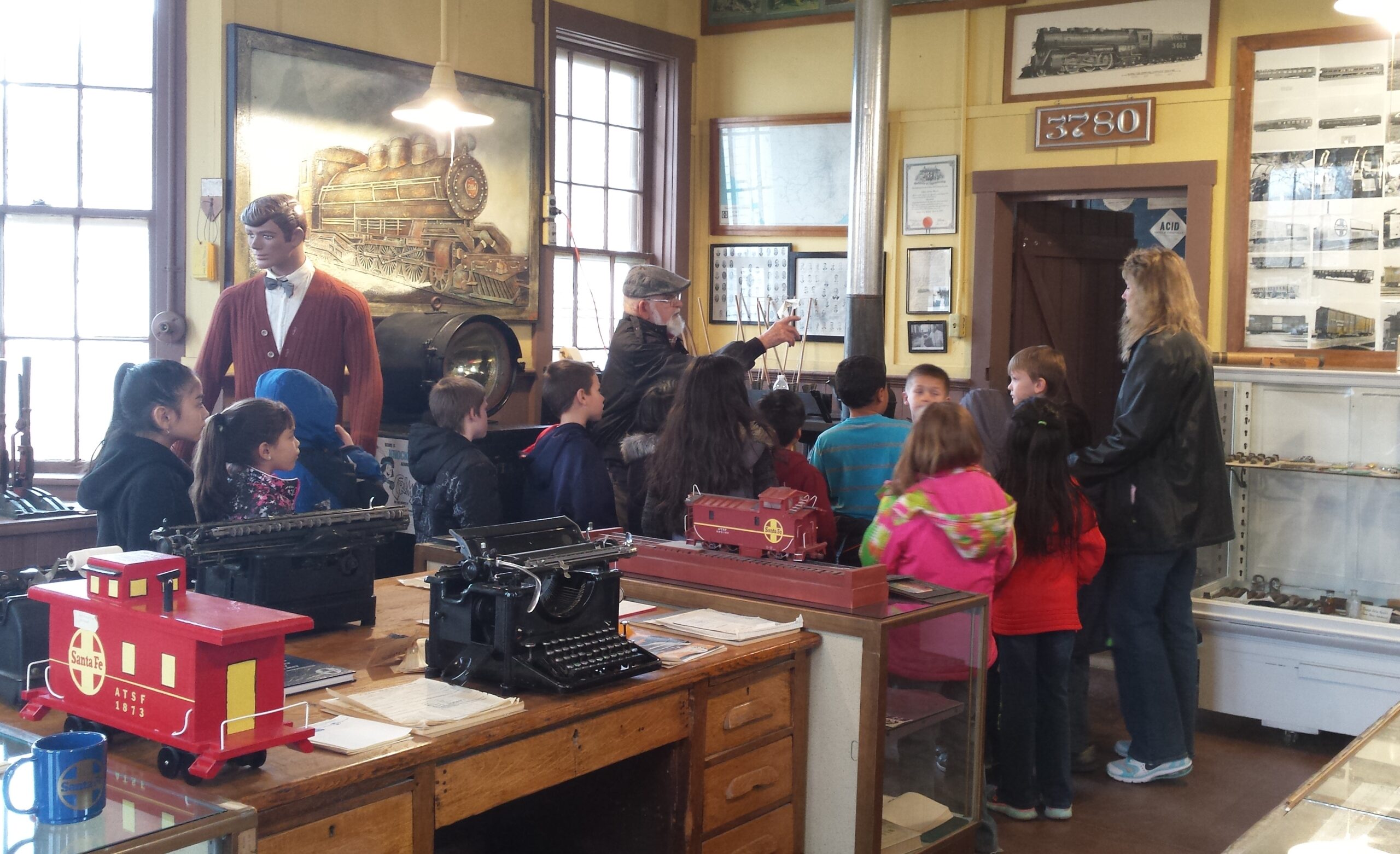
Jim Woodrow gives a tour of the depot to Mrs. Miller’s second graders in 2016.
Amy Fontenot talks about Kansas Day and one-room schoolhouses in Columbia School in 2018.
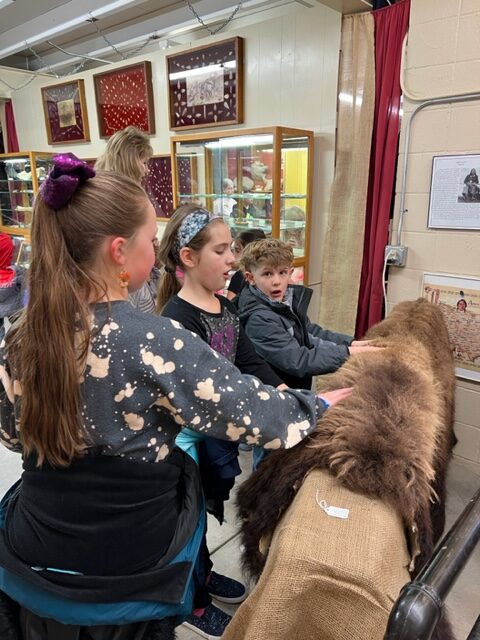
Third graders get the opportunity to feel a buffalo hide at the Museum in 2023.


KANSAS

Not for what she hath done for me,

Though it be great,

For what she is, her majesty,

I love my State.

Thomas Emmet Dewey


SOURCES: Sunflowers, A Book of Kansas Poems; The Story of Kansas by Bliss Isely and W.M. Richards; Kansas … Our State by Goebel, Heffelfinger and Gammon; Kansas State Historical Society, and Museum archives.
The illustrious Barney O’Connor

Barney O’Connor was quite the character. The Canadian-born Irishman had already lived a colorful life before his arrival in Kearny County. One of 10 children, he moved with his family from Canada to Lincoln, Nebraska in 1870, and soon found his way to Kansas where he secured work as a cowboy. He was the first boy to ride horseback between Wichita and Medicine Lodge, accomplishing the difficult and dangerous feat in 1871 at the tender age of 14. That same year, O’Connor went to Matagorda, Texas, and drove a herd of cattle back to Newton which was at that time the terminus of the Santa Fe Railroad.
Barney eventually hired on as a pony express rider on the old Hutchinson-Medicine Lodge trail, and in 1874, he played a major role in one of the last Indian battles of Kansas. He started out early one morning on his regular route but had travelled only a few miles when he sighted a large war party of Indians camped on Sand Creek. Barney raced to Medicine Lodge to give warning then led a troop of 35 mounted soldiers back to where he had spotted the encampment.
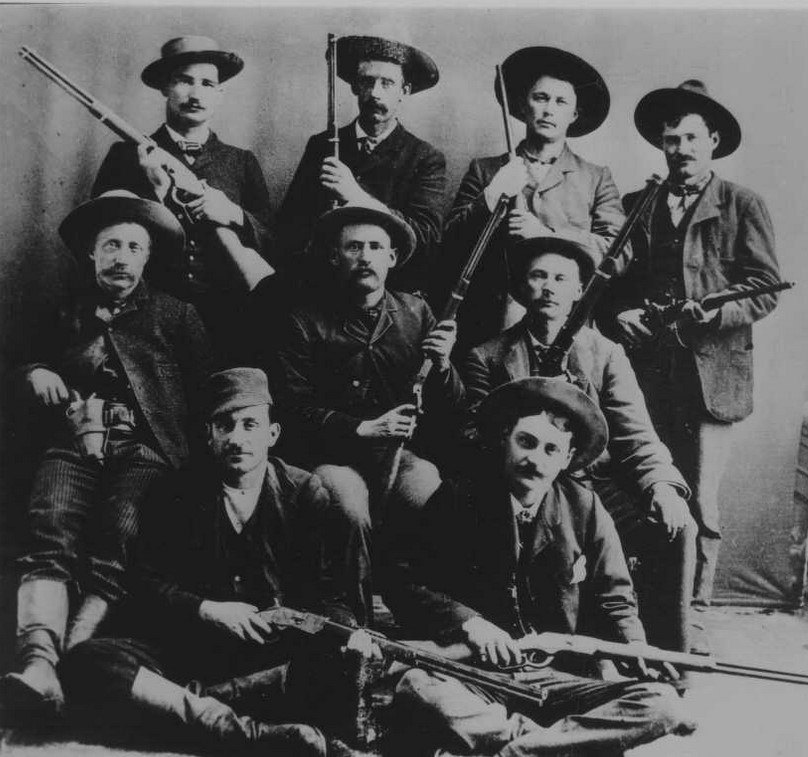
In the spring of 1884, O’Connor organized a posse of men to chase down four men who had attempted to rob the Medicine Lodge bank and killed the bank president and cashier in the process. The gang of criminals was led by the very jaded Henry Brown, city marshal of Caldwell, Kansas, and his deputy, Ben Webster. With Barney at the helm, the posse pursued the gang with shots flying all the while until they cornered the would-be robbers in a canyon about eight miles west of Medicine Lodge. The gang was taken to the jail at Medicine Lodge, but an angry mob broke them out of jail and hung them, including Marshal Brown who was killed while trying to run away. As a memento of the escapade, O’Connor took a time piece from one of the assailants and a Winchester rifle from another. The watch, which did not belong to the criminal who was wearing it, led to Barney being arrested about 11 years later when it was spied upon his wrist.
The Medicine Lodge Posse. This group of men were responsible for capturing marshal Henry Newton Brown of Caldwell, Kansas, and the would be robbers of the Medicine Valley Bank. Barney O’ Connor is standing second from the left on the back row.
Later in 1884, O’Connor proved up a claim north of Lakin where he engaged in cattle raising and farming. He and Frank McAlister, a pal from the Medicine Lodge area, established Parlor Livery Feed and Sale Stable, and many of their horses were used for the mail hacks in an area of Western Kansas from Wallace to Hugoton which was known as Hugo at the time. O’Connor was also president of the Northwestern Stage line.
Soon, Barney was appointed as Undersheriff of Kearny Township of Finney County. In January of 1886, he was shot while helping a deputy United States marshal bring in a suspected horse thief by the name of Al McClure. McClure was wanted in Montana Territory and was working on a ranch on Bear Creek when O’Connor and the marshal went to bring him in. O’Connor knew McClure and thought he could be trusted so he didn’t handcuff the suspect. All three men were in a buggy riding back to town when McClure grabbed O’Connor’s revolver from his hip pocket and aimed it at the marshal’s head. Barney sprung into action, and the bullet intended for the marshal hit O’Connor’s left arm just above the elbow. A scuffle ensued, but McClure was finally secured and brought to Lakin without further ado. In December of 1886, Barney received the appointment as Deputy United States Marshall.
O’Connor also took a prominent part in the Kearny County seat battle after Hartland cowboys stole the records from Lakin, strapping on his guns and riding to Hartland with Tommy Morgan to retrieve the county books. Six-shooter in hand, O’Connor stood over the election judges while votes were counted in February of 1889.
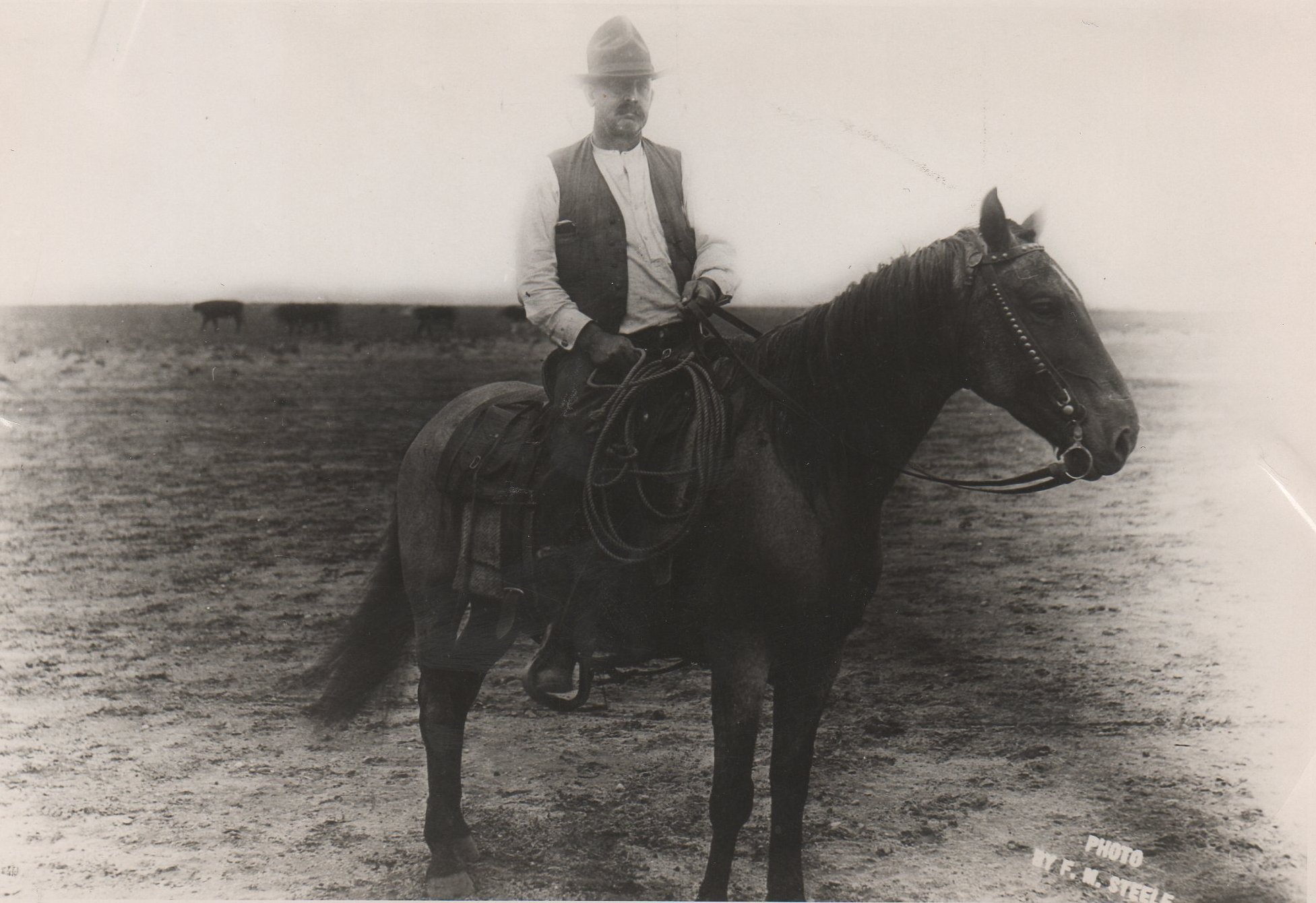
In the spring of 1889, Barney and his family left for Hutchinson, but the nomadic Irishman was not one to let the grass grow beneath his feet. Eventually, the O’Connor family relocated near Boise, Idaho. In 1892, a herd of 4,000 steers were shipped from Flagstaff, Arizona to Wyoming where Barney took over and drove the cattle overland more than 800 miles to Saskatchewan, Canada. By the mid 1890’s, O’Connor was back in central Kansas but became entrenched in legal woes for peddling liquor. Next, he made his way to Kansas City, Missouri where he operated a livery stable, but O’Connor returned to Lakin in 1904 and located in the sandhills. In 1909, he moved to Garden City. In 1911, Barney purchased the 1,700-acre Pig Pen Ranch on the Cimarron River in northeast Grant County which had been originally established by fellow Irishman and Lakin’s founding father, John O’Loughlin. O’Connor’s holdings grew to more than 6,000 acres.
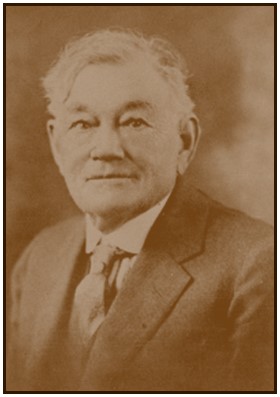
Barney O’Connor at Pig Pen Ranch in Grant County.
In 1924, Barney suffered a stroke which left him almost helpless, and nine years later he died at his Garden City home on the corner of Seventh and Chestnut streets. The Lakin Independent wrote that “O’Connor’s life was filled with experiences that would have filled many a Wild West novel, and which would have eclipsed those of many a frontiersman who was less reticent about his experiences.” It was said that Barney traveled all over the country from Old Mexico to Canada on horseback with nothing but a gun and a pair of boots.
Bernard H. O’Connor was buried at Valley View Cemetery in Garden City, and beside him rest the remains of three young sons. Daniel died at the age of 18 months and was Barney’s firstborn with first wife, Mercy Catherine Young. Bernard Young, also born of his marriage with Mercy, was struck and killed by a train at Walla Walla, Washington when he was 11. Bernard Keroher O’Connor, the first child of Barney and his second wife, Dove Agnes Keroher, died at 5 months of age. Barney had four other sons: Patrick, Michael and James with his first wife, and Collins with his second. The large yellow house on the corner of Kansas Street and Russell Road in Lakin was originally the O’Connor home.
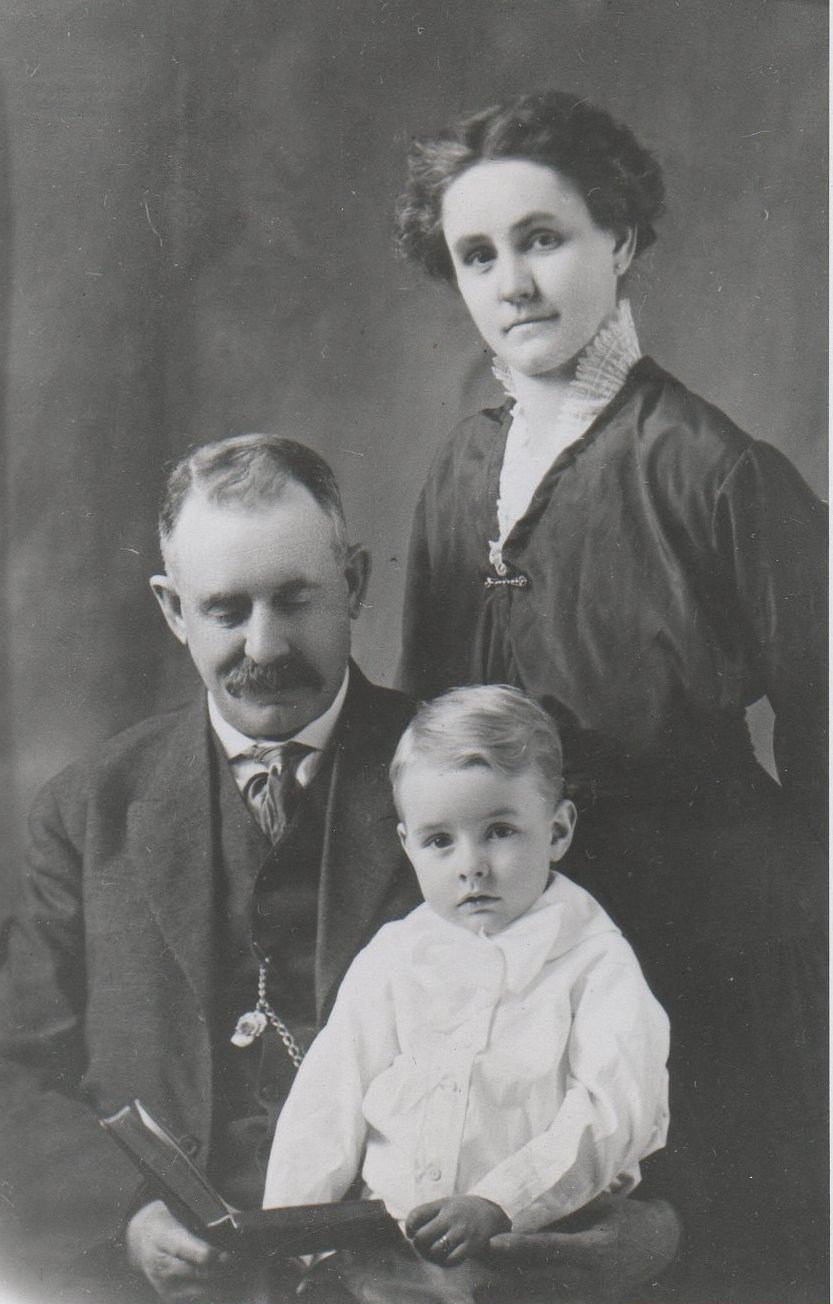
Barney O’Connor with his second wife, Dove, and their son, Collins.
SOURCES: Conquest of Southwest Kansas by Leola Howard Blanchard; History of Kearny County Vol. 1; Find a Grave; Ancestry.com; and archives of The Helena Star, Wichita Star, Wichita Daily Eagle, Garden City Irrigator, Kearny County Advocate, The Lakin Investigator, Pioneer Democrat, and Lakin Independent.

Lawman John Henry Carter

When Mike Fontenot takes the oath of office as the new Kearny County Sheriff on January 13, he will become the latest in a long and storied list of local lawmen dating back to the 1800s. John Henry Carter was the first man charged with keeping the peace in our area. He was appointed undersheriff of Kearny Township in 1879 when what is now Kearny County was part of Ford County. Southwest Kansas was considered part of the wild, wild west at that time, and Carter’s heroics are well documented.

In 1882, a lucrative reward was offered for the capture and conviction of Thomas Wooten (sp.) and James McCullom who had robbed and murdered a railroad section foreman near WaKeeney. After hearing that the fugitives had been seen in our neck of the woods, Carter guessed the duo was headed to Point of Rocks Ranch in the extreme southwest corner of the state. Carter secured a good horse and reached the area about nightfall but learned that no strangers had been seen there. He cautioned the ranch’s owner and cowboys to show no surprise nor suspicion if the men arrived later. After everyone had gone to their bunks, two men rode up on worn-out horses and asked to spend the night. They were given coffee and food and allowed to sleep in their blankets on the kitchen floor which was next to where Carter was to sleep. But Carter saw no sleep that night, remaining constantly alert for any movements from the suspected men.

At dawn, lawman Carter slipped his rifle over the kitchen window sill and made his way out of the house, walking through the area where the desperadoes were still wrapped in their blankets. Carter secured his rifle and went to a deep buffalo wallow between the house and where Wooten and McCollom’s horses were tied. The wallow afforded partial concealment to John. Wooten came out of the house and started for the horses, and when he was about 50 feet away, Carter shouted, “hands up.” Wooten swiftly pulled two revolvers out and sent bullets flying in Carter’s direction. Carter returned fire, missing with his first shot but hitting Wooten with his second which left a silver-dollar-sized hole in the man’s shoulder.

McCullom reached the scene, and seeing his compadre lying on the ground in great agony, fired several bullets at Carter. The shots missed the lawman but raised a cloud of dust. McCullom then rushed towards Carter before firing his last charge. Carter waited until McCollom was within such close range that his vision was clear, took aim and killed McCollom with one shot. Carter brought Wooten to Lakin where the killer’s wound was dressed. Trego County undersheriff Joseph Lucas came to Lakin and took custody of the prisoner, but Lucas was later assaulted at WaKeeney by a masked angry mob who took Wooten. Some accounts say the mob hung Wooten while others say he escaped; regardless, Carter was deprived of the very handsome reward despite a concerted effort to secure a special $1,000 appropriation from the Legislature for his bravery. One account claimed that Carter did receive $300 for his efforts.

In August of 1887 when talk was circulating in the area about the Governor appointing a temporary sheriff here, both Chantilly and Hartland endorsed Carter for the position. Nearly 500 voters signed a petition asking the Governor for Carter’s appointment. “If Governor Martin should see fit to appoint John H. Carter to this office the people will secure a careful, honest and courageous Sheriff, and one whom the lawless element yet remaining in the county have a wholesome fear,” decreed The Hartland Times.

“That gentleman has lived on his present farm ten years, and has succeeded, by careful management and industry, in making himself comfortable well off. During that time he has seen the country grow from a border territory, ruled by the cowboy, and occupied only by cattle and their owners, to its present thriving condition of handsome towns, farm homes, school houses and other evidences of advanced civilization. But such changes were not made without trouble, and though he himself engaged in cattle raising, John Carter was always in the front, protecting the rights of the weak settler . . . he has done the state signal service in arresting murderers and other desperate criminals, always at the risk of his life, and sometimes when human life had to be taken in order to protect law abiding citizens.”

This was a time of rampant hijinks and game play between towns vying for county seat and some shady characters vying for offices. Governor Martin appointed R.F. Thorne, not Carter, as the first Kearny County sheriff, but John Carter’s public service did not end there. He served multiple terms as a county commissioner, as an officer with the Hartland Republicans, school director for the Hartland school district, was undersheriff again in the 1890s, and was a member of the GAR, having served during the Civil War.

Born in 1844 at Collinsville, Illinois, John arrived in the Hartland area eight years before the town was platted. He built a homestead and filed a timber claim on his property which was adjacent to the townsite near Indian Mound and the famed Chouteau Island. Carter’s was the first timber claim proved up in the county, and the grove was a popular venue for early-day celebrations. Carter also ran a butcher shop and farmed. He and his first wife, Mary Penn Carter, had four children: Amy, Ezra, Hattie, and Alice who was the first girl born in this county. John Carter died at the age of 80 at San Diego, California in 1924.

SOURCES: History of Kearny County Vol. 1; Southwest History Corner by India Simmons; Buffalo Jones’ Forty Years of Adventure by Charles Jesse Jones; archives of The Hartland Times, Lakin Pioneer Democrat, Lakin Herald, Lakin Index, Western Kansas World and Topeka Daily Capital; Museum archives; and Ancestry.com. Special thanks to Charlotte Carter Isaacs, great-great granddaughter of John H. Carter.