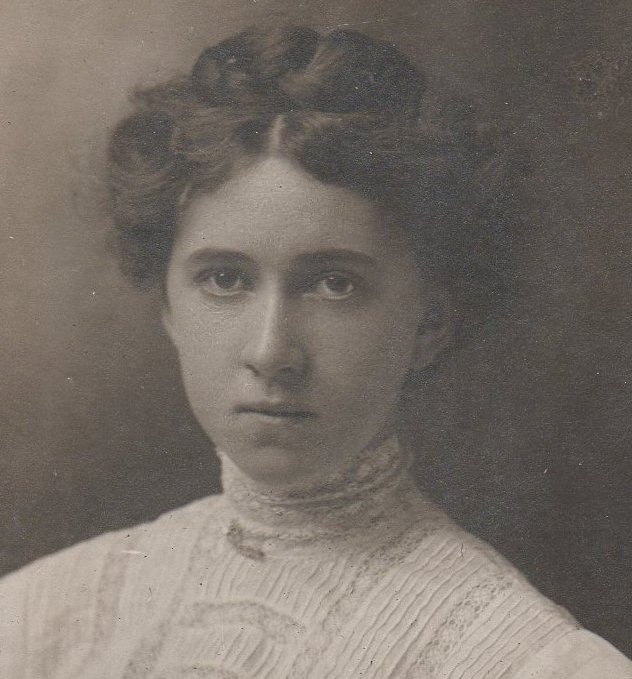
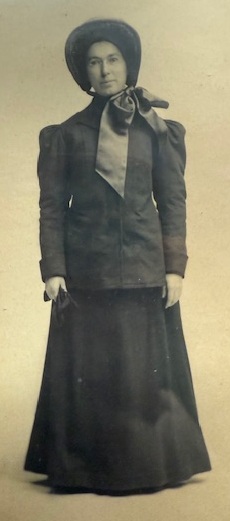
Veturia E. Boyd, one-room school teacher

Fortitude was a standard requirement for one-room school teachers in Kansas during the late 1800s and early 1900s. Instructors were often female, unmarried, and in many cases, only a year older than some of the students in their classroom. Challenged with limited resources and rudimentary rooms and supplies, rural school marms generally had minimal teacher training too. Most were recent graduates of normal schools which in this area of Kansas amounted to a one-week crash course to prepare them for the classroom. These young women were not only responsible for teaching all grades in a single room, but also performed custodial duties, served as counselors, and administered first aid. They were charged with maintaining the classroom, hauling water for drinking and washing, and were responsible for hauling wood (or cow chips) and kindling the fire. Teachers had to be at school early to get the wood-burning stoves started to warm up their rooms before the arrival of their students.

Veturia E. Boyd taught at the Deerfield school in the winter of 1887-1888. Miss Boyd walked back and forth to her school each day as she boarded with Ada Oliver, a single woman who lived in a dugout three-quarters of a mile north of the schoolhouse. The school board told the young teacher that if a blizzard ever arrived to never send the children home but to keep them at the schoolhouse until help arrived. On December 19, 1887, a blizzard arrived during school hours and unleashed its fury. Somehow, Miss Boyd got all the school children dismissed safely, and she started for Miss Oliver’s place in the middle of the afternoon. Starting was about all she got done. For nearly two hours, she walked around in circles and asked the good Lord for help.
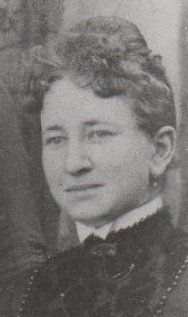
She eventually stumbled upon the dugout door of a young bachelor named Dayton Loucks. Hearing a loud noise and wondering what it was, Loucks pried opened his door and in dropped Miss Boyd. Both were quite surprised to see one another; nonetheless, Miss Boyd was thankful to have found shelter. She was a shy and modest woman and spent the night in her wet clothes, sitting in front of the fire for warmth and to dry her clothing. Outside, the blizzard howled on, but the next morning dawned bright and clear. Miss Boyd thanked Loucks and walked a quarter mile south to the Neil Beckett farmstead where Mrs. Beckett gave her some breakfast and fixed her a lunch to take to school for her dinner. Miss Oliver, worrying that Miss Boyd had not made it home the night before, went to the schoolhouse and found the educator there getting ready for her students and another day of teaching.

Boyd’s story is not atypical of the young women who taught in rural schools. Many a night was spent inside a schoolhouse because of severe weather, sometimes with charge of students and little (if any) food. Occasionally these young female teachers were left in their schools to battle the forces of nature all alone. Their grit was unmatched.

Miss Boyd was born in 1862 in Indiana and came to Kearny County in the spring of 1886 to take a claim near Lakin. She also taught at Lakin and in Finney County before she returned to the Midwest where she taught in a Chicago suburb. She later became a doctor of osteopathy and often led five-mile nature walks and hikes in the Chicago area. Miss Boyd never married, and she returned to Lakin on more than one occasion to visit friends she had made during her time here. She died in 1935 at Chicago.

Kearny County Museum tips our hat to Veturia Boyd and other teachers like her who left their mark on history and in the hearts of the students they taught. And that’s a rap for Women’s History Month! We hope you’ve enjoyed the stories we’ve shared this month about some of the remarkable women of Kearny County, Kansas!

SOURCES: History of Kearny County, Vol. I; archives of The Lakin Index, Kearny County Advocate, Garden City Herald, Chicago Tribune, and Warrick Enquirer; ancestry.com and findagrave.
 

Mary Campbell Thornbrough, Lakin’s First Lady of Scouting

Kearny County Museum takes this opportunity during Women’s History Month to recognize Mary Campbell Thornbrough for her tenaciousness, generosity, and commitment to the Lakin community.

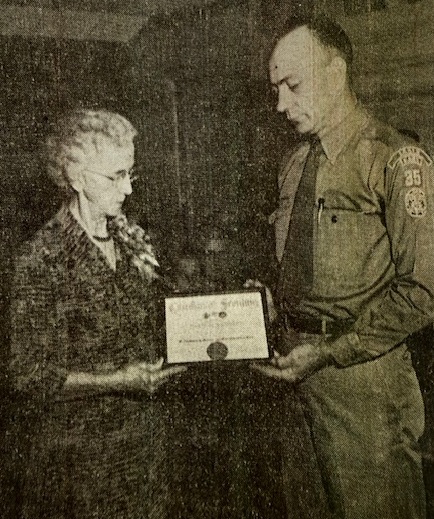
Always a loyal booster and supporter of the Boy Scout movement, Mary Thornbrough was presented the “Guardian of Scouting” award in a special ceremony in May of 1957. The long-deserved tribute honored Mary who gave thousands of dollars to benefit scouting, including more than $5,000 to build the Boy Scout cabin in Lakin’s City Park. Mary’s generous donations to the building fund were made in memory of Lt. Wayne Thornbrough, her youngest son who lost his life in service to his country during World War II. In 1945, Mary and Wayne’s widow donated two bonds totaling $1,500 to the Southwest Kansas Boy Scout Council to be used for camping equipment. A scouting hut, originally donated to the Lakin troop by Miss Sue Tate and the Tate family, was put up for auction in 1948 with the monies to be used to fix club meeting rooms above the Lakin Implement Co. Mary purchased the hut for $25 and then turned it back to the Scouts to be sold a second time. She again bought the structure, later resold it for $200, and handed that money over to the troop.

Richard H. Heitsmith, who organized the first scout troop in Lakin in 1933, said Mary aided the scouting program financially time and time again and “was always such an inspiration when I needed advice.”

Interesting enough, both of Mary’s sons, Albert and Wayne, wanted to be Boy Scouts, but there was no scouting program in Lakin when they were of scouting age. Through the Boy Scouts of America correspondence course, the Thornbrough boys became “Lone Scouts.”

Mary Thornbrough receiving the “Guardian of Scouting” commemorative plaque from Scoutmaster Bert McCue in May of 1957.

Mary Edith Campbell Thornbrough was born January 28, 1890, in Scott County, Mo., the third child of A.G. and Sarah (Mudd) Campbell. The family came to Kearny County in 1902. Mary was an outstanding student at Lakin High School from where she graduated in 1908. She then furthered her education at Emporia College.

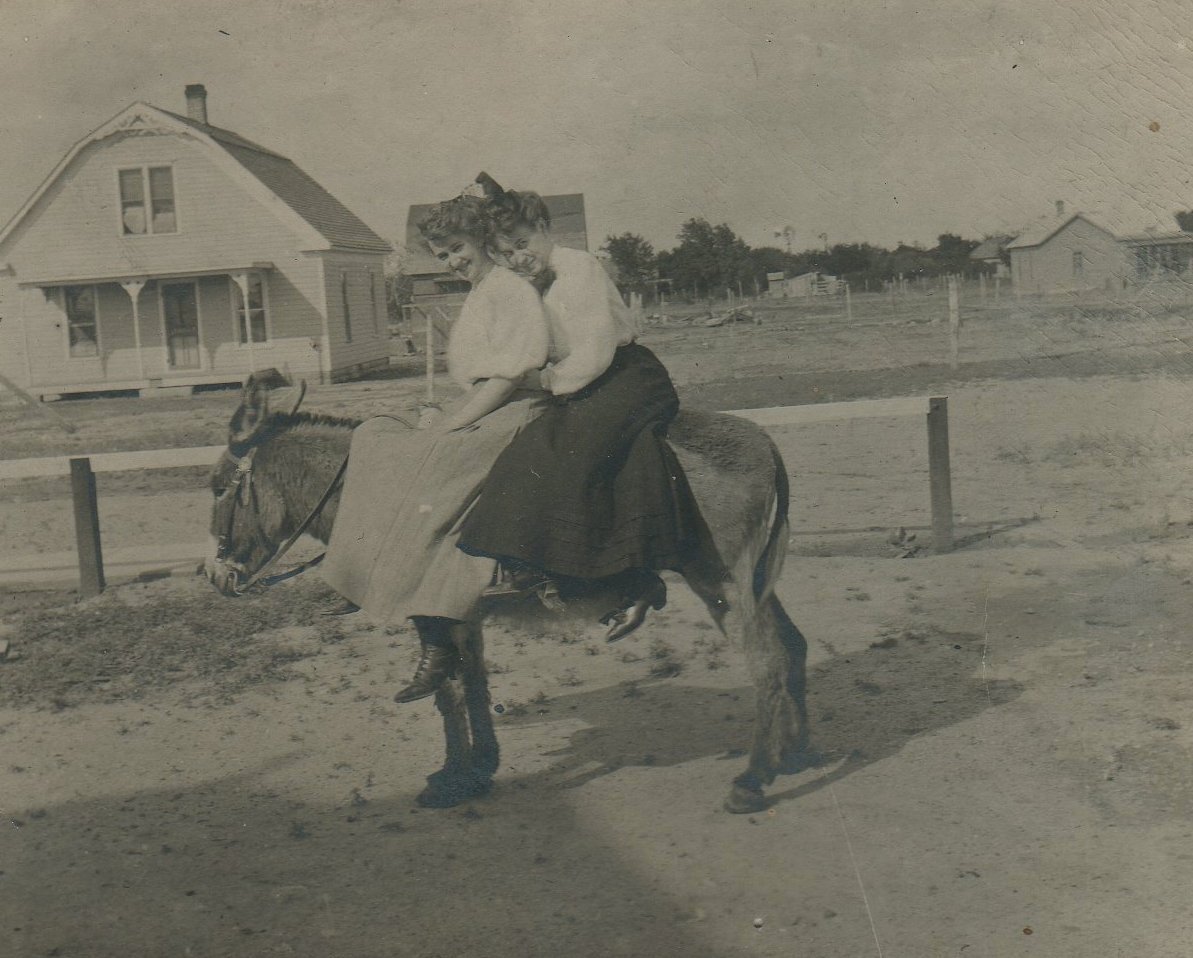
Mary Campbell Thornbrough is on the front end of the donkey and Ida Piper is on the back in this picture from 1907. The house in the background is currently the Speer home on the southeast corner of Lincoln and Garfield.

In 1910 in the home of her parents on the southwest corner of Lincoln and Garfield, she married businessman Roy Thornbrough. The couple made their home at Holly, Colorado for a while but returned to Kearny County and lived at Deerfield where Roy was assigned duties in 1917 as an Army recruiter. Roy and Mary later divorced. She and her sons lived with her parents prior to moving in to a home which was built for them next door at 107 N. Garfield. That house still stands, and some may remember it as the home of Jack and Leona Randolph.

According to her great nephew Earle Dean Rice, Mary and her sons spent weekends homesteading land in the sandhills south of Lakin where a house was built for them. The house apparently was once blue because it was called the Blue House, and her family used that name as the name of their trust, The Blue House Family Trust. Mary would later acquire the original townsite of Hartland.

Ms. Thornbrough worked for Campbell-Loucks Realty, Campbell Mercantile and as a stenographer in various private offices. She substituted in various offices in the court house and served as deputy county treasurer prior to being elected treasurer in 1936. She became a licensed and bonded abstractor, and construction began in June of 1948 on her own business building. This structure at 117 N. Main is currently the business location for Matthew Medill, CPA.  Always self-reliant, Ms. Thornbrough did her work with great care.

Mary was the first treasurer of the American Legion Auxiliary at Lakin, a charter member of the Lakin Book Club, and as a member of the Kearny County Historical Society, contributed to Volume I of the History of Kearny County. She also held membership in the Order of Eastern Star, Auxiliary of the American Red Cross, and United Presbyterian Church.

In addition to the Boy Scouts, Mary gave liberally to the all-faith Memorial Chapel at Kansas State University at Manhattan which both of her sons graduated from. She also gave to the local hospital, her church and many other civic causes.

Interested in history and genealogy, Mary researched the Campbell and Mudd family histories and contributed significantly to the book, “The History of the Mudd Family in the United States of America.” The genealogy was of one of the oldest families in the United States. Mary’s mother was a first cousin three times removed of President Abraham Lincoln. She was also related to Dr. Samuel Mudd who treated the broken leg of John Wilkes Booth and was sentenced to life imprisonment when a military commission found Mudd guilty of aiding and conspiring in Lincoln’s murder. President Andrew Johnson later released Mudd from prison, but the doctor’s conviction was never overturned despite repeated attempts by family members and others to have it expunged.

Mary Campbell Thornbrough died February 28, 1962 at Lakin. In 1965, her surviving son, Albert, donated all of block four of the Thornbrough Subdivision to the City of Lakin for a ball park and place of recreation. The donation was a visible expression of the love and affection Albert bore toward his beloved mother and his brother, Wayne.

Mary Campbell Thornbrough


SOURCES: Diggin’ Up Bones by Betty Barnes; History of Kearny County Vols. I and II; Ancestry.com; Wikipedia; archives of The Manhattan, Kansas Mercury, The Wichita Beacon, Lakin Investigator, Advocate and Lakin Independent; Museum archives and information provided by Earle D. Rice.


Mary Blanche Waterman Sanford, M.D.

     Mary Blanche Waterman was only four years old when her family moved to Lakin in December of 1880. Her father, James Waterman, had accepted the position as agent for the Atchison, Topeka & Santa Fe Railroad. The family of four, which included Blanche’s two-year-old brother, boarded with the Boylan family until the new railroad section house was completed in 1881. Then they made their home there. There were few houses in Lakin at the time and even fewer playmates for the little girl. The vast and rambling landscape was quite different than what Blanche was used to in Worchester, N.Y. where she was born. In her own words, her back yard, “reached north to where the sky met the earth.”
     Blanche was given strict limits to just how far she was allowed to roam in that expansive back yard. Three boys built a playhouse from a big wooden packing box and other smaller boxes, and the house was just big enough for those three youngsters to squeeze in. After they drifted off to other adventures, the playhouse became a delightful refuge for little Blanche and her dolls. When indoors, the young girl listened intently to her mama’s stories. “Our treeless, hill-less, stoneless and usually snowless prairie made a large screen on which these word pictures were painted.”
     When Blanche grew older, she frequently volunteered at the town’s social events. She belonged to the Lakin Literary Society and was known for giving excellent recitations. Miss Waterman attended Lakin schools, and when the spring semester ended in 1893, she moved temporarily to Wichita to take classes at the short-lived Garfield College. When she returned to start her senior year at Lakin High School, the practical-minded, respected and highly responsible Blanche was elected school librarian.
     Inspired by Doc Lovin who cared for the sick and had a drug store here, she left the plains of Kansas after her graduation for Chicago where she earned her medical degree in 1899 from Northwestern University. She interned at Chicago’s Cook County Hospital before being appointed as the college physician at Blue Mountain Female Institute in Tippah County, Mississippi. “Dr. Waterman, the lady physician at the college is an expert in her profession and is rapidly making friends. . . as an expert surgeon she has already gained an enviable reputation and received many flattering offers from different state and local institutions where lady physicians are required,” raved a Tippah County newspaper. Dr. Sanford worked at Blue Mountain for three years. In 1903, she joined the Salvation Army and was placed in charge of a maternity hospital in Tappan, N.Y.
     The good doctor never forgot her Lakin roots and spent many summers and vacations here, often having charge of the practice of local physician Dr. George Johnston in his absence. When Mrs. Ross Elvin and her seven children were struck by a train at the railroad crossing east of Lakin in 1919, it was Dr. Sanford with the assistance of Dr. Lena June Madison Hull who set the bones and cared for the five surviving children until Dr. Johnston’s return.
     Dressed modestly in her blue Salvation Army suit and carrying a spray of lilies of the valley, the good doctor married Ensign Hobart Sanford on September 1, 1908. Blanche was a captain in the Salvation Army by that time and the head of a rescue mission in Buffalo, New York, and her husband had been in the Salvation Army since 1901. It was a mutual interest in the organization’s work that led to their courtship and eventual marriage.
     Hobart’s service with the Salvation Army led the couple to various cities along the eastern seaboard, but they made their home at Mount Vernon, New York for around 20 years. Hobart retired as a commanding brigadier after dedicating over 40 years of service to the Salvation Army. After his retirement, the Sanfords moved to Methuen, Massachusetts, but retirement did not rest easy for Hobart. A year and a half later, he was back with the Salvation Army in Cleveland, OH. When Dr. Sanford retired from active service with the Salvation Army, she accepted an appointment as resident physician at Mahoning County Tuberculosis Hospital in Youngstown, OH, where she worked for three and a half years.
     In 1966, Dr. Sanford died at Orlando, Florida where she was spending the winter. She was 89 years old. Brig. Sanford died at the age of 97 at Asbury Park, New Jersey nine years later. They were the parents of one son and three daughters. Their son was a career serviceman with the U.S. Air Corps and daughter Ruth, like her parents, made her career in the Salvation Army.
     During Women’s History Month, we honor Dr. Mary Blanche Sanford for her compassion, bravery, service and selflessness. She is but one example of the many fine women who grew up in Kearny County and made significant contributions to society.
SOURCES: History of Kearny County Vols. I and II; Ancestry.com; Findagrave; Museum archives and archives of the Franklin Repository, Mount Vernon Argus, Allegheny Mail, Orlando Sentinel, Asbury Park Press, Kearny County Advocate, Lakin Index, and Lakin Pioneer Democrat.

Pioneer Girl’s Night Ride

On a bitter cold night, January 16, 1912, the operator of the Santa Fe station at Lakin hurried into a restaurant with a telegram in his hand. The restaurant was the only place in the town still open, and a number of men lingered there.

The operator told the men that the envelope had to be delivered to the Isaac Hoffman ranch that night, 35 miles south of Lakin. It was from Otto Lewis to his nephew, John Lewis, working at the Ike Hoffman ranch, and said Lewis must come at once to Hutchinson, for his father lay dying in a hospital there.

In addition to the men in the restaurant was Mrs. McRae, who ran it, and her 17-year-old daughter, Agnes.

One by one, the men in the restaurant made excuses why they could not take to the message to John Lewis – especially on such a cold and nasty night. The operator, in despair, was about to go when Agnes spoke up from behind the counter and said she would take the telegram to the ranch.

Her mother, surprised, told the girl she would do no such thing, but the daughter replied, “How would you feel if you were out on our ranch and such a message should come for you, telling you that father had died?”

She asked the liveryman to saddle her pony, Button, and kissing her mother, rode out into the cold with the letter.

It was a half mile to the long bridge across the Arkansas River. Already the lights of the town had given way to the black of a winter night. The pony’s hooves struck the planks of the bridge, and the clatter echoed up and down the valley in the brittle air. At Alvin Beaty’s ranch, near the bridge, peafowl were disturbed by the noise and set up a clamor.

As soon as the bridge was crossed, Button, who had been snorting in protest at being led from a warm barn into the cold night, settled down to a steady gait.

The horse and rider passed the Billy Stutzman, Nathan Fulmer, George Bahntge, and Thomas Gibson ranches and galloped on into the sandhills. Halfway through the hills they passed the Frank McAlister ranch where no one stayed at night. Twenty miles south of Lakin they reached the Charles Hoffman ranch.

Agnes woke the Hoffmans and told them her story. Charles Hoffman took Button into the barn, and throwing the saddle on Chinook, his own saddle horse, sent the girl on her way with a fresh mount.

At about one o’clock in the morning she arrived at Ike Hoffman’s ranch, southeast of Ulysses, delivered her message and started on her return.

Through the sandhills, going south and coming back north again, every bush cast a menacing shadow in the cold night. The crusted snowbanks dotted the hills like ghosts. Wild-eyed cattle would start up at sight of the horse and rider, then race off in a wild stampede. Wire fences had to be crossed, and Agnes crossed them by stepping on the wire while the horse passed over them.

When she reached the Charles Hoffman ranch again, Mrs. Hoffman had prepared coffee and a lunch which the girl ate with relish. The saddle was put back on Button again, and the girl started for home.

As dawn began to streak the eastern horizon, Agnes reached home again. She had ridden 70 miles through a winter night – a little over a third of it through the trackless sandhills of Kearny County. And all this on an errand of mercy.

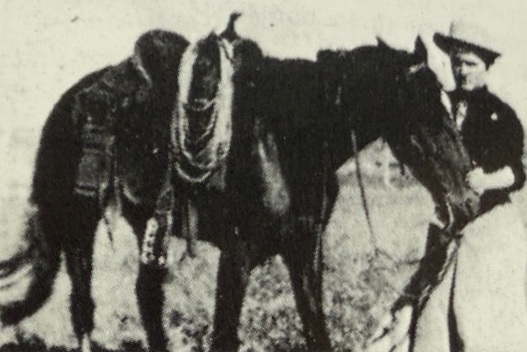
Agnes McRae and her favorite steed.

March is Women’s History Month and an opportune time to share this story which appeared in Volume I of the History of Kearny County and was written by the Rev. F.F. Thomas, subject of last week’s article. The eldest daughter of Billie and Josephine McRae, Agnes was born on the McRae’s Bear Creek ranch in the sandhills south of Lakin. As she grew up, she showed an unusual ability to handle horses and often joined her father on the range. When she was 12 years old, she helped in the cattle roundups doing just as good a job as many of the ranch hands. At 15, Agnes was not only an expert rider, but she was also more skillful with a rope than her father. Mr. McRae stayed on the ranch during the winter, but Mrs. McRae moved to Lakin so their children could attend school. She ran the restaurant as a way of helping out with expenses. While Agnes knew the sandhills well from childhood, still the ride across them in the cold and dark against unknown dangers was one that made grown men hesitate to undertake it. The fact that she made the ride is another feather in the cap of pioneer womanhood. In 1913, Agnes married Everett Kemper whose family resided on the South Side. They made their home at Lakin until 1942 when they moved to Dodge City where she died in 1963.