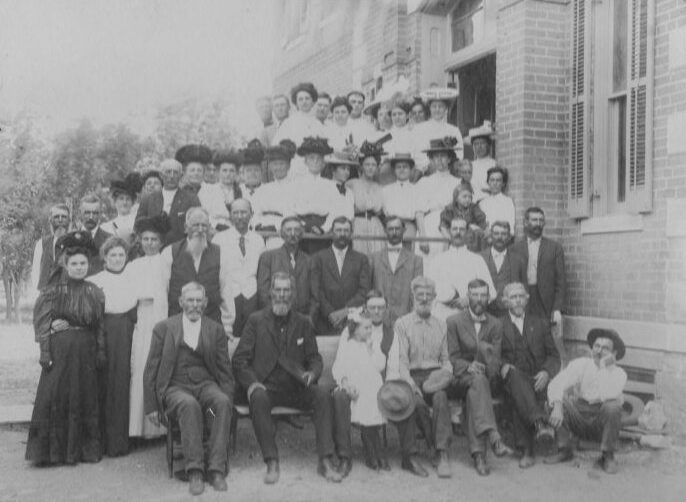
Kearny County Old Settlers’ Association


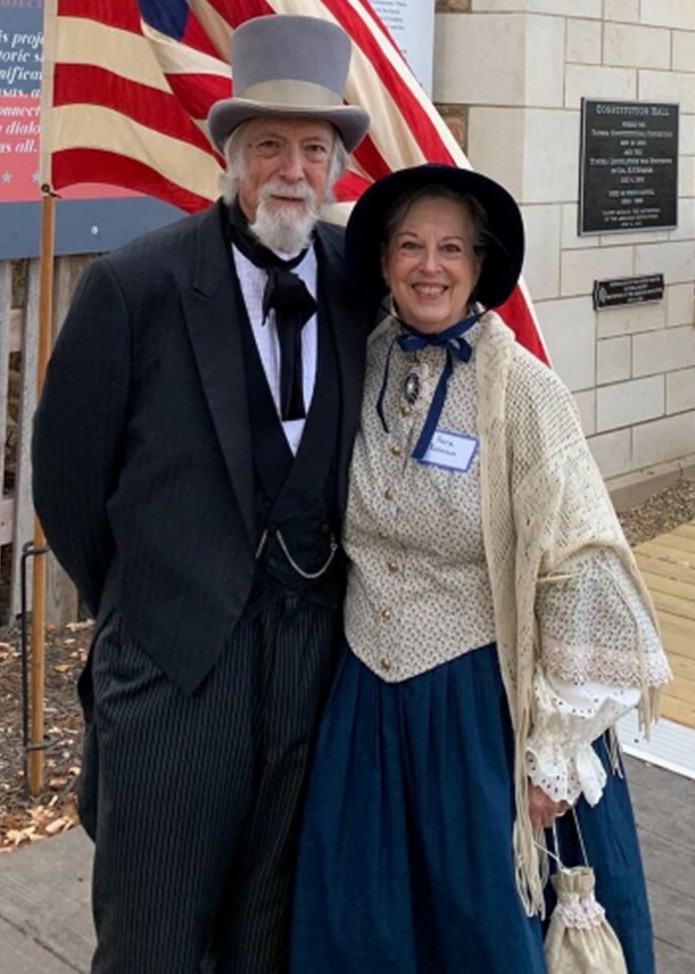
First Kansas Governor Dr. Charles Robinson and his wife, Sara, will make an appearance at the Kearny County Historical Society’s Annual Meeting on May 3. Portrayed by Steve and Suzanne Germes of Topeka, the presentation is guaranteed to be both educational and entertaining. The public is invited to attend the event which also includes a meal and short business meeting. There is no charge, but reservations are required. To make yours, call the Museum at 620-355-7448 by 4 p.m. on Thursday, April 24.

This story about a 1930s dirt storm was written by the late Cora Rardon Holt and appeared in Volume II of the History of Kearny County.
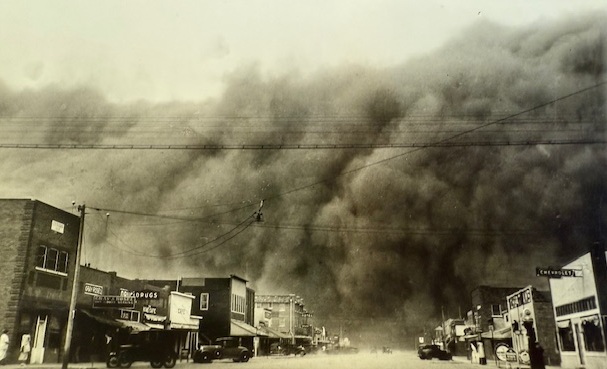
I woke up one Tuesday morning and the smell which confronted me told me what to expect. A musty odor, that was disgustingly familiar, was the immediate explanation for the dim, strangely-colored half-light, that would be with us for some time. Outside the wind was howling and I knew we were having another duster. What I didn’t know was that it would be Friday morning before the air would again be clean and pure.
Sitting up in bed to turn on the light, I noticed the white print of my head on the pillowcase – everywhere else it had taken on a gray-brown color. Everything in the room was covered with a layer of tan silt. The curtains looked like they had been dipped in it. My bedroom slippers had to be emptied before I could put my feet into them. I had forgotten to turn them upside down the night before, a precautionary measure I had learned from past experience.
We lived in a sturdily-built stucco house with a living room extending the length of one side – 30 feet. As I came into this room, the light at the opposite end glowed like a fuzzy ball suspended in a thick haze, which made everything appear indistinct and far away. I looked down at the window sill, which was filling up with dirt, and a tiny landslide started and trickled down to the floor. Outside the window there seemed to be a wall; visibility was zero. This wall enveloped us as if we were contained in a capsule and, for days, changed only in color. If it took on a reddish-brown hue, we guessed New Mexico was going over; if it lightened to a dirty white, it might be Oklahoma; but always it would be black again, just like night.
Time hung heavy on our hands as the day progressed and eating posed a real problem. We learned to either gulp something like cereal and milk quickly under a newspaper tent, or to take our plates to the stove, ladle directly from a covered pan, and eat standing. Even then my teeth always ground particles of dirt and seemed to be coated with a layer of grime. My nose was full of it, like I had rooted in the ground. My face and skin were always gritty, and to scratch in my ear made a magnified, grating sound. Worse than all this to me, was the grit on everything I touched. It was a sandpaper effect that took the fun out of much we could have done to make the time pass more quickly – games for instance. We worked countless crossword puzzles from a stack of old Kansas City papers; we watched the changing colors at the window and a pile of dirt grow under a keyhole; and we scooped paths from room to room using a dustpan. Real cleaning of house or ourselves was an absolutely futile activity. But, perhaps, the most unbearable experience of all came at the end of the monotonous day when we had to go to sleep in a dust-laden bed.
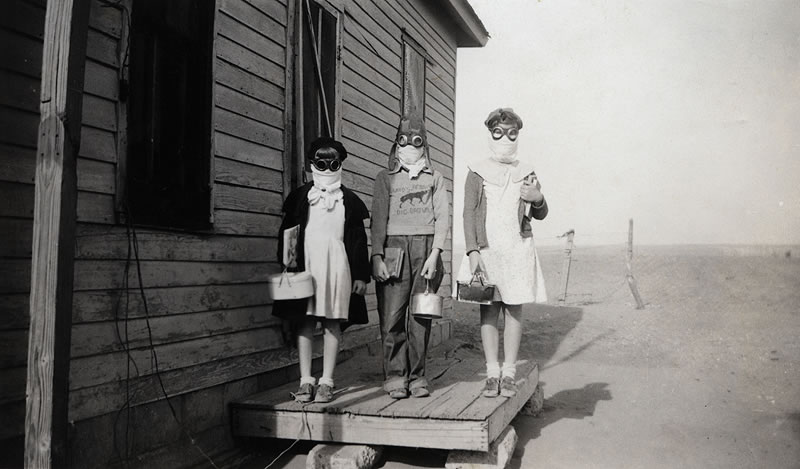
We lived two miles from town at that time and owned the drugstore. My father went the distance each morning to be there in case someone needed medicine. He would don his homemade gauze face-mask and top that with a narrow-brimmed Stetson hat, which was his trademark, before he braved the elements. When he returned, he was even dirtier than the rest of the family. He was our only link with the outside world. There was no telephone service, no trains ran, and the highways in all directions were blocked. People from eighteen states were marooned in our little town during this blackout.
We had some day-long dirt storms again two decades later and newspapers coined the phrase, “Filthy Fifties,” but we old-timers sort of chuckled and said, “They don’t hold a candle to the ‘Dirty Thirties.’”


April 14th marks the 90th anniversary of Black Sunday, the day that the Great Plains was struck by what was considered to be the worst dust storm of them all. It wasn’t the first dust storm that Kansans endured during the Dirty 30s, and it definitely wasn’t the last. Drought had ravaged the plains states since 1931. Little to no rain – together with poor soil conservation and overplowing – meant that when the typical high winds that are common in this area blew, they blew dirt. Eyewitnesses said one could tell where the dust storms originated by the color of the dust: black soil came from Kansas, red soil from Oklahoma and gray from Colorado and New Mexico. In all, it is estimated that 350 million tons of soil from Kansas, Texas and Oklahoma were deposited in eastern states.
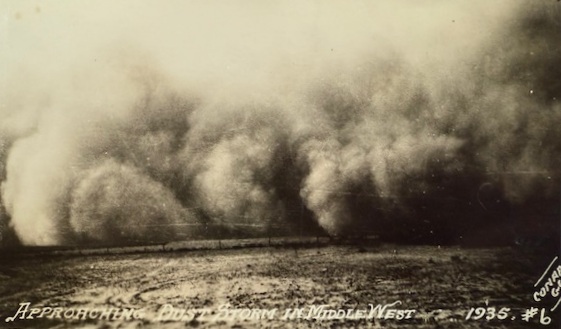
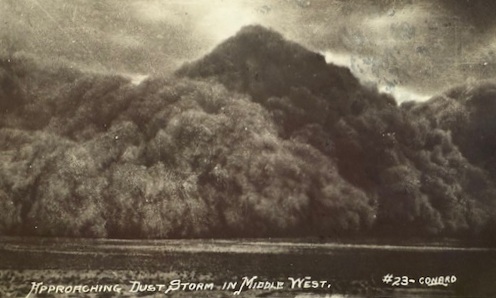
Black Sunday started out mildly enough. The dust had settled out of the air, and it was a quiet afternoon with few clouds in the sky. Working on a farm south of Kendall, Howard Zook saw the rumbling wall of dirt approaching. “It just looked like a big solid bank rolling in,” said Zook. “When it hit the sun, the sun disappeared, and we beat it into the house. We stood there leaning against the wall. The only way you knew where people were was by feel. We could reach out and hit ‘em. You couldn’t see ‘em a foot away from ya. The dirt was just that thick.”

John Grusing and his sons were working a mile northwest of their home in northern Kearny County when the storm hit. “We couldn’t see the road or anything at all. We didn’t know where to turn south or where we were after we turned south. Then we came to a fence,” he recalled. “I knew my own fences so we felt of the wires … knowing the fence west of the house was a two-wire and the fence north was a three-wire, I could tell where we were. Every joint in the fence sparked with electricity. The fence was a three-wire fence and by that we knew how to follow it to the house. There were lights on in the house, but we couldn’t see the lights from the windows as the dust was so dense. But we knew now where we were and finally felt our way to the door.”
The Lakin Independent reported, “A spectacular dust storm came over us Sunday afternoon from the north, and within two minutes the country was plunged into dense midnight darkness. It was impossible to see a hand before your face or to drive a car into the garage. Ernest White was out on horseback and unable to see the horse he was riding. After a half hour the atmosphere cleared a little, but the storm kept on, and lamps were needed the rest of the day.”
Hannah Rosebrook lived in the Fairview Community near the Wichita County line and wrote a weekly column for The Independent. In the April 19th issue, she said, “Still we are fighting dirt. Not a minute’s let-up since Sunday at 1:00 p.m.”

The Black Sunday storm was estimated to be 500 to 600 feet in height, moved at a rate of 50 to 60 mph, and covered approximately 800 miles. Some wind gusts reached up to 100 miles per hour. The temperature dropped 25 degrees per hour, and more than 300,000 tons of soil blew away. That is twice as much dirt as was dug out of the Panama Canal. It was after the Black Sunday storm that Robert Geiger, an Associated Press reporter, coined the phrase, “Dust Bowl.”
Meteorologists rate the Dust Bowl as the #1 weather event of the 20th Century. The first notable dust storm with winds reaching 60 mph was documented on Sept. 14, 1931, and the weather bureau reported 14 bad dust storms the following year. By 1933, the number had increased to 38. During March and April of 1935, about 4.7 tons of dust per acre fell on western Kansas during each dirt blizzard. In 1937, a high of 72 storms marked a peak in the Dust Bowl era. Rosebrook reported not seeing the sun from Saturday until Wednesday noon during one of the severest periods in February of 1937.
The Independent described the dirt as, “fine, penetrating dust that fills the air like driven snow; stifling, blinding, it comes in through every crack and crevice and fills the whole house with silt, and piles up in drifts beside buildings and in sheltered places as it blows and swirls through town and country.” Those who inhaled the dust suffered coughing spasms, shortness of breath, asthma, bronchitis and influenza. Hundreds died from dust pneumonia, also known as the ‘brown plague.’ Infants, children and the elderly were especially susceptible. The Red Cross set up emergency hospitals in the Dust Bowl states and handed out 17,000 gauze masks, but it could take less than an hour exposure outside to darken one of the masks.
Livestock also suffered. Lack of feed reduced them to weakened conditions, and many were unable to stand the black blizzards. Some drifted with the storms and starved before being found while others smothered. Dust buried buildings, shrubs, farm fences and machinery. Tourists were unable to further their journeys and took refuge wherever they could. Trains were stopped in their tracks, and dust storm “holidays” were declared for students.

Complicated by the Great Depression, overpopulation of jackrabbits and hordes of grasshoppers, conditions continued to deteriorate on the Great Plains. By 1940, 2.5 million people had left the area, at least 300,000 traveling to California in what was considered the largest single migration in U.S. history. Approximately 250,000 boys and girls became hobos.
Several national programs such as the Civilian Conservation Corps and Soil Conservation Service were born to combat the effects of not only the crippling dust storms but the drowning economy as well. Men were put back to work through programs like the Works Progress Administration and Public Works Administration which led to the construction of the Kendall bridge, Menno Community building and the Kearny County courthouse. Still others were employed on conservation projects like planting tree rows or shelterbelts. Causes for the Dust Bowl were carefully studied, and new agricultural methods were encouraged such as terracing, contour farming, crop rotation, strip farming and planting ground cover.
The drought and its associated impacts finally began to subside in the spring of 1938, and by 1941, most areas of the country were receiving near-normal rainfalls. These rains, along with the outbreak of World War II, alleviated many of the domestic economic problems of the preceding decade. Drought returned in the 1950s, and from 1954-1957, twice as many acres in the Great Plains were damaged annually by wind erosion as from 1934-1937. Improved farming techniques and equipment, soil conservation, and irrigation saved the area and its people from a repeat of the Dirty ‘30s.
SOURCES: National Weather Service; National Drought Mitigation Center; Kinsley Public Library; “Dust Bowl” by Donald Worster; “Ethnic Heritage Studies: The Fairview News”; History of Kearny County Vol. II; Archives of the Lakin Independent; Hutchinson News, and Southwest Kansas Senior Beacon; and Museum archives.