Gardens of and for the Victorious

Picking a nice juicy, vine-ripened tomato from your home garden can feel like sweet victory, especially to those of us whose green thumbs are a bit challenged. During World War II, home-grown produce was considered an all-out victory for a country facing food rations and possible food shortages. The groundwork of the U.S. Victory Garden program was launched at a National Garden Conference in Washington, DC in December 1941. As part of the war effort, the government rationed foods like sugar, butter, milk, cheese, eggs, coffee, meat and canned goods. Many of those who had been engaged in agriculture were off fighting the war, and transportation systems were needed for hauling soldiers, weapons and supplies; thus, harvesting and moving fruits and vegetables to market became difficult. To avoid a food shortage, the government turned to its citizens and encouraged them to plant Victory Gardens which were also known as war gardens or food gardens for defense.
“Uncle Sam’s wartime food needs have put the all-but-forgotten family vegetable garden back on the map. Millions of Americans are now poring over seed catalogs, checking tools and eyeing likely planting sites,” reported the March 20, 1942 Lakin Independent. “This effort is part of a great national Victory Garden program.”
During the course of World War II, the U.S. Department of Agriculture emphasized that home gardens would reduce pressure on the public food supply and help lower the price of vegetables needed to feed the troops. The money saved could be spent elsewhere on the military. In Kansas alone, a 1942 goal was set for 115,900 gardens compared to the 80,306 gardens planted in 1940. Growing Victory Gardens was a morale booster because Americans on the home front felt that they were helping to win the war. Magazines like Saturday Evening Post and Life wrote about Victory Gardens, and women’s magazines gave instructions on how to grow and preserve homegrown vegetables, fruits and herbs. People with no yards planted small war gardens in window boxes, and rooftop plots sprung up in the cities. Community spaces were also used for Victory Gardens. Even schools got into the act, planting Victory Gardens on their grounds and using the produce in school lunches. In 1944, 18.5 million gardeners took part in Victory Gardens, supplying 40% of the nation’s fresh vegetables, and by the time the war was over in 1945, American Victory gardeners had grown between 8 and 10 million tons of food.
Eleanor Roosevelt played a key role in promoting the Victory Garden movement. The First Lady established a Victory Garden on the White House lawn in 1943 as a patriotic and political message; however, she did not tend to her own garden. Diana Hopkins, the 11-year-old daughter of presidential adviser Harry Hopkins, reportedly cared faithfully for the beans, carrots, tomatoes, and cabbage with a spade, a hoe, and rake.
Youth played crucial roles in contributing to the Victory Garden movement. Many 4-H boys and girls were already involved with helping with the family garden so it was only natural that they would help win the war on the food front. Based on figures collected at the end of 1942, 4-H clubs were responsible for raising three million bushels of garden products, but produce wasn’t their only contribution. They were directly responsible for over 77,000 head of dairy cattle and 246,000 swine. They also answered the call to boost the poultry and egg supply by raising 6.5 million birds.
The concept of Victory Gardens wasn’t new in the United States. In March of 1917, Charles Lathrop Pack organized the National War Garden Commission and launched the war garden campaign during World War I. Food production fell dramatically during the first world war, particularly in Europe. Fertile farmland across the European continent was rapidly disappearing as croplands became barren from drought and were often the scene of battles. Agricultural labor had been recruited into military service, and Europe was running out of food. Pack’s plan, aimed at increasing food production and freeing up resources for the military and Allied forces, resulted in over 5,000,000 gardens in the U.S. Rallying behind President Woodrow Wilson’s cry that “Food will win the war,” American war gardens led to foodstuff production exceeding $1.2 billion by the end of the first world war. After World War I, the movement initially continued with a focus on supporting the stabilization of Europe; however, as commercial food production recovered and Europe began to rebuild, the need for large-scale war gardens declined until they came back into popularity during World War II.
When World War II ended, so did the government promotion of Victory Gardens. Most war gardens disappeared as people became disinterested and wanted to distance themselves from the food hardships of the Great Depression and the war. There was also a significant shift to processed foods, largely driven by factors like economic prosperity, advancements in food processing technology, and the desire for convenience.
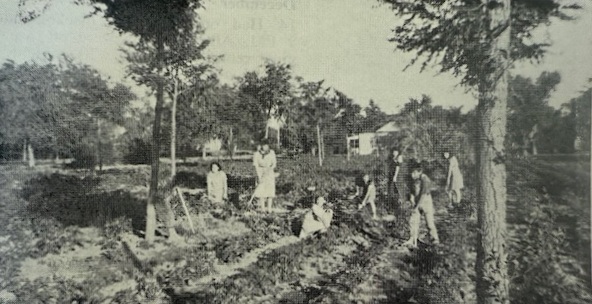
The Sunset 4-H Club with Mrs. Iman Wiatt, leader, at work in their Victory Garden, Spring 1943. The ground lay where the Kearny County Senior Center stands.
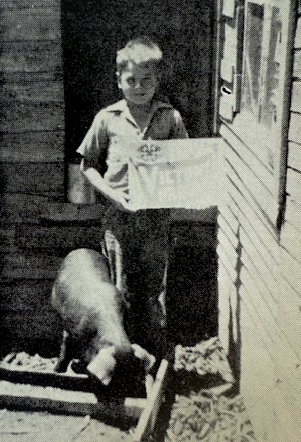
Edward Wiatt, age 10, doing his bit to help win World War II with his 4-H Victory Project, Suzie the Pig.
SOURCES: The Iman Wiatt Diaries; History of Kearny County Vol. II; National Park Service; Wikipedia; National World War II Museum of New Orleans; 4-hhistorypreservation.com; theworldwar.org; boundarystones.weta.org; Museum archives, and archives of the Lakin Independent and Eureka Herald.
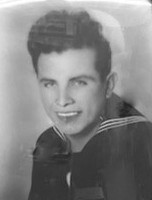
Tony Gonzalez, local hero

Honoring the men and women who have died while serving in the U.S. military is the primary purpose of Memorial Day. On May 5, 1868, the Grand Army of the Republic (GAR), an organization of Union veterans led by Major General John A. Logan, formally established Decoration Day as a time to decorate the graves of Union soldiers who died in the Civil War. The GAR order placed the ceremonial observation on May 30 to ensure availability of “the choicest flowers of springtime” all over the country. Through the years, the event increasingly became known as Memorial Day, and the focus shifted from solely honoring the Civil War dead to commemorating all who have served and died in the military. Legislators enacted the Uniform Monday Holiday Act in 1968, designating Memorial Day as a national holiday and moving it from May 30 to the last Monday in May. This became effective in 1971.
Kearny County Museum takes this opportunity to honor and remember one of our own. Tony Deluna Gonzalez was born at Lakin January 17, 1922. The son of Miguel Sr. (Mike) and Basilia Gonzalez, Tony enlisted in the United States Navy in 1942, and he received his basic training at Corpus Christi’s Naval Air Station in Texas. Tony asked his parents to save his monthly military checks so that they could make a down payment on a house of their own, something that the Gonzalez family had long yearned for.
Lakin native Tony Deluna Gonzalez was 22 years old when he went missing in action in the South Pacific in 1944.
In December of 1943, a letter from Tony stated that after graduating from gunner school, he was assigned to a bombing squadron of B-24’s. “Now I am one of the gunners in one of our plane crews . . . As for our crew we are ready to go any time and in perfect trim. We practice our shooting day in, day out. We hope to be a great success toward our goal of victory.”
Tony, an Aviation Machinist’s Mate Third Class, was aboard the PB4Y-1 Liberator when it took off from Morotai Island on October 23, 1944. On a patrol mission deep in enemy territory over the South China Sea, the bomber failed to return to base after being attacked by Japanese fighters. Tony’s parents were notified by telegram that he was missing in action according to a November 1, 1944 entry in his sister’s diary. On October 24, 1945, the Department of Defense officially declared the Liberator’s entire crew as missing in action. Each crew member is memorialized on the Walls of the Missing at Manila American Cemetery in the Philippines. Although Tony’s remains were never recovered, a military headstone was also placed at the Lakin Cemetery.
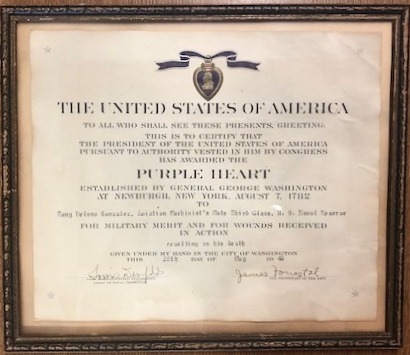
Tony was awarded the Air Medal for distinguishing himself by meritorious acts and demonstrating heroism while participating in flight operations, and in May of 1946, he was honored with the Purple Heart for military merit and for wounds received in action which resulted in his death. In 1950, Tony’s parents accepted his Distinguished Flying Cross medal in a ceremony at the Veterans Memorial Building. The honor was bestowed for Tony’s heroism and extraordinary achievement as an air-crewman in Patrol Bombing Squadron 101 during operations against enemy Japanese forces from June 1 to October 23, 1944. “Gonzalez rendered invaluable assistance to his pilot in carrying out hazardous long-range attacks against hostile planes, shipping and ground installation in the face of anti-aircraft fire and aerial opposition…Gonzales, by his skill and courageous devotion to duty throughout this period, upheld the highest traditions of the United States Naval Service. He gallantly gave his life for his country.”
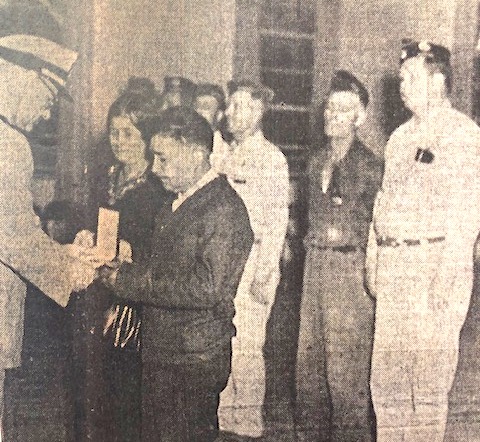
Mike and Basilia Gonzalez accept their son’s Distinguished Flying Cross from Lt. Cmdr. Ray Chance of the U.S. Naval Reserve in July of 1950.
In addition to his parents and five siblings, Tony also left behind a wife, Jessie, whom he had married in 1943. Tony is the only Hispanic from Kearny County to lose his life in service to his country and one of approximately 79,000 Americans listed as missing in action at the close of World War II. This Memorial Day, let us remember Tony Deluna Gonzalez and others like him who made the ultimate sacrifice for their country.
SOURCES: Diggin’ Up Bones by Betty Barnes; History of Kearny County Vols. I and II; news.va.gov; PacificWrecks.com; findagrave.com; ancestry.com; Museum archives; and archives of the Lakin Independent, Hutchinson News-Herald and Garden City Telegram.

Armed Forces Day & Lakin’s tank

Armed Forces Day is observed annually on the third Saturday in May to honor and thank our U.S. military for their contributions to the defense of our nation. In the aftermath of World War II, national leaders sought to unify all military services under the umbrella of one federal department. Congress updated the National Security Act in 1947 establishing the Department of Defense, and the creation of Armed Forces Day was announced by Secretary of Defense Louis Johnson on August 31, 1949. The single-day celebration was intended to replace separate Army, Navy, Marine Corps, and Air Force Days and promote unity among the military branches. May 20, 1950 marked the first Armed Forces Day, and the theme for the special occasion was “Teamed for Defense.” Declared by President Harry S. Truman, the event was marked with parades, open houses, receptions, flyovers and air shows. Americans joined together to honor the Armed Forces and show their appreciation and support for the sacrifices made by military personnel and their families.
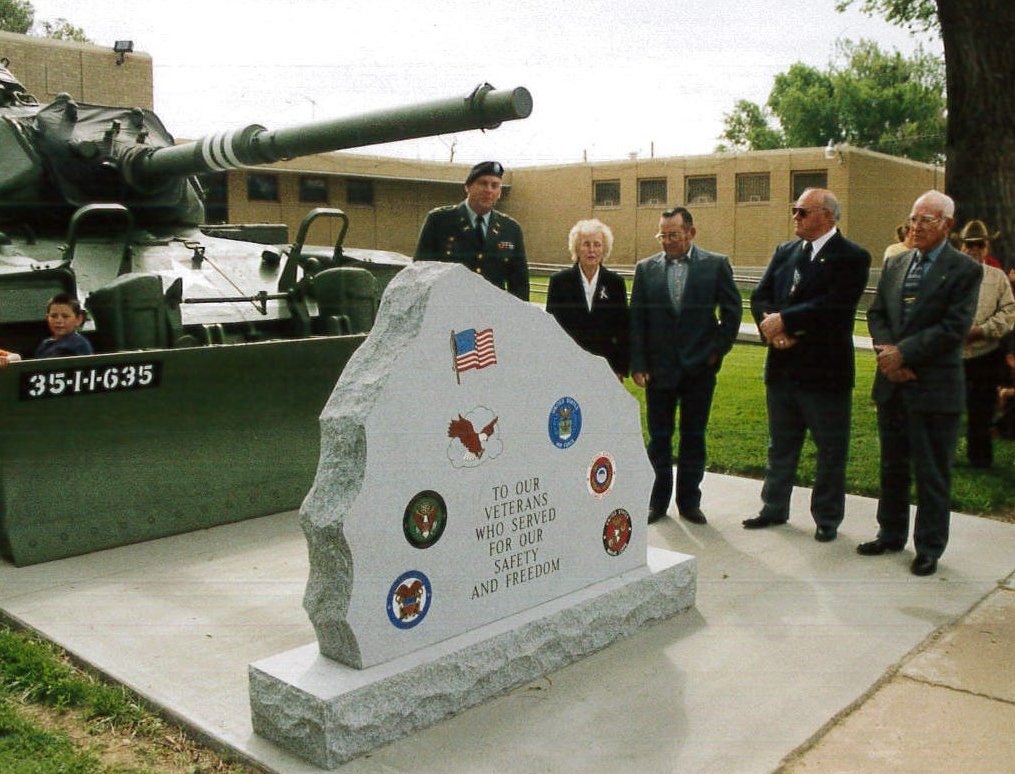
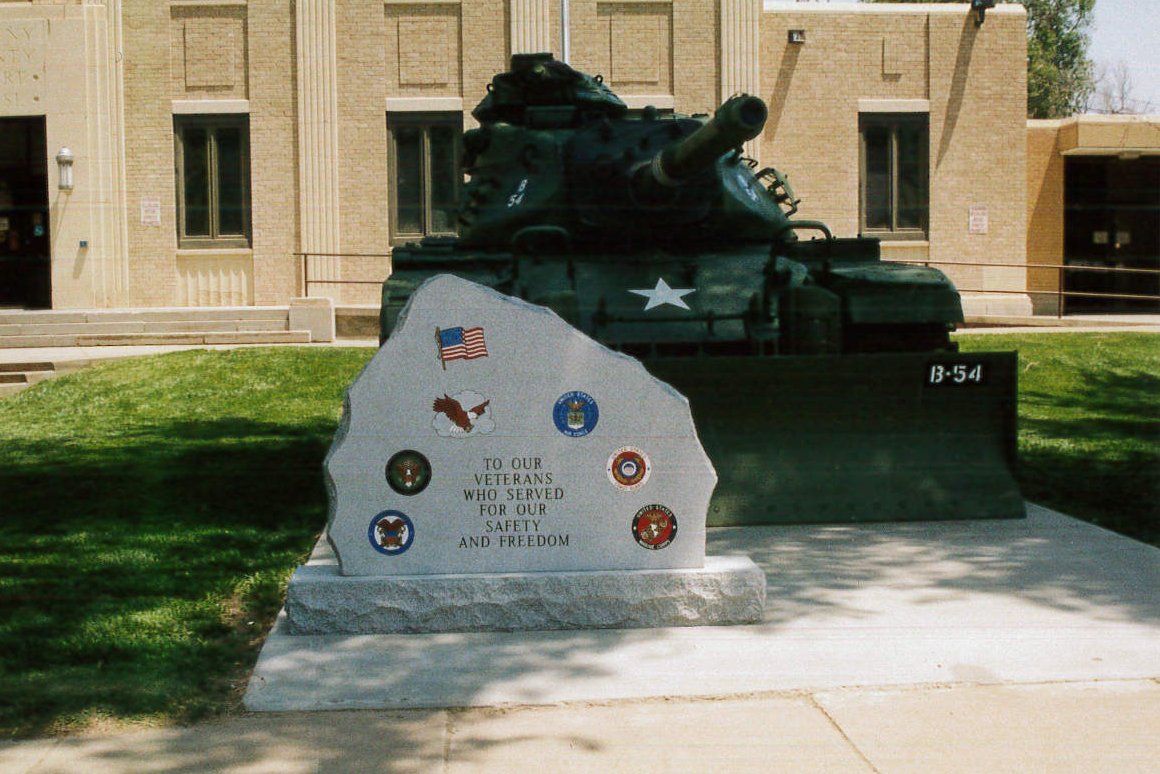
On Armed Forces Day in 2002, approximately 100 people from Kearny County and the surrounding area braved a chilly morning air to attend a veterans recognition ceremony and the dedication of a M60A3 tank on the court house lawn. Representative Gary Hayzlett, emcee for the ceremony, led the group in the “Pledge of Allegiance” as the American and POW flags waved gently in the morning breeze. Raymond Burch was presented the Bronze Star during the ceremonies, and Tim Blackburn led the crowd in singing, “God Bless America.” Pastor Linda Bolz of the United Methodist Church gave the benediction. To conclude the ceremony, Major Christopher Burr of Hutchinson assisted Memorial Building board member Della Enslow in unveiling a monument to honor all Kearny County veterans.
The veterans monument and Army tank before they were moved to the Lakin Cemetery.
Gary Hayzlett, State Representative at that time, was the emcee for the dedication ceremony on May 18, 2002. Sitting behind him left to right are Veterans Memorial Building Board members Norman Simshauser, Della Enslow and Billy Moore; County commissioner Corky Bless, Economic Development Director Ralph Goodnight, Pastor Linda Bolz, and Major Christopher Burr.
Standing left to right behind the monument are Major Christopher Burr, Della Enslow, Dallas (Corky) Bless, Billy Moore and Norman Simshauser.

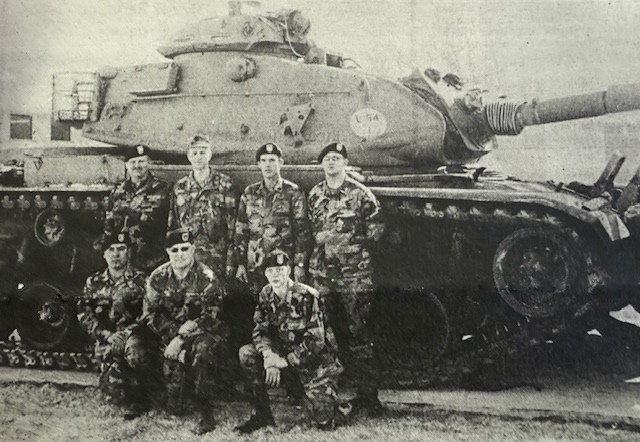
Discussion had begun a year earlier regarding the establishment of a veterans memorial. Olive Beaty made a generous donation to the Veterans Memorial Building Board, and after looking into the expense of erecting a memorial in front of the building, the board opted to get a tank, cannon or something else to honor the veterans. The project was turned over to the county commissioners who in turn appointed Paul Hendrix to oversee it. Hendrix drafted a letter to the U.S. Army Tank-Automotive and Armaments Command in Warren, Michigan and received word on September 28, 2001 that a tank was available at Fort Riley. First, the tank had to be demilitarized by the MATES at the base. On February 7, 2002, SFC Greg Verdoorn of Army Detachment 1, 443rd Transportation Company out of Dodge City received the release notice on the M60A43, and on February 15, the unit went to Fort Riley to load the tank and returned to Dodge City that night. On February 16, the unit left Dodge at 8 a.m. and entered Main Street in Lakin just before 10 a.m. Three U.S. Army vehicles and seven soldiers blocked off the street and had the tank unloaded and situated on a recently poured concrete pad before noon.

Members of Army Detachment 1, 443rd Transportation Company of Dodge City pose for a picture after delivering the M60A3 tank.
The M60A3 was the latest in a long series of improvements to the original M60, the first American main battle tank which entered service in 1960. The tank was last produced for the U.S. Army in 1980, but production of the unit for Foreign Military Sales continued until May 1985. The 31’6” long tank is 12’1” wide and 10’8” tall. Carrying 375 gallons of fuel, the system had a combat weight of 57.5 tons, a top speed of 30 miles per hours, and a cruising range of 280 miles. The M60A3 was manned by a commander, gunner, loader and driver when in action. The main gun was the M68 105 mm rifled cannon with a secondary armament including an M85 .50 caliber machine gun, an M240 7.62 mm coaxial machine gun and two six-barreled smoke grenade launchers. The tank carried 63 main gun rounds, 900 .50 caliber rounds, and 5,950 7.62 mm rounds.
In 2005, the governing board of Lakin Cemetery District #2 and county commissioners agreed to relocate the M60A3 to the Lakin Cemetery. At the time, Lakin was undergoing a major Main Street renovation, and changes were made to the courthouse lawn as a result of the street improvements. There was more room at the cemetery to build an appropriate memorial there so the tank and monument were both transferred. The cemetery’s new Veterans Memorial featuring five walls representing each branch of the military and engraved with the names of local veterans was dedicated Veterans Day, November 11, 2008. The tank is a fitting accent to the memorial.
Armed Forces Days is this Saturday, May 17. Consider showing your support and appreciation for our military by wearing red, white, and blue; displaying the American flag, thanking those who serve or have served, and or donating to veteran or military-based organizations.
SOURCES: Archives of The Lakin Independent and Garden City Telegram; Museum archives; Marines.mil; mysticstamp.com, and govinfo.gov.

Lenora Boylan Tate, Lakin’s first graduate

We are recognizing Mother’s Day and Lakin High School’s upcoming commencement with a history lesson about a local matriarch who was also the first graduate at Lakin. Lenora (Lena) Boylan was born in June of 1872 at Belle Plaine, Minnesota and moved to Lakin in 1875. The Boylan clan consisting of Lena, her parents, A.B. and Castella Boylan, and her younger brother, Bradner, was the second family of permanent settlers in the community. An older sibling, Hannah, had died at Sioux City, Iowa, in 1873 after being struck by a wheel that came off a passing train. The three-year-old was standing on a railroad platform when the tragedy occurred.

The Boylans were the first to live in the large white house which is now part of the Kearny County Museum complex. One of the first memories that Lena had about their new home was her father waking her up at dawn one morning so that she might see a buffalo eating from the haystack in their back yard. It was in that same back yard, while sitting on railroad ties that had been placed on end to form a fence, that she and her brother watched one of the first cattle roundups. The cattle, eight and ten abreast, started coming by in a steady stream during the early afternoon hours. By 10:30 that night, all the cattle had been driven across the river where they were cut out of the herd by their various owners.

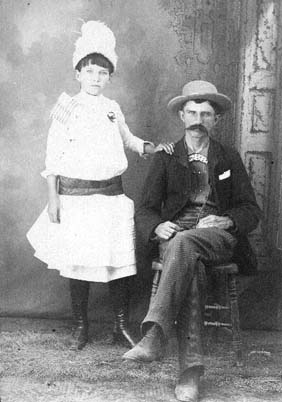
Lenora Boylan with her father in 1886.

Lena spent most of her childhood following her father around on horseback. An expert horseman, A.B. had come to Lakin as railroad agent but later took up farming, ranching, and the capturing and training of wild horses. One evening when father and daughter were in a spring wagon returning to Lakin from a day’s work north of town, they came across a buffalo on the trail. With patience and careful handling of the horses, they were able to drive the animal into town. A favorite past time of Lena’s was to pack a lunch, saddle her horse and ride out to a draw about 12 or 13 miles west of Lakin. She would sit there under two little trees to eat her lunch and then return home.

Lena’s formal education began when her mother purchased an empty store building for a school, and Amy Loucks began teaching a small group of local children there. When the 1886 school was built, A.B. Boylan was the first director of the school board. Lena completed the required two-year course for the high school and became the first ever graduate and only graduate in 1890. On Decoration Day, a starched and ruffled Lena delivered her commencement address on “National Cemeteries,” and she attended every alumni banquet until her health prevented her from doing so.

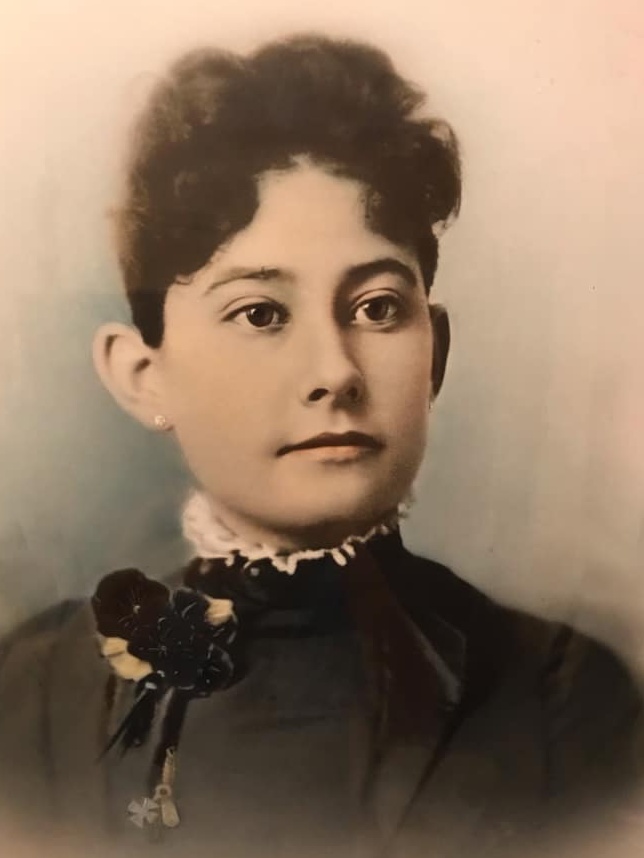
Lenora Boylan’s high school graduation picture.

In June of 1891, Lena, her mother and brother left Lakin for Nepesta, Colorado where A.B. Boylan was employed as a Santa Fe agent, and in 1894, Lena married George Tate Jr. at Monument.  Familiarly known as Harry, Tate had come to Lakin in the spring of 1885 with his father, George H. Tate Sr., who established a general hardware and mercantile business here. The newlyweds returned to Lakin, and Harry eventually took over managing his father’s store and was involved with other business ventures as well as the development of the community. About 1916, work was begun on a fine home on the northwest end of Lakin’s Main Street for Harry, Lena and their five children – James Noell, Victor, Cecil, Roland and Susannah (Florence Fletcher). This is now the residence of Lena and Harry’s great granddaughter Tammy Tate Meisel and her husband, Greg.

Harry and Lena Tate with their two oldest children, James and Victor.

Over the years, Harry and Lena acquired quarters of land in Grant, Kearny and Hamilton Counties. They became ranchers in 1927, buying an 11,000-acre spread south of the river between Coolidge and Syracuse. This enabled them to lock up two large acreages and some other adjacent quarters to make quite a nice ranch suitable for summer and winter pasture. They stocked this first with cattle, then with work horses and brood mares, then started raising mule colts.

Lena dedicated her life to her family and her community. She was the local chairman of the Red Cross for 13 years, served on the school board, and was the first president of the American Legion Auxiliary. She was also an Old Settlers Association president, and Mrs. Tate served as county chair for the Women’s Council of Defense during the first world war. She held membership in the Lakin Literary Society, Lakin Woman’s Club, Women’s Missionary Society, Womens Christian Temperance Union, Kearny County Historical Society, PEO Chapter F.Q., Mus-Art Club, Lakin Book Club, Farm Bureau, Garden City’s St. Thomas Episcopal Church, and Order of Eastern Star where she served as Worthy Grand Matron and belonged to the Past Matrons’ Club.

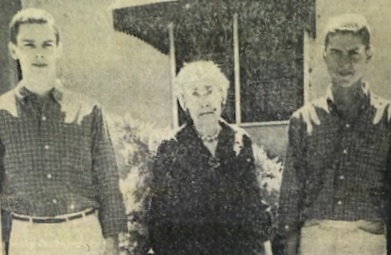
Lenora Boylan Tate stands between her great-grandson Steve McCormick on the left and grandson Walt Fletcher on the right in this picture from 1960. Both men graduated from Lakin High School that year.

Lena lived through drought, dust storms, blizzards, plagues, prairie fires, two world wars, the Great Depression, the development of the automobile, and countless other technical advancements. She witnessed firsthand the evolution of Southwest Kansas from open, rolling prairies filled with buffalo and wild horses to bountiful fields and bustling communities.

“A lot of the old timers like to look back and call them the good, old days, but I don’t know. I believe I’ll take electricity and gas with mine,” she said with a smile in a 1949 interview for the Garden City Daily Telegram. Lenora Victoria Boylan Tate died September 21, 1970, at Lakin. Her side saddle is one of the many treasures on display at the Kearny County Museum.


SOURCES: “Pioneering Tate Family Celebrates 100 Years In Kearny County” by Florence Tate Fletcher; Diggin’ Up Bones by Betty Barnes; History of Kearny County Vol. 1 & 2; The Boylan Web Portal; Ancestry.com; archives of Kearny County Advocate, The Lakin Independent, and Garden City Daily; and Museum archives.

Bacon Drug, a long-time fixture on Deerfield’s Main Street

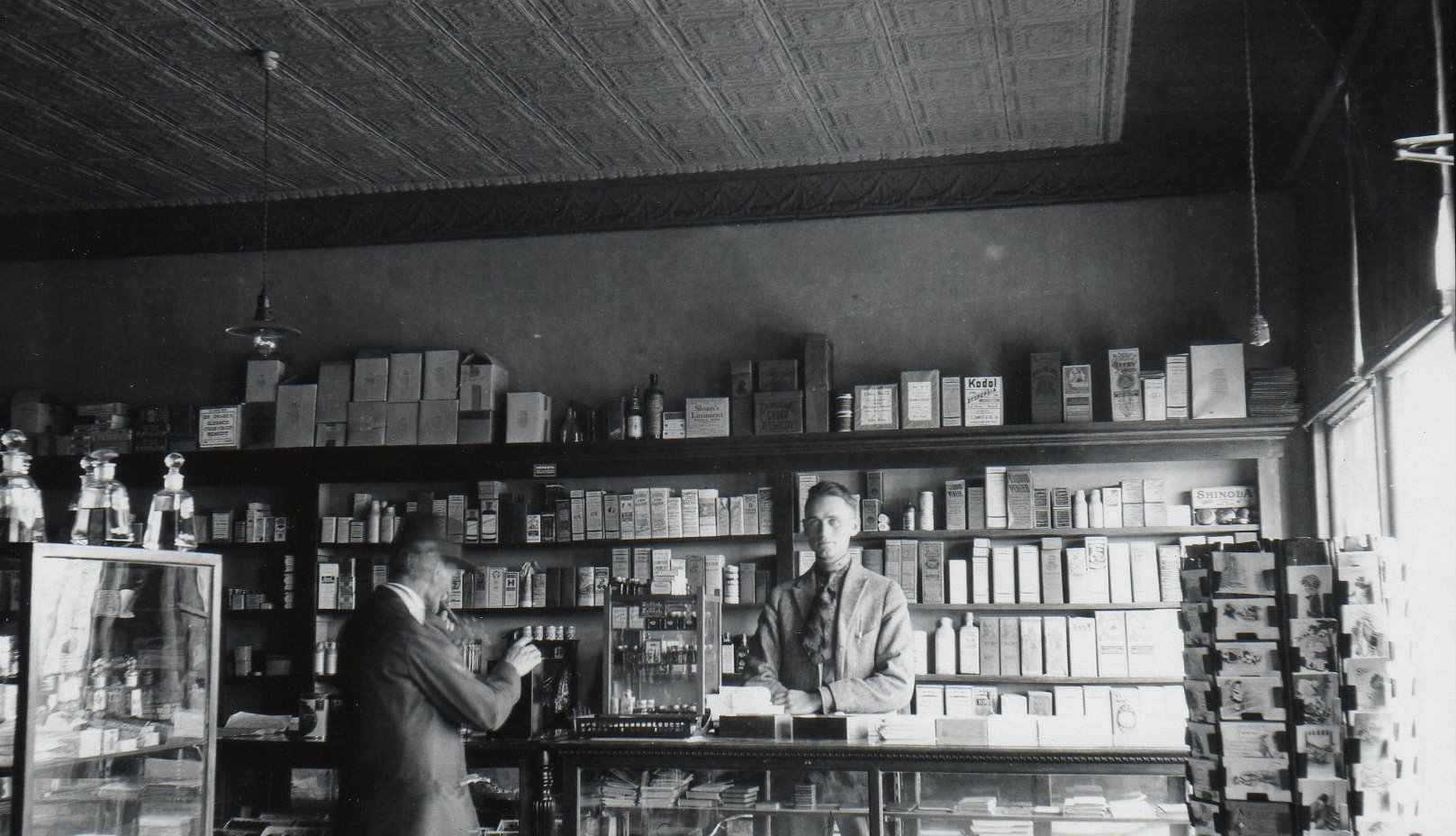
The Bacon Drug Store was a staple of the Deerfield Community for nearly 60 years. In 1907, Dr. G.C.W. Richards of Lakin opened a pharmacy in the east end of the Deerfield State Bank building. He hired Max E. Bacon to run the store, and by 1909, Bacon owned the business and was running it as Bacon’s Red Cross Pharmacy.
Bacon came to Lakin from Illinois in 1888 with his parents, Benjamin and Sarah Bacon. His father was cashier at the Kearny County Bank but died unexpectedly in 1899, and Max became the man of the house. Max was a popular young man and excellent student. He attended college at Kansas State and held jobs for the Santa Fe and at The Index newspaper prior to his employment at the drug store. At Deerfield, Max served terms as the mayor and city clerk. A charter member of the Deerfield Masonic Lodge, he helped establish the organization there.
In 1910, Max married Nella Allen, but their happiness was short-lived. Nella suffered from a lung ailment, and she died one day after her 22nd birthday in 1913 in New Mexico where Max had taken her in hopes that the climate change would benefit her health. Anthony Sharpe, a physician and surgeon, briefly ran his practice out of the pharmacy during this time.
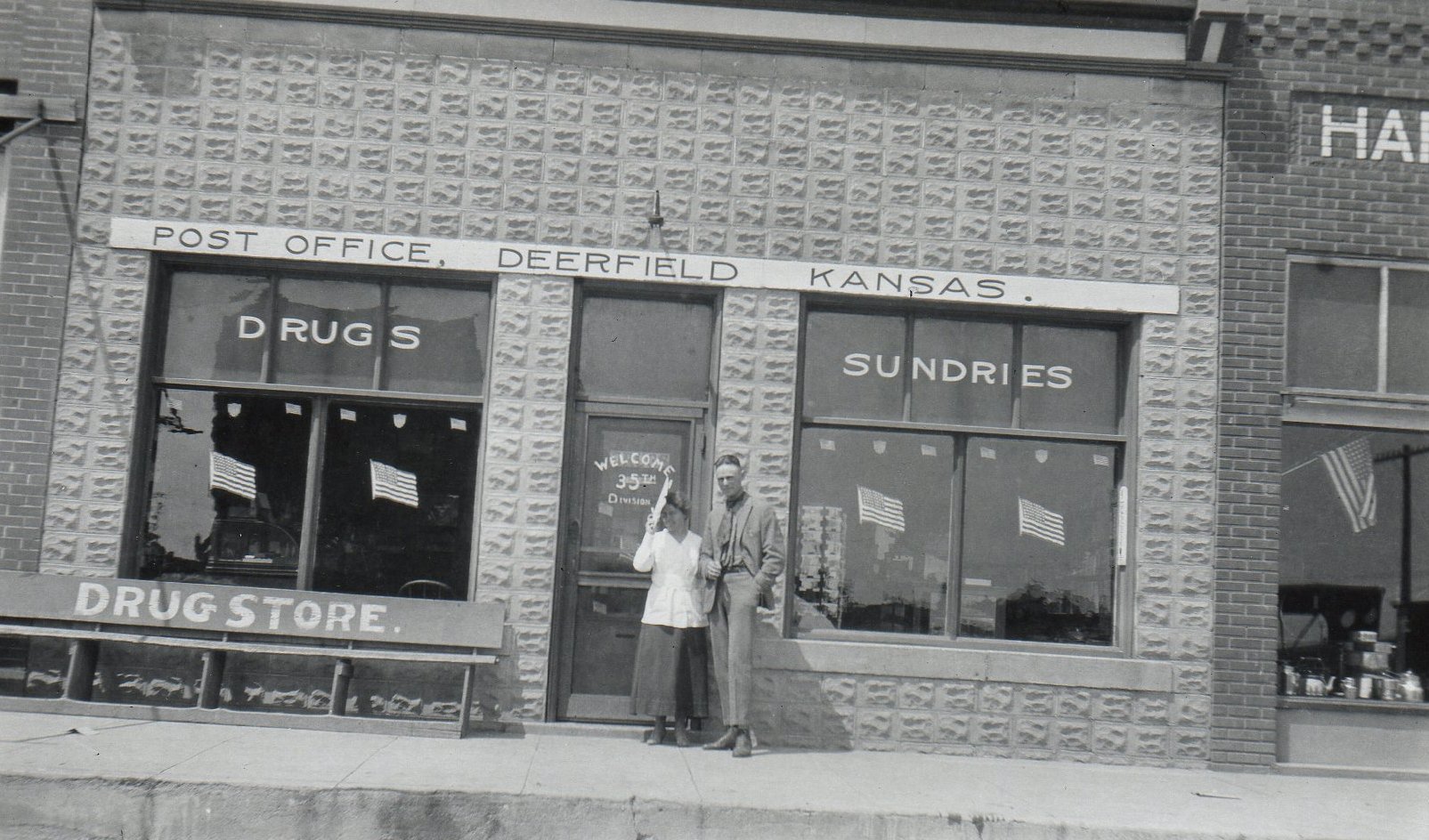
Bacon’s pharmacy was eventually moved to a concrete block building that had been constructed in 1910 on the west side of Deerfield’s Main Street to house the post office. Max was appointed postmaster in September of 1913, and in January of 1919, he secured the services of Henry Van Doren to assist in the drug store and post office. Van Doren, formerly of Salina, had recently been discharged from service at Camp Funston.
Bacon Drug was located at 603 Main Street in Deerfield. Built in 1910, the building was razed in 2002. Man in picture is believed to be Henry Van Doren. Woman is unidentified.
In 1920, a 30-foot addition was built at the rear of the store. The Advocate reported that, “Max Bacon and Henry Van Doren of the Bacon Drug Company are evidently satisfied with the outlook for the future of Deerfield as they have enlarged their Drug Store and Post Office building to twice the original size. They have installed new show cases and shelving, have repainted the walls and ceiling and will soon have as up to date a drug store as you will find in any community. They expect to carry considerable more stock and plan to install a soda fountain next season. The boys have come in for quite a little good natured Kidding from the public with regard to the longer walk to the mail boxes but everyone seems well pleased with the appearance of the store and we predict a nice increase in business for these progressive merchants.”
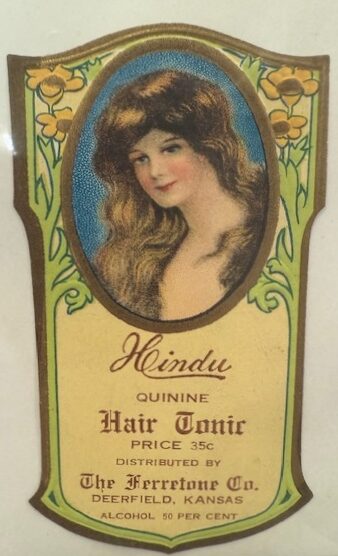
In October of 1924, Bacon began marketing a line of products specifically to the Spanish-speaking community. He had been working on the proposition for over a year, and the initial line was composed of three remedies: Ferretone Tonic Tablets, Ferretone Laxative Tablets and Ferretone Contra Dolor (anti-pain) tablets. To market to his clientele, Bacon used high-class advertising materials with the text entirely in Spanish. In 1926, The Independent announced that Bacon was putting up a new 14×28 building across the alley west of the Campbell Mercantile. “His business has increased until his present location is too small. His Ferretone business is growing fast.”
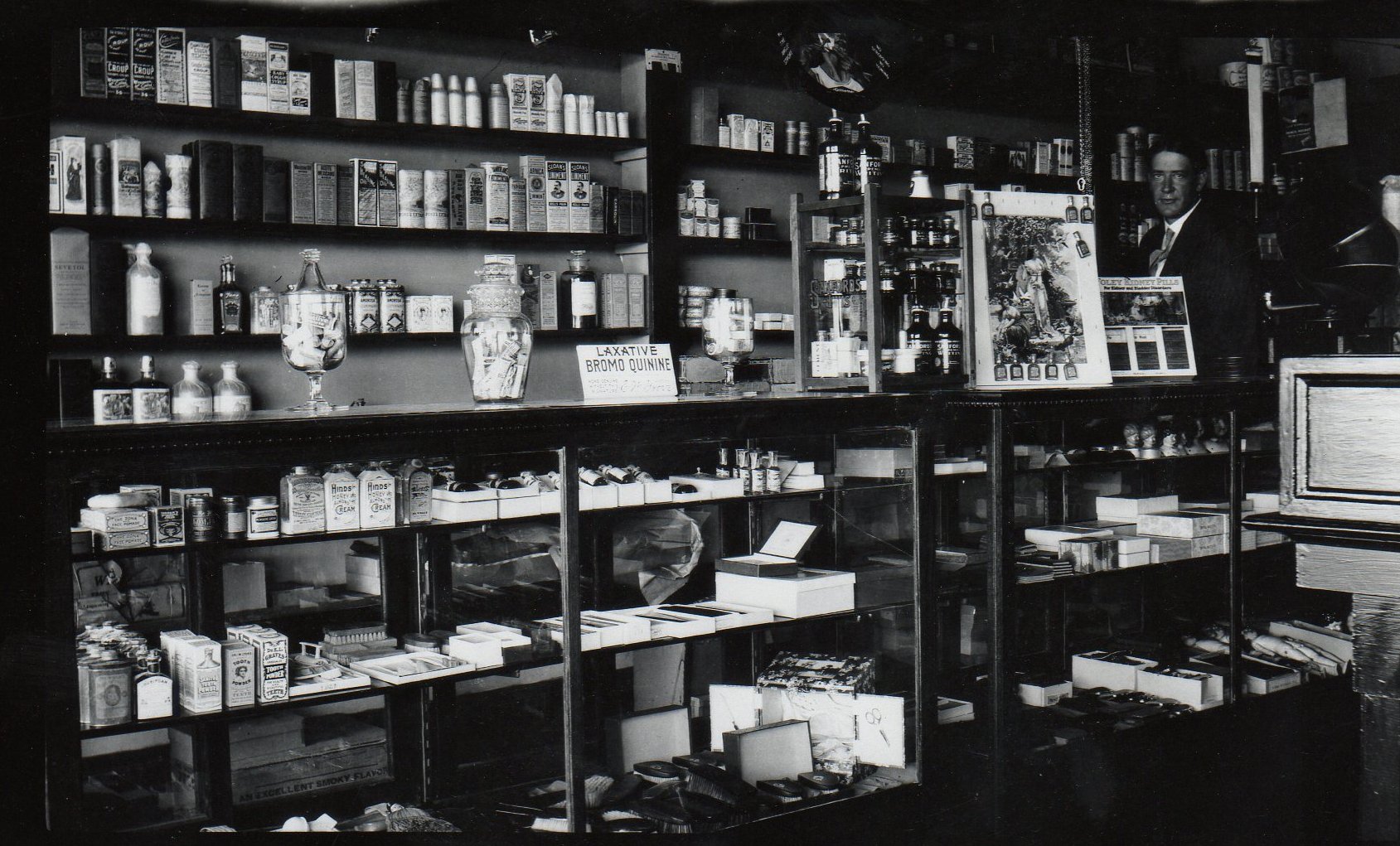
Max Bacon inside his drug store at Deerfield, Kansas.
A label from one of Max Bacon’s Ferretone products.
Max moved Ferretone to Wichita in 1929. The Wichita Eagle reported that Ferretone was fully financed and had enjoyed a steady growth for several years. “It is because it has outgrown the accommodations from a shipping standpoint which the smaller town offers that it is moving to Wichita. The company does a big mail order business, chiefly among the Spanish speaking people.” Ferretone products shipped all over the Southwest.
In 1937, Bacon found himself in trouble with the law for violations of the Food and Drug Act. He was found guilty and fined $1 and court costs which amounted to $32.50. He continued in business for a few more years but died in 1947. He was survived by his second wife, Amelia Gerteis Bacon.
A young Henry Van Doren behind the counter at Bacon Drug.
In 1924, Van Doren became a registered pharmacist and was appointed Deerfield postmaster. He eventually acquired the Deerfield drug store and continued to operate the business under the name, Bacon Drug. He had married Catharine Campbell, daughter of Adam and Sarah (Mudd) Campbell of Lakin, in 1923. Presumably as a tip of the hat to Henry’s mentor, the Van Doren’s named their firstborn child “Max”. Henry was active in the Deerfield Methodist Church, American Legion, Masonic Lodge and Order of the Eastern Star. He also served as a school board member, Deerfield city officer, and a director of Kearny County Bank.
The announcement came in November 1967 that Van Doren was retiring, selling all his stock and closing Bacon Drug. The Van Dorens moved to Garden City following Henry’s retirement. His wife passed in 1981, and Henry in 1992. They were survived by their sons, Max and Phil.
The old drug store continued to grace Deerfield’s Main Street and housed Santa Fe Motor’s TV and repair shop followed by James Jarboe’s TV shop. Then Pioneer Telephone used the building for storage and as a drop-off for Deerfield residents to pay their monthly bills. In 2002, the structure was razed to build the parking lot for the Deerfield Community Center.
SOURCES: findagrave.com; Ancestry.com; History of Kearny County Vols. I and II; Archives of The Advocate, Lakin Investigator, Lakin Independent, Garden City Telegram, Wichita Eagle Beacon and Osborne County News; and Museum archives.