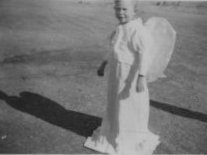
 This little angel is reaching out to say “Merry Christmas” and to let you know that the Kearny County Museum will be closed to the public from Dec. 24 until Dec. 30. Pictured is Donnie Bohl in 1945. Myrna Michel was to be the angel for the Christmas play at Columbia School, but she was sick with the flu so Donnie was her substitute. We think he looks pretty darling!
Month: December 2025
Memories of Christmas on the Prairie
(This story was written by the late Helen Kysar and appeared in the December 7, 1975 Methodist LIFE. Helen Grusing Kysar was born in 1906 at Salem, Oregon, the daughter of John and Anna Grusing. She moved with her family to Kearny County as a child, and after graduating from Lakin High School, she attended Fort Hays State University. Helen taught school in Kearny County before marrying Preston Kysar in 1930. After a brief time in Ellis County, they moved back to the Lydia area in Kearny County and then into Lakin in 1971. Helen was a member of the Lydia United Methodist Church in rural Kearny County and attended the Lakin United Methodist Church after moving into town. She died at the age of 96 on Christmas Day 2002.)

Even though the times were hard and the going was rough in the early days on the plains, nearly twenty-five miles from town, there are many fond memories for me to remember. As I think back and remember how scant were the things which we now take for granted, it would seem we could not be as happy as children are today. But they were as happy (maybe, more so) than today. And, of course, Christmas time was the happiest time of the year.
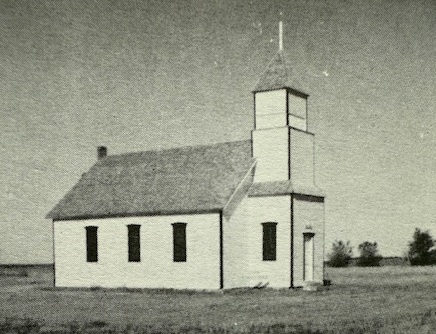
One of the things that stands out in my memory of Christmas on the plains was the Christmas program at the small country church. The Christmas program was always on Christmas Eve. The church building set rather alone on the prairie and it seemed as if it could gather all the coldness there was to spare of the whole neighborhood. A large pot-bellied stove stood in the center of the building. When the day before Christmas arrived, my father would start the fire early in the morning so that the whole building could be warmed through and not have to have such a hot fire in the center of the room with the outer edges of the room freezing cold.
There would always be a tall Christmas tree decorated with a few beautiful ornaments (how they acquired them, I do not know), yards and yards of strung popcorn and real candles. While the candles were lit, two young men stood behind the tree equipped with long sticks, the tips covered with cotton. A bucket of water stood nearby. In case a candle burned down or caught the tree afire, the cotton tipped stick would be plunged hastily in the water and snuff out the candle. How beautiful was that tree to welcome the people in! Two kerosene hanging-lamps hanging from the tall ceiling and six bracket lamps on the walls, one at each window, added to the cheeriness and warmth of the welcome.
Because there was no other place to go, everybody went to church. The families came in lumber wagons and spring wagons, the father and mother and maybe a youngster or two on the front seat. Hay was put in the wagon bed and the rest of the children would sit on the hay with comforters put over them to keep them warm. The horses were tied to the long hitching rails near the church during the program and the comforters were put on their backs to keep them warm.
The Christmas programs were similar to today although in those days literature and program books were scarce and many times the recitations by the children were verses from the Bible pertaining to the birth of Christ. I remember one evening very distinctly when the whole program consisted of songs and reciting Bible verses. I was reciting some verses from Luke 2 in front of the Christmas tree when suddenly my father who was sitting in the front pew motioned to the boys behind the tree that a candle had gone rampant. I was just sure my hair had caught on fire, or worse yet, that my beautiful new ribbon bow on my hair was afire. I almost forgot what I was to say. Strangely, the next words were “Fear not -.” The songs sung to the accompaniment of a pump organ were some of the very songs we sing today. Always the program ended with all singing the song, “Silent Night.” How happy we children would be because we knew that now was the time we would get our sacks of candy and nuts and maybe an orange. This being the only time that we would ever get candy, it was a great expectation for us. Every one present got a sack, handed out from wash boilers carried around by two young men.
Even though the years have passed and times have changed very much, it always has been the same Christmas spirit and the same story of Jesus’ birth.
Lakin’s First Methodist Church
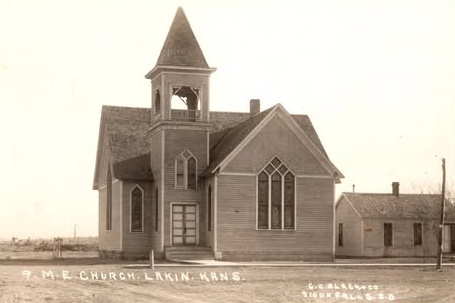
Hopes were high that Lakin’s Methodist Church would be completed by Christmas of 1907, but that was one wish that Santa could not fulfill. Instead, the church was completed and dedicated on March 1st of 1908. The house of worship had been a long time in the making.
Just newly ordained, Rev. William V. Burns arrived in Lakin in time to preach the first Sunday of April 1886. The April 3rd Kearny County Advocate announced the new pastor as “a young man, sent specially by the conference to this work and we trust our people will give him a warm welcome.” The first quarterly conference of the M.E. Church for this circuit was organized at the residence of B.C. Parcells later that month, and Rev. Burn’s salary was fixed at $600. In addition to his duties at Lakin, Deerfield and Hartland, Burns also often preached at Sherlock (Holcomb).
At Lakin, the fresh-faced man of God delivered his sermons in the town hall. On June 12, 1886, the Pioneer Democrat announced that “considerable interest is being manifested in the church services held by Rev. W.V. Burns, and the city hall is nearly always crowded when he holds service there.” That week’s Advocate reported that Rev. Burns had organized a Methodist Episcopal Sunday school with W.P. Haywood as superintendent. The school was to meet at 10 a.m. every Sunday, “and our Methodist friends will no doubt work energetically to build up a flourishing and promising school.”
After the town hall was destroyed by a cyclone that July, Methodists began meeting in Holmes Hall which was on the second story of the building at Main and Waterman that would later become the county court house. Later, services were held in the brick schoolhouse that was completed in the fall of 1886, but discussions were already taking place about building a church. According to the September 4, 1886 Advocate, “The necessity of erecting a building for church purposes is pressing itself upon the minds of the membership, and after discussing the matter the question was thought to be both advisable and practicable, and steps were inaugurated looking to that end. We feel confident that our church going people will render aid to such a desirable undertaking.” Still, by the following summer, no church building was in the making. The Pioneer Democrat reported, “Rev. A.P. George P.E. Methodist church passed through Lakin Thursday evening. He says when this county seat question is settled he will attempt to build a church here, as he could not get the minds of the people in harmony until that time. We hope he will take hold of the matter and push things forward. We need a church and must have one.”
An August 1895 Lakin Index noted that a Metodist church was going to be erected that fall as several hundred dollars had already been promised; however, that did not come to fruition. By the turn of the century, Lakin’s Methodist congregation had reached the 100 mark, but there was still no church even though members had long been hoping to build one of their own. Then, in 1901, two lots were purchased at the corner of Kansas Street and Prairie Avenue. Construction did not begin until the summer of 1907 with the cornerstone being laid on September 29.
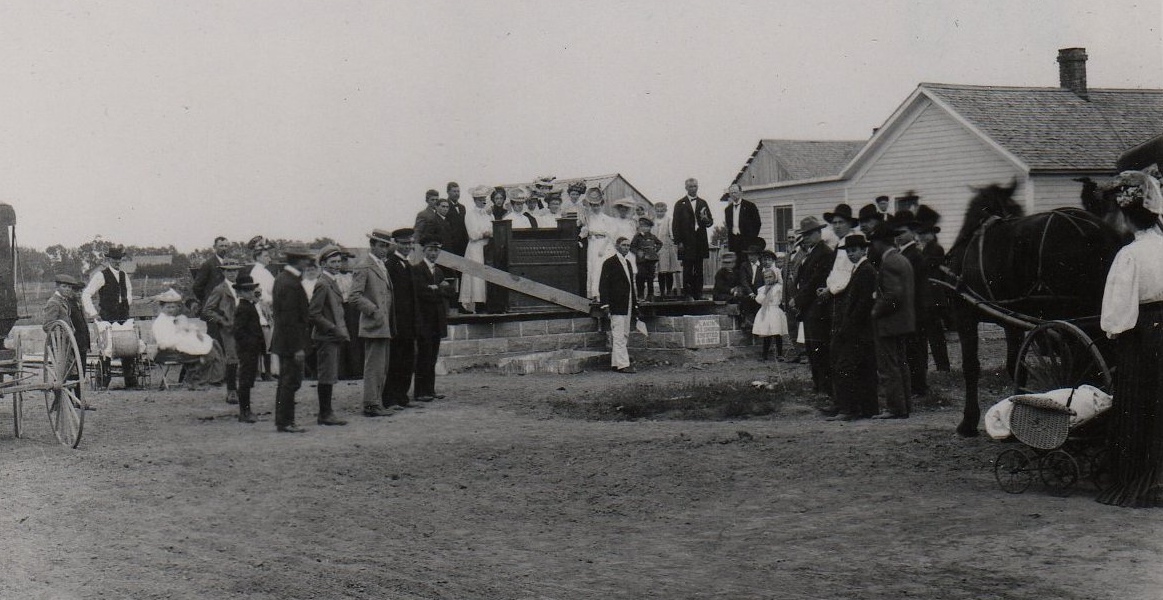
Dedication Day was a red-letter day for Methodists. At 11 a.m. on the first Sunday in March 1908, the new church was filled to capacity. Other churches dismissed their services and joined in the festive occasion of dedicating the church. Excellent music was rendered by a large choir made up of members of all the church choirs of the community. Methodist pastor, Rev. H.A. Schneider, along with Rev. Thomas of Lakin’s Presbyterian Church, Pastor A.W. Yale of the Baptist Church, and Rev. Dr. F.E. Mossman of Southwest College at Winfield, addressed those in attendance. Three services were held, and Rev. J.F. Irwin, the Presiding Elder of the district, administered communion at the afternoon service.
The building committee reported the cost of the building to be $3,600. According to a history of the church compiled by the late Hazel Stullken, the church was built with donations from many sources and from all denominations. The Ladies Aid Society adopted a novel method of helping raise money for the new building. “The idea was an exemplification of the old adage, ‘take care of the pennies and the dollars will take care of themselves.’” The object was to gather a mile of pennies and to do that, each member was provided with a narrow strip of paper one foot in length. Each foot held 16 pennies. When the mile of pennies was received, the sum of $844.48 would be added to the building fund. A very large contingent from Deerfield also helped in a very material way in raising the necessary funds. After footing up the pledges and contributions at the morning service on dedication day, the church was about $50 short of the necessary amount. “This was soon subscribed and the church was dedicated to the service of God.” There was no air conditioning and no plumbing, but Methodists believed it to be a splendid home for worship.
In 1927-28, the white frame building was raised and a full basement was put under it to provide kitchen and dining room space as well as additional Sunday school rooms. While this remodeling was being done, church and Sunday school were once again held in the building at Main and Waterman. By 1951, the Methodists had begun to think seriously of enlarging their facilities again. Times were good. Natural gas development in addition to greatly enlarged farming operations brought an unprecedented prosperity to the area. The last service in the old church was held on April 13, 1952. The building was sold, lifted off the basement and transported intact to north Buffalo Street where it was made into an apartment complex and where it still stands just across the street from the swimming pool.
SOURCES: “Lakin Methodist Church” by Nina Russell for History of Kearny County Vol. 1; “History of the M.E. Church Begins in ‘86” by Luella Stutzman; “Laity Sunday” by Hazel Stullken; Archives of Peabody Gazette-Herald, Garden City Telegram, Lakin Index, Pioneer Democrat, Kearny County Advocate, and Lakin Independent; and Museum archives.
Thank you Western Kansas Community Foundation for your generous grant of $5,000!

Deerfield’s first Methodist Church dedicated in December 1907
Rev. William V. Burns was sent to southwest Kansas in 1886 to serve the Methodists of Deerfield, Lakin and Hartland. It was his first charge as a missionary as he had just been granted a license to preach at the Annual Conference of the Methodist Church held at McPherson in the spring of 1886. The western part of Kansas was then being settled, and the church was ever mindful of the spiritual needs of new communities within its jurisdiction. Rev. Burns was sent with instructions to “Go Preach.” It was a large field with big responsibilities and even greater possibilities. The enthusiastic young preacher, not yet 21 years of age, met the challenge.
At Deerfield, Rev. Burns found five Methodists to organize a church. They were A.R. Downing, R.A. Beckett, Mrs. C.L. Beckett, “Grandma” Mary Keep and Mrs. Sam Barker. The first year the members met in the office of a lumber yard or the general store. The first trustees, five in number, were required to sign an official document upholding the Constitution of the United States and the State of Kansas. This was notarized August 17, 1895 by B.B. Bacon. A school house was built in 1887, and church services were held there until a church was erected.
In the fall of 1905, the United States Sugar and Land Company gave a building site and $100 towards the building of a church. The Methodist’s new church was dedicated to worship on Sunday morning, December 9, 1906. According to Garden City’s Reflector, the weather was a little threatening early in the day, but by 11 a.m. the church was well filled. Dr. F.E. Mossman, president of Southwest Kansas College at Winfield, delivered the address “after which, in a comparatively short time, nearly $1,400 were raised to cover the remaining indebtedness on the church building, its entire cost being about $3,000.”
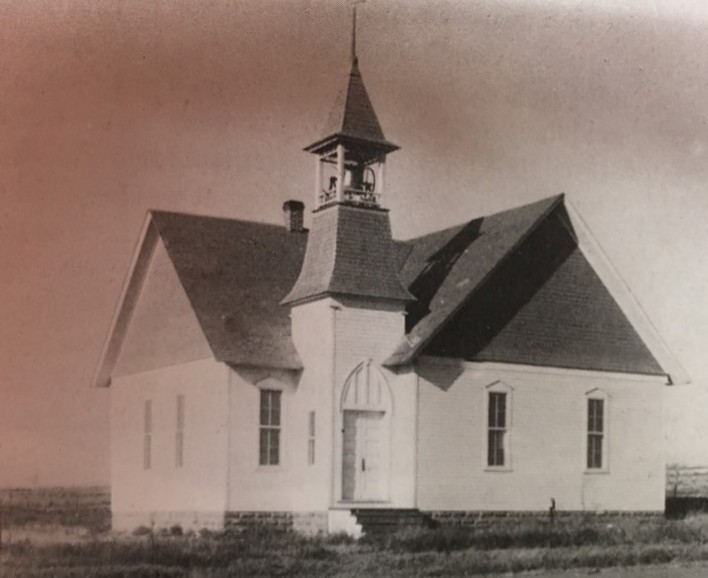
In 1919, the church basement was begun. It was completed in 1920 and dedicated by the Rev. E.L. Nicholson. Services were held in the Baptist Church during construction. After completion, a community kitchen shower aided materially in furnishing the basement kitchen. A remodeling program was begun in 1949 under the leadership of Rev. W.A. Hawes, and on Easter Sunday 1950, a dedication program was held. The electric organ, a gift of the Ralph Miller Family, and other furnishings were dedicated by the district superintendent, Rev. J.R. Throckmorton.
On November 19, 1961, Deerfield Methodists celebrated their 75th anniversary by dedicating a beautiful new educational building. The building and furnishings cost $34,434.44 plus donated labor. Designed by Howard Blanchard, the building was constructed by Richard Landon. The Rev. Bob Fleenor was the minister at that time, and Dr. Lester R.Templin, district superintendent, was guest speaker for dedication activities which included morning and afternoon worship services as well as a family basket dinner. The event brought to a close a successful three-year funds campaign.
On March 21, 1973, a building committee was elected to look into replacing the old church building. The last service was held in the old church on Sunday, March 3, 1974. The building was torn down starting on Monday, March 11 that year. This was done by men, women and children working together. Soon the workers razed the facility, cleared the site and made ready for the construction of a new church.
Groundbreaking ceremonies for the new brick structure were held on April 21 of 1974, and construction began the following day. The placing of the cornerstone was held March 2, 1975, following church services in the Lutheran Church where services had been held since March 10 of 1974. The placing of the cornerstone was done by Richard and Kent Landon and Anson Maddux. Some of the articles placed in the cornerstone included bulletins from special services; special anniversary bulletins; articles written about the Methodist Women, Men’s Brotherhood, choir, youth groups, ministers and church history; Bibles; hymnals; choir tape, Sears and Montgomery Ward catalogs and 1974 coins.
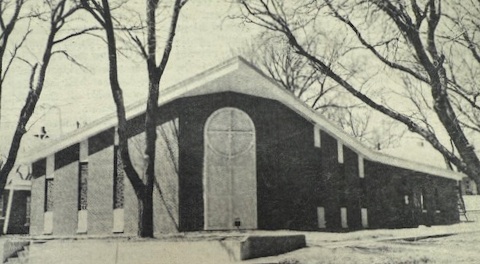
Consecration services were held April 20, 1975, and a record number of former pastors, members and friends came to participate. Then, on December 7, 1975, the Rev. Dr. Ruben Reyes, pastor of the church, was assisted by Bishop Earnest T. Dixon of Topeka at the dedication service. Rev. Charles Hadley was the pastor when the church initiated the building program, drew plans, and launched the successful financial campaign which raised sufficient funds to begin building. Designed by architect Keith Fillmore and constructed by Richard Landon, the beautiful new building at Eighth and Walnut was originally estimated to cost $139,000, but the cost at completion was $125,000. “It was the labor and love of this congregation for many previous years, that made this possible for us to have this beautiful sanctuary, fellowship hall and kitchen.”
On October 16, 1990, the decision was made to remodel and add on a second floor to the educational building. On November 4 that year, Jay Dean Landon, Dick Horton and others started removing the roof and soon the volunteers were in action. Richard and Kent Landon were the contractors for the remodeling and new addition, and they too volunteered many hours. The first Sunday School classes were held in the new addition in April of 1993 with the dedication taking place on October 17, 1993 under the leadership of then minister Rev. Don Koehn. The total cost for remodeling and the new addition was around $75,000. Memorial money helped fund the addition and furnishings, and two beautiful stained glass windows were designed and donated by Jay Dean and Joan Landon for the new addition. This addition would not have been possible without the hard work of all volunteers and the love, the skill, and dedication of the congregation. A VIP club (Volunteers In Painting) was formed and donated money to have both levels painted. The educational building was then named “The Hazel Shriver Educational Building” in honor of one of Deerfield’s own who gave immensely to the community as well as to the church to help it grow and reach its goals.
“We celebrate, however, not only the beauty and magnificence of this building, but the faith, the love, and the dedication of all those who worked, prayed and gave of their monies that we might have this house for the praise of Him who is the giver of the house itself, our lives, and all things.”
SOURCES: October 17, 1993 Deerfield UMC program; archived Deerfield UMC Congregation Directory; History of Kearny County Vol. I; Museum archives, and archives of the Harper Sentinel, Reflector, Garden City Telegram, Methodist LIFE, and Lakin Independent.
2025 Historical Society Royalty
Congratulations to Martin and Donna Neff on being selected as the 2025 Kearny County Historical Society King and Queen!
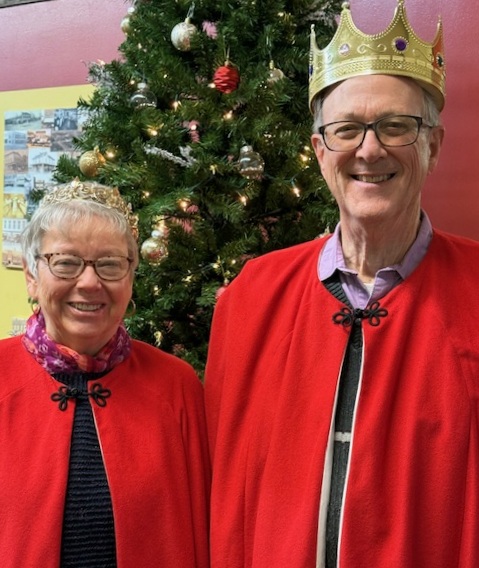
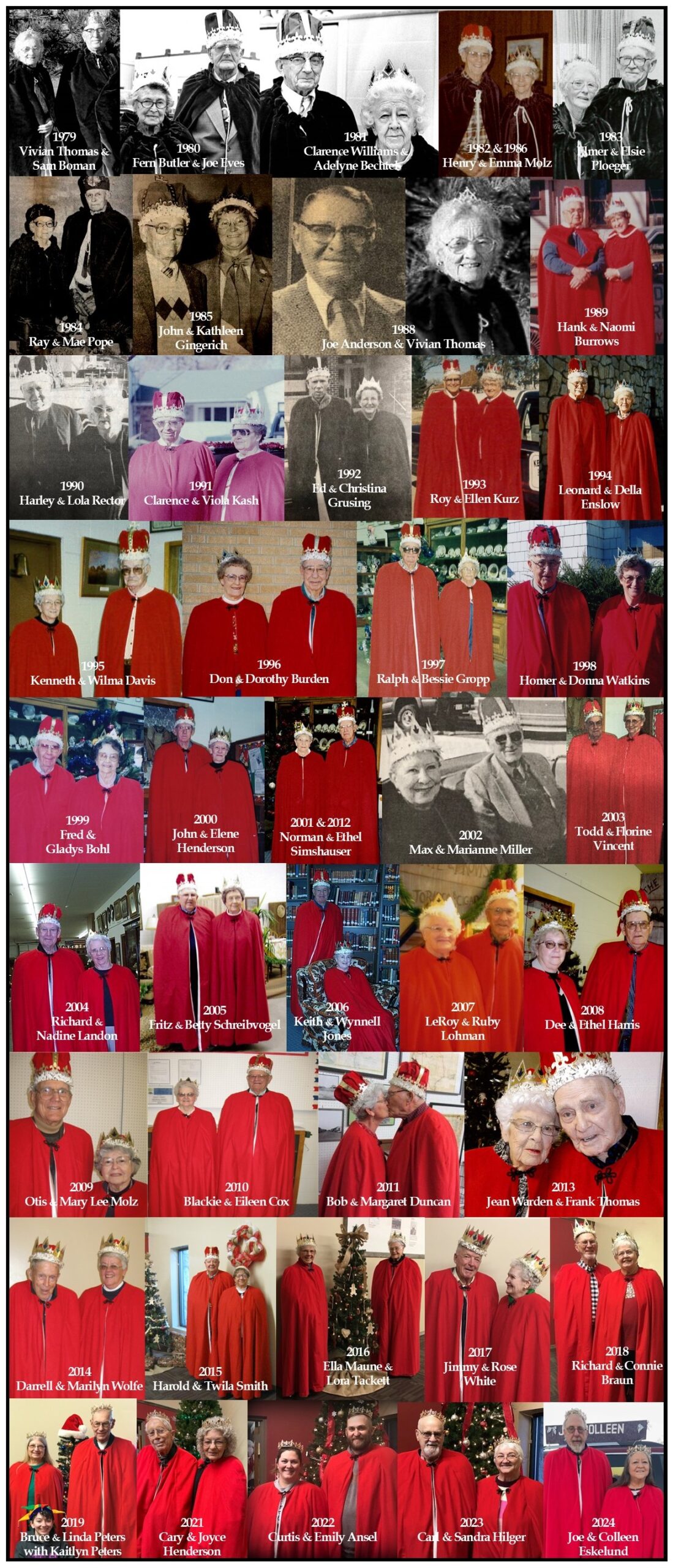
KCHS Royalty through the years
This Saturday, a Kearny County couple will be honored with the title of Kearny County Historical Society King and Queen and ride in a carriage of honor down Lakin’s Main Street during the Frances Bostrom Memorial Lighted Christmas Parade. This tradition dates back to 1979 when Sam Boman and Vivian Thomas were crowned as the first KCHS royalty. Vivian Thomas, Henry and Emma Molz, and Norman and Ethel Simshauser were all bestowed with the honor twice, and there were junior and senior princesses a few years. Instead of a royal pair in 1987, several city officials and past officials rode down Main Street in convertibles to kick off the start of Kearny County’s centennial, and there was no parade or royalty in 2020 due to Covid. Who will this year’s royal couple be? Come to the parade Saturday at 6 p.m. and see for yourself!!!