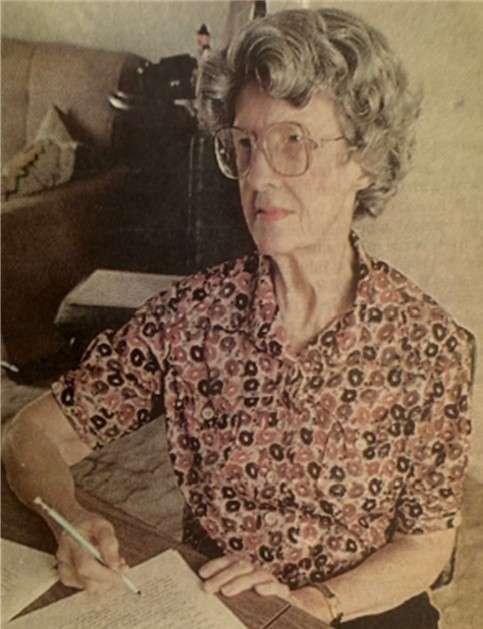
 Enola Vastine Feldman was a young child when her family moved to a farm northwest of Deerfield, Kansas in the 1920s. She read and re-read the magazines her family subscribed to, and her desire to write was awakened. Enola’s first published work was a poem in “Leghorn World” which yielded her a free 10-year subscription to the magazine. After graduating from Deerfield High School in 1930, she attended Ottawa University and earned a $10 gold piece for winning the short story contest for freshmen. Enola continued to write, and in 1942, she was named Kansas Poet Laureate by the American Poet Laureate Search Committee. Her poetry and short stories garnered her several awards from the Kansas Authors Club through the years. In 1988, Enola received the prestigious J. Donald Coffin Award for her first book, a historical novel entitled “Flame in the Wind.” She would go on to write two more fictional novels, “Long Shadow” and “Purple Rocks.” Enola passed away at her home in Garden City in 2000 at the age of 87. This poem, written by Enola, seems appropriate with our current season and with January 29th marking Kansas Day and our state’s 165th birthday.
Kansas Winter
When the mercury reaches zero and the autumn days are past
And you hear the coyotes yipp’ng like each cry would be their last . . .
And the baying of the hound-dogs so anxious for a run,
You’re scared they may break loose too soon and maybe spoil the fun . . .
Well, then is when a feller keeps a-grinning all the time,
For you feel as bright and husky as a newly-minted dime
As you jump astride Old Rocket … and his hoofs are beating fast
When the mercury reaches zero and the autumn days are past!
There’s something sort of bracing-like about the atmosphere
When the hazy autumn’s over and the days are cold and clear.
Of course, we miss the posies in the pasture and the trees
Are looking kind of barren-like without their rustling leaves,
But the air’s invigorating, and it makes your pulses thrill
At the sights and sounds that greet you from the top of Knobby Hill.
Sure, ‘twould make a startling picture, and I’d paint it if I dast
When the mercury reaches zero and the autumn days are past.
The soft-toned change of color from the blue to fluffy gray
Of clouds that roll up silent over stacks of winter hay . . .
The quiet falling snow flakes that soon cover all in sight
Keeps a feller sort of reverent-like from morning until night.
But when the wind starts howling from the north, you grin and say,
“How about a pair of skates and a lunch packed up today?”
Oh, it sets my heart to beating like a sail against a mast
When the mercury reaches zero and the autumn days are past.
The moon lays down a carpet from the world’s frozen edge
And bids the timid wood-folk leave the shelter of the hedge.
The lake has turned to platinum, smooth and granite-hard.
There’s diamonds in the treetops, and pearls in the yard,
And opals shine with moonstones in a wealth that can’t be spent.
Makes you feel as rich as Croesus if you haven’t got a cent!
Old Mother Nature really has the seasons all out-classed
When the mercury reaches zero and the autumn days are past.
Late at night you bring the buckets of the warm milk from the barns
And set around the kitchen popping corn and swapping yarns.
Your wheat has all been planted, and your women-folks are through
With their canning so there’s nothing but the quilting left to do . . .
I don’t know how to tell it, but if such a thing could be
As Saints a-wanting boarding and they called around on me,
I’d accommodate them proudly, from the first plumb to the last.
When the mercury reaches zero and the autumn days are past.