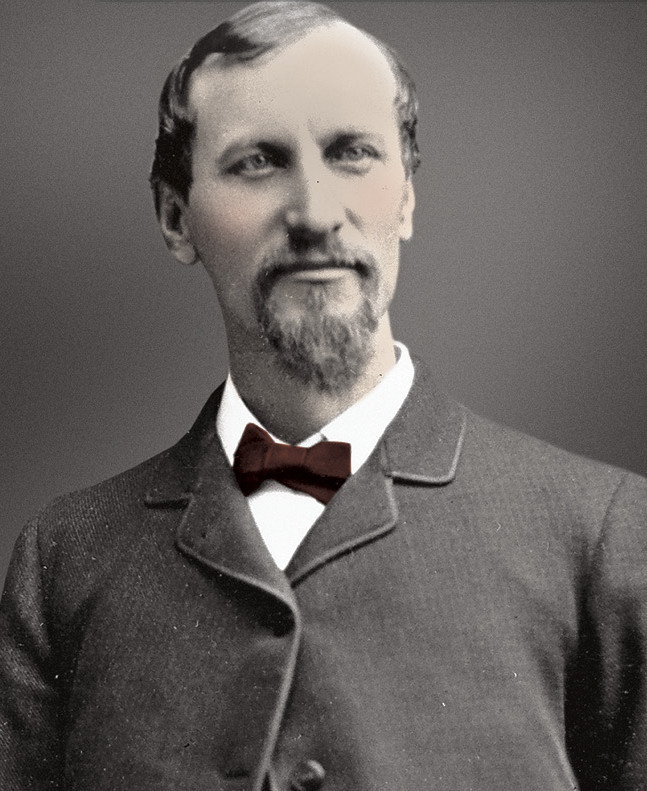
 Fred Harvey’s business ventures in Kearny County were not limited to Lakin’s two-story railroad dining hall. He also owned one of the largest ranches in the area. When Harvey learned a herd of 10,000 cattle had been put up for sale, he reached out to William Strong of the A,T & SF Railroad, and offered him the chance to be his partner in ranching. Soon, Harvey and Strong partnered up with another Santa Fe executive. Harvey spent $4,000 for his share with an option to purchase the rest, and the men established the XY Ranch about six miles east of Lakin. Headquarters were north of the tracks near Deerfield while the range sat south of the railroad. Eventually Harvey and his partners bought so much land that the XY range spread over 4,000 square miles, extending down through the Oklahoma Panhandle and into Texas. This made the XY almost as big as the state of Connecticut.
Major Falls was in charge of the ranch, but quite a number of hands were needed to operate the enterprise among whom was Samuel Harris Corbett. During the four years Corbett was employed, he traversed the Harvey range from Garden City west to Hartland, and the spring roundups brought him in contact with almost every hill and vale within a radius of 250 miles.
Another ranch hand was a young lad by the name of Eli Hall. Eli left Chicago at the age of 18 in 1882 to seek his fortune as a cowboy in the West. He promised his childhood sweetheart that he would return to Illinois in a few years and marry her. Eli quickly earned the nickname “Romeo” from the other cowboys while working for the XY. In the fall of 1885, the young cowpoke came down with the fever and was eventually taken to Deerfield’s railroad section house to receive medical care, but sadly Eli lived only a few more days. A casket was made from boxcar doors, and the young man’s body was interred on the hill on the south side of the Eastern ditch at Deerfield where he often sat upon his pony gazing over the broad expanse of prairie, river and sandhills. In 1886, a schoolhouse was built near his grave, and the grassed-over mound of Eli “Romeo” Hall’s final resting place was visible in the school yard for years to come.
Ranch life was dangerous but also exciting. The boys had to continually be on the lookout for hostile Indians and cattle rustlers. Those were the days of the open range before barbed wire fencing. During roundup time, there were often more than 200 cowboys roaming Harvey’s land looking for XY cattle or others that had strayed from nearby herds. At night, there would be huge campouts where cowboys would drink and share stories.
Each cowboy had a favorite pony which he dearly loved. One such horse was Gyp. Gyp was not only the favorite steed of his rider, Jim Mahoney, but of every cowboy who knew of the horse. Gyp was born, branded and raised on the XY and was said to have run in 100 races, winning every time. One night during a roundup, some horse traders camped with the cowboys. The traders had a racehorse that had been raking in the money, and they soon let it be known they wanted to arrange a race. The cowboys kept quiet about Gyp’s record, allowing the strangers to think Gyp would be easy prey. The strangers would not race for less than a $100 purse which sort of took the cowboys’ breath away at first as money was mighty scarce. Five dollars looked like a big stake at that time. The more the Missourians bragged, the more anxious the cowboys were to back up Gyp, and finally the money was made up.
The strangers wouldn’t let their horse run on the prairie; they insisted on going where there was a hard track. Mahoney finally agreed, and with the foreman’s consent, took Gyp to Lakin where there was a smooth hard stretch of the Santa Fe Trail reaching from the old depot eastward to the east ford of the Arkansas. Gyp‘s quick pace gave him the initial lead against the longer strides of his opponent, a glossy black horse by the name of Prince, but soon Gyp’s lead was shortened with every second. Mahoney felt desperate. While touching Gyp on his shoulder, he managed to strike with much more force than usual in a seemingly accidental way. At the same time, he spoke to Gyp in the loving voice he always used on the range, yet with a strong note of urgency, “Come Gyp. Do your best, old boy.” Gyp seemed electrified. He leaped forward, fairly spurning the ground with his swift, light hoof beats and exultingly reached the wire a full body length ahead of Prince amid shouting and rejoicing from spectators. Mahoney stood at his horse’s head patting him, and Gyp bent his knee and dropped his head for the audience like a little bow of acknowledgement.
Fred Harvey always stopped at the XY to check up on his cowboys and the livestock during eating house inspection trips. He loved the cattle business, and about 1882, Harvey took full ownership of the ranch. Even though he owned several thousand head of cattle, they did not provide Harvey easier access to meat for his restaurants. Since the West had few slaughterhouses and scant refrigeration, cattle were still shipped live on the railroad cars back to Chicago or Kansas City to be butchered.
An increasing number of settlers in southwest Kansas led Harvey to move the XY farther west in 1885. The May 30, 1885 Kearny County Advocate reported, “Major Falls, XY manager, of Granada, was on our streets Tuesday morning. The major has moved the XY ranch from Deerfield to Granada, Col., where they now have permanent quarters. Lakin will miss the boys very much.” Harvey’s Colorado operation expanded into raising dairy cattle and chickens for his eating houses, and with much of the acreage under irrigation, produce was grown for Harvey’s dining halls as well. Harvey’s ranch was one of the most successful in the valley.
Fred Harvey died in 1901, and that same year, The Pantagraph of Bloomington, Illinois reported that D.H. Bane and Owen Bassett, two wealthy Illinois capitalists, had purchased the XY for $250,000. The expansive acreage of choice Arkansas Valley land was to be broken up into 20 and 40-acre tracts. Decades later, a portion of the XY was used for the Granada Relocation Center (also known as Amache) during World War II.
The program for the Kearny County Historical Society Annual Meeting will be about Fred Harvey, his Harvey Houses, and the entrepreneur’s role in civilizing the West. Harvey will be portrayed by Steve Germes, and Steve’s wife, Suzanne, will take on the role of Alice Steele, Harvey’s head of personnel. This April 18th event promises to be entertaining and educational. If you haven’t placed your reservation yet, please do so by 3 p.m. April 9 by calling the Museum at 620-355-7448.
SOURCES: History of Kearny County Vol. I; Appetite for America by Stephen Fried; National Park Service; and Archives of the Kearny County Advocate, Lamar Register, Rocky Ford Enterprise, and The Pantagraph. Photo courtesy of the Kansas State Historical Society.