On the morning of June 25th, 1949, Garden City law enforcement discovered a blood-covered scene in the rest room at the Stevens Park bandshell. They were told that a person had been carried from there to a car and concluded that a scuffle had taken place; however, a check with area hospitals revealed that no fight victims had been treated. Then Garden City Police Chief Lee Richardson received a tip that a murder had been committed.
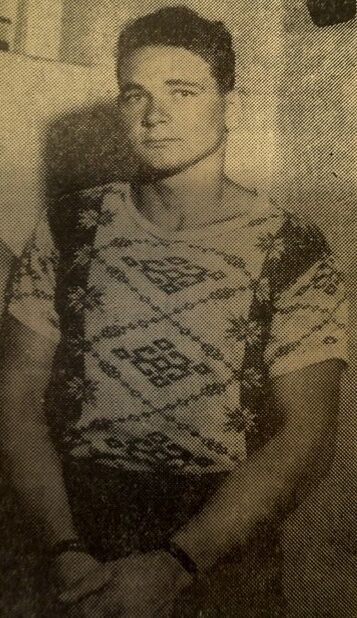
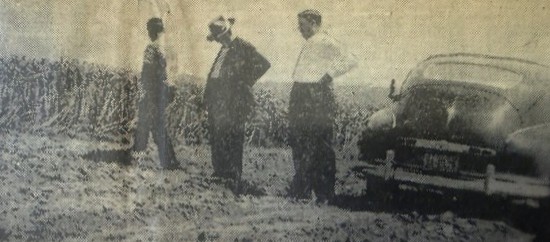
Officers questioned persons who had been in the vicinity of the bandshell the night of June 24, and this led to the July 2 arrest of 22-year-old William Stebens at the Garden City Experiment Station where he worked. William told law enforcement that his younger brother, Wilmer, had forced him to help bury 40-year-old John Walter Mooney, and then William took them to a site on the edge of a wheat field north of the Experiment Station to retrieve the body. Only freshly turned earth was found upon their arrival. The body was gone.
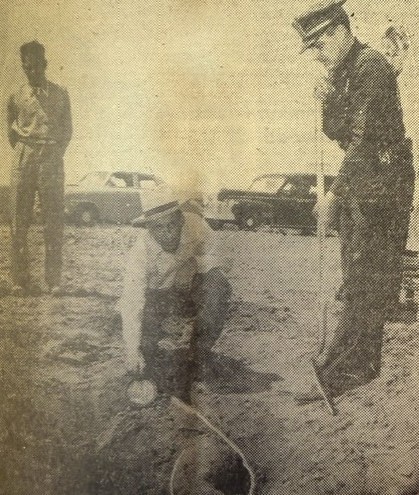
The following day, Wilmer Lee Stebens was apprehended at Lamar, Co. He told officers that he had reburied the body on the afternoon of June 26 because of his brother’s involvement with the first burial. Wilmer led authorities to the second grave, marked crudely with the lid of an empty can, in a summer fallow field 14 miles north and two miles east of Garden City. Officers probed the ground with two shovels and within a couple of minutes, they located Mooney buried only inches below the surface. The corpse was badly decomposed, and the left arm had been severed apparently by a plow as the field had been plowed since the grave had been dug.
Wilmer was charged with second-degree murder and William with accessary after the fact. Neither of the Stebens brothers could post bond, and both were committed to the Finney County jail. While awaiting trial, Texas authorities arrived on the scene trying to link 20-year-old Wilmer to the murder of Tex Thornton in Amarillo on June 22. Although the out-of-work old field worker admitted to making a long trip through oil fields of Kansas, Oklahoma and Texas to find work, Wilmer said he could produce witnesses to prove that he was not in Amarillo at the time of Thornton’s murder. That investigation into Wilmer “fizzled” out according to newspaper reports.
The Mooney murder charges, however, stuck. According to Wilmer, he and some other men had had a few beers at a tavern north of Stevens Park on June 24, and they bought a beer for Mooney, a 40-year-old transient farm worker from North Carolina. Mooney said he had hid a bottle in a bush at the park so they went to the park to look for it. Unable to locate the bottle, Mooney and Wilmer went to the bandshell where Mooney reportedly pulled a knife on Stebens and threatened to sexually assault him.
Stebens told officers he hit Mooney with his fist and knocked him down the stairs into the women’s rest room. When Mooney rose, Stebens hit him again and seized his knife, throwing it as far as he could. Stebens said he thought that Mooney was only stunned so he left the bandshell, but then he returned an hour later and found Mooney’s cold body. Stebens panicked and forced his brother William to help bury Mooney.
Stebens’ mother told authorities that Wilmer told her he held Mooney’s head under water in the band shell toilet for 45 minutes and tried repeatedly to crush his skull against the concrete floor of the restroom. Charges were changed to first-degree murder as the investigation “gave reason to believe that robbery was the main motive.” Wilmer was found guilty and sentenced to life imprisonment. Charges against William were dropped in exchange for testifying against his brother.
Wilmer was taken to the state penitentiary, but in the fall 1950, he was transferred to the Larned State Hospital to be treated for a hyperthyroid condition. On November 4, he and another inmate jumped a guard and escaped then stole a car. They were picked up near Inverness, Fla., a week later after a nation-wide manhunt, and Wilmer was returned to the state pen in Lansing.
In September of 1951, papers reported that Stebens had confessed to the slaying of George Seahorn who was found deceased in his car near Lakin in March of 1948 with a wound in his left leg. At the time, no foul play was suspected, and the Kearny County coroner ruled that Seahorn had probably died as a result of exposure. The 56-year-old Kearny County landowner had also reportedly been suffering with heart attacks. It was believed that Seahorn had used his leg to break out a window in his car which was found in a snow-filled ditch south of the tracks near the stockyards.
Stebens saw Seahorn’s unattended death as an opportunity and made up an elaborate story as to how the murder took place. Wilmer later admitted that he concocted the tale in order to be brought back to Southwest Kansas where two former prison buddies were going to help him escape the night before his hearing. Those buddies failed to show, and Stebens went on to plead innocent. Suspecting foul play on the day of his arraignment, security at the Kearny County court house was beefed up with peace officers from seven neighboring counties, the highway patrol and Lakin police. Wilmer was later subjected to a four-hour lie detector test which cleared him of the Seahorn murder charge, but that was not the end of Wilmer’s shenanigans.
In October of 1969, Stebens escaped from the Kansas penitentiary and abducted a female student at the Kansas Medical Center. The 21-year-old woman told police she had just parked her car when a man approached her, pulled a knife and told her to start driving. Stebens did not hurt the girl but forced her to drive to Clinton, Mo., and then back to Kansas City, Kans., where he released her. Wilmer was captured near Greensburg following a chase three days later. He was given an additional 20 years in prison for kidnapping.
According to newspaper articles, Wilmer Stebens was rated as one of the toughest young men ever to go to the state penitentiary. He was 73 years old when he died at Kansas City, MO, in December of 2002, having outlived his brother William, ex-wife and a daughter.
SOURCES: Ancestry.com and archives of the Lakin Independent, Hutchinson News, Garden City Telegram, Emporia Gazette, Jefferson City, MO Daily Capital News, Jefferson City, MO Post Tribune and Evening Eagle.