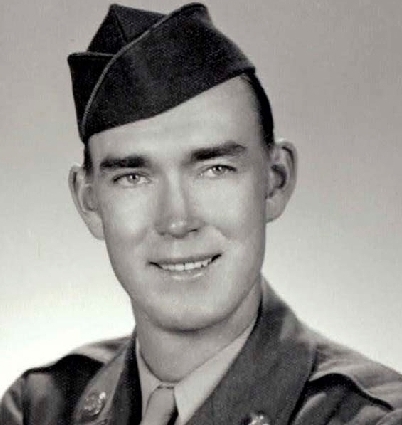
This December 7 will mark 85 years since the Japanese shocked the world with their surprise attack on the U.S. naval base at Pearl Harbor in O’ahu, Hawaii. A Kearny County soldier was there that day and lived to tell the tale of the horrific event. William “Big Bill” Simshauser was stationed at Bellows Field, and was on his way to breakfast when Japanese warplanes attacked his squadron of A-20 Boston Bombers.
“I saw overhead a low wing fighter plane with a red ball on the side of the fuselage. Then I heard a machine gun firing short bursts over the tent area, and the first thing that came to our minds was “get a gas mask the Japanese are attacking.”
Not able to obtain any gas masks, Bill ran to the operations building and into the armament shop. There, fellow soldier Al Gardner had acquired a 1906 Springfield rifle but no loose ammunition. Simshauser said he punched out bullets from a machine gun belt and handed them to Gardner who put them in the Springfield and fired at the oncoming Japanese aircraft which had lined up behind each other and were strafing a fuel truck directly across the road in front of the armament shop.
When the refueling truck caught fire, Bill told his cohort that they needed to get of there before the truck exploded. Simshauser crawled down the porch past the operations office, and as he rounded the corner of the building, behind a pile of rocks sat the air operations officer. “He said to me, ‘Son, get down here beside me and watch the show. There is nothing more you or I can do at the present time.’ That was a direct order as far as I was concerned.”
During the time that this was going on, Lt. George A. Whiteman was taking off in a P-40 fighter. Three of the Japanese fighter planes converged on Lt. Whiteman and shot his airplane down in flames at the end of the runway. After the Japanese aircraft left the area, Bill was given a 1903-06 Springfield rifle and assigned by his commander to guard the remains of Lt. Whiteman and his aircraft until medics arrived. He was then assigned as a guard truck driver and drove the sergeant of the guard around through the cane fields for the next three days. Bill remained in Hawaii until June of 1943 when he was moved to Ascension Island, a strategic lookout and defense point to protect the vital local Eastern Telegraph Company cable station from German warships and raiders.
Simshauser, the son of William James and Alma Carlile Simshauser, was born in Kearny County in October of 1921, and completed his schooling in Deerfield. He entered the Army Air Corps. on November 24, 1939 at Ft. Leavenworth and became a career military man. Subsequent to World War II, he served an overseas tour of duty in Japan. During the Korean Conflict, Simshauser was awarded the Bronze Star Medal for performing meritorious services as a technical inspector of aircraft maintenance by making frequent trips to forward airstrips to evaluate and supervise the maintenance of battle-damaged aircraft, working 12- to 16-hour days for many consecutive days. His duty assignments throughout his military service were primarily in the aircraft maintenance career field.
Master Sergeant William E. Simshauser retired on July 31, 1961. During his military career, he received the Bronze Star, Good Conduct Medal with Clasp with 5 Bronze Loops, Presidential Unit Citation with 2 Oak Leaf Clusters, American Defense Service Medal, American Campaign Medal, Asiatic-Pacific Campaign Medal with 2 Bronze Service Stars, European-African-Middle Eastern Campaign Medal with 1 Bronze Service Star, World War II Victory Medal, National Defense Service Medal, Korean Service Medal, Air Force Longevity Service Award with 4 Bronze Oak Leaf Clusters, Republic of Korea Presidential Unit Citation and United Nations Service Medal.
“Big Bill” died in 2013 at the age of 91 of apparent heart failure while at a North Las Vegas military surplus store where he was considered an inhouse expert on insignias and military items. He was survived by his wife and daughter, two granddaughters, a great grandson, a sister, and his brother, Norman Simshauser of Lakin who also served his country during World War II.
Because of the massive scale of the draft and voluntary enlistment during World War II, millions of American households saw two, three, or more brothers—and sometimes fathers and sons—serve simultaneously. Well-known instances captured national attention such as the case of the Sullivan family – five brothers from Iowa who tragically died together on the USS Juneau in 1942. Due to the risk of devastating family losses, the U.S. military eventually established the Sole Survivor Policy to protect the last remaining son of a family that had already lost members in combat.
SOURCES: History of Kearny County Vol. II; Las Vegas Review Journal; Information provided by the late William E. Simshauser, and Museum archives.