Mark your calendars! ![]()
![]()
![]()

Mark your calendars! ![]()
![]()
![]()

In August of 1950, an open house was held at the new Kearny County Hospital located at 305 Kansas Street in Lakin, but it would be several months before the doors were opened to patients. About 1947, local Jaycee President B.C. Nash began talking up the idea of building a community hospital. He had plans, estimates and letters suggesting ways of financing the project. According to Monte Canfield, publisher of the Lakin Independent, Nash kept pestering everyone in town with his idea until they finally took notice. âHe kept at it and finally got The Independent to launch a publicity drive which eventually culminated in a mass meeting to talk over the possibility of a Kearny county hospital.â
That meeting was held in February of 1948, and a large group of interested citizens took the ball from Nash and ran with it. They circulated petitions among registered voters, and the question of whether to issue $100,000 in bonds was placed on the ballot in November of 1948. The issue carried by a vote of more than four to one.
Soon after the bonds were voted, the county commissioners appointed a board of hospital trustees as provided by law to go ahead with plans to build a hospital. The board consisted of E.L. White, Madison Downing, Glenn Steward, J.R. Hutton and Canfield. When estimates were made, it was discovered the bond funds were insufficient, but county commissioners agreed to proceed and figure out how to come up with the necessary additional funds. These were raised in 1949, and construction began that October.
When the facility was finished in the summer of 1950, the hospital board was anxious to have as many people as possible see the inside of the new building. At the time, equipment was being ordered and hospital groups were being contacted with the hope that by the time the hospital began operations, a professional hospital organization would be secured to manage the facility. As funds were still needed to finance the furnishing of the rooms, donations were sought. More than $7,500 was received from individuals, business firms and organizations, and a small tax levy was made available which helped make it possible to finally get enough money together to equip the hospital as it should be. The facility featured the most modern equipment for caring for the ill. The technical equipment was the best that money could buy and plentiful while the patient rooms were cheerful. A contract was entered into with the Lutheran Hospital Association of Kearny County to operate the facility. The association was composed of members of the Immanuel Lutheran Church at Deerfield which elected a five-man hospital board. They worked without pay and often without recognition for the time and talent they contributed to the hospital.
An open house on January 11, 1952, gave everyone a chance to inspect the fully equipped facility before it began receiving patents the following week. According to Canfield, the fine institution was not just the work of a few but ârather the accomplishment of many. It took not only the members of the board, whose responsibility became the supervision of the actual building, but also the thousands of citizens of the county who voted to finance and build this hospital. Without their unqualified support there never would have been a Kearny County hospital.â Canfield called the feat âa dream of many years come true.â
The Lakin Chamber of Commerce and business firms announced that gifts totaling several hundred dollars would go to the first babies born in the new hospital and their parents. The first baby born there was Gary Neil Moreland of Deerfield, on February 5, 1952.
Nash was paid the recognition due him by being asked by the board of trustees to preside at the dedication program held January 20, 1952, in the Lakin Grade School auditorium. Nash gave a short history entitled, âBuilding A Hospital.â The impressive dedication ceremony included a concert by the Lakin High School and Lakin Grade School bands, musical numbers by the Lakin Quartette, and the recognition of members of the Lutheran Hospital Association board, hospital administrative staff, members of the hospital board of trustees and distinguished guests.
In April 1956, the hospital board received the first half of a Ford Foundation Grant of $10,000. That November, a bond issue of $115,000 to expand the facilities was overwhelmingly approved by voters. The Ford Foundation Grant Fund was used for equipment, and the approval of the bond issue meant that a much-needed addition and upgrades were made to the hospital including more bathrooms, patient rooms, a new nursesâ station, larger waiting room and kitchen, and much more.
In April of 1975, the Lutheran Hospital Association ended their 23-year lease and transferred the control and operation of the hospital to a county board of trustees. All assets owned by the association were given to the county. President of the Lutheran group, Otis Molz, pointed out that his association had felt for some time that the move should be made, and the proper time had come since Lakin had fine doctors and medical staff using the facilities and the occupancy rate was at a peak. Representing the new county board were Carl Bentrup, chairman; Ann Tate, Bob Glunt and Elmer Branine. Ted Morgan was the hospital board attorney, and Jerry Horton was named as new administrator. In January of that year, doctors J.R. Zimmerman and Jon S. Wheat had expressed interest in construction of new hospital facilities. The Kansas Street building was used as a hospital until 1978 when a new Kearny County Hospital was opened in the White addition.


SOURCES: Archives of the Lakin Independent, History of Kearny County Vols. I and II, and Museum archives.

Much has been written about the one-room school on the Museum grounds, but what about the man who gave the school its name? Willard Amos Miller, of Shelby, Ohio, came to Western Kansas in April of 1886. He filed on a quarter section of land in Kearny County on The Flats about 16 miles north of Lakin where he built a comfortable, cozy sod house. The two-room home was plastered inside and had a coat of white wash, and his older sister, Ida, sent him short curtains for the windows. The building was warm in winter and cool in summer. Beneath the house was a fruit cellar. Miller dug and cemented a cistern for drinking water, but water had to be hauled in barrels from his neighborsâ wells to replenish his supply. After building several cisterns for others on The Flats, he became known as âThe Cistern Man.â

In November of 1886, Miller went to Wellington to engage in the broom industry for part of his winterâs work. He returned to the broom industry several times during the slack winter seasons on The Flats. In January of 1887, his broom factory work yielded him $11 per week which he considered to be a fair wage as jobs were scarce. Willard later returned to his claim and broke the virgin sod with an ox team which he had named Tom and Jerry. He paid $160 for a wagon, plow, and the team of oxen which plowed at the rate of one to one and a quarter acre per day. Miller often plowed for his pioneering neighbors, breaking up acres of the beautiful, virgin buffalo grass.
Miller wrote in his personal notes, âImagine yourself in the center of a field which is nearly level and on which the grass is about two inches high with no fences to obstruct the view. You can look in all directions without trees or anything to hinder the view, and all around, the ground and sky seem to meet.â
One day he was plowing for a neighbor about three miles from his home. In the evening, Miller picketed the oxen close to where he had been plowing in a draw where there was good grass. âIt was dry and hard plowing, so I walked home to let the oxen have more rest. A good rain came up during the night and when I returned to the oxen the following morning, there Jerry and Tom were standing in water waist-deep.â It was too wet to do any plowing so Willard picketed the oxen so they could just reach the water and walked home again, returning the next day when plowing was ideal.
The rains were bountiful on The Flats in the summer of 1887 so he began to build a new home on the south side of his claim. Miller dug a basement and put in a wood floor and used shingle roofing. He made two comfortable rooms finished with regular doors and windows and plastered the inside. âIt was as comfortable a house as any we ever had.â He also dug a well and cemented the sides. âI think as Benjamin Franklin said, âA farmer is rich when he has a little farm well tilled, a little house well filled, and a wife well willed.â This statement was found in Willardâs notes and was written about eight months prior to him taking a wife.
Willard returned to Shelby and married Alice Malone on January 30, 1888. Both had been school teachers, and their romance started in a schoolroom where Professor Miller was the teacher and Alice, one of the older pupils. Aliceâs family prepared a big turkey dinner for their wedding feast. About a month later, they started for Kansas. It was a cold day when they arrived at Lakin. A neighbor had driven Willardâs team to the railroad station to pick up the bride and groom, and it took most of the day to take the couple to their new home on the prairie. âW.A. Miller escaped a heavy shiverre by bringing a blizzard along with his bride,â was one of the tidbits in the âOanica Jottingsâ section of the Kearny County Advocate on March 18, 1888.


In addition to farming, Willard returned to teaching in order to make financial gains. Willard and Aliceâs first child, Florence Miller Strauss, was born in April 1889 when her father was teaching at the Holloway School one mile north of their sod home. The Millers had an agreement that Alice was to place a white cloth on a pole in view of the school house if she thought the stork was coming. About 11 a.m., the expectant mother placed the white cloth, but Willard did not see Aliceâs signal as it was a quiet day and there was no breeze to make the flag wave. As Willard came home from school, his bride was in the yard waving to him. He thought all was well so he took his time. When he arrived home, he found out otherwise and immediately got busy. He rode his pony to the Loyâs home about ž a mile away to have Mrs. Loy fetch the midwife; however, the stork arrived before the midwife could be retrieved. The young school master delivered his firstborn, severed the umbilical cord, and all went well. He had gained his knowledge about delivering babies from a book. The midwife, Septha Fulmer, offered to stay two weeks and assist with the new baby as she and her husband greatly needed feed for their stock. âSepâ was given fodder in exchange for her services. Alice hand sewed all the baby clothes, but they were too small, like doll clothes. âSepâ ripped them all out and remade them for her.
When a new school building was built on The Flats in 1893, Willard suggested that the school be named Columbian in recognition of the Columbian Exposition, the worldâs fair held in Chicago that year. Miller was the first teacher in the new school, and patrons overwhelmingly approved his suggestion.
Willard not only taught in several of the one-room school houses in Kearny County but helped organize the school system here. He and Alice also organized a number of churches and Sunday schools. In 1896, The Advocate reported that the family had been taken with the eastern fever and left for Franklin County, Kansas. In 1909 at Thayer, they purchased property that had previously belonged to Kansasâs eighth Governor, John Pierce St. John. But the Millers were attached to Western Kansas and were back by 1914, making their home in Finney County where they lived out the remainder of their years. Willard Amos Miller died in 1940 at the age of 77, and his bride died in 1959 at the age of 88. In addition to daughter Florence, the couple had five more children: Lucy Miller Englund, Carl Miller, Pearl Miller Dell, Ralph Miller and Willard B. Miller. Several generations of Willard and Aliceâs family have made Kearny County their home, and many descendants followed in their footsteps by entering into agriculture and/or education. All but one of Willard and Aliceâs children became teachers with Florence and Ralph teaching at both Columbia School and in the Deerfield schools like their father had.

SOURCES: Information and pictures provided by the late Florence Miller Strauss and donated to Kearny County Museum by the late Max and Marianne Miller; and archives of The Garden City Daily Telegram, Kearny County Advocate, Thayer News and Garden City Herald.

Whether remembered as the Red Crown CafĂŠ, Mouse House, Haroldâs Hideaway, or Bennyâs Grill, plenty of delicious, comforting meals were served in the building that sat at 110 E. Santa Fe Trail Blvd. in Lakin. The property was demolished in November 2017 to make room for the Caseyâs General Store. The Teeter Irrigation building to the west, originally a Standard Service Station, was also torn down.
The Standard Service Station was built in 1952 by F. W. Stewart. In 1956, Stewart added on to the east side of the building to house the Red Crown CafĂŠ. That cafĂŠ was first leased by Mrs. B.A. Jefferson, followed by Datha Bushek, then Mrs. George Homm. In October of 1958, Bertha Johnson took over management of the Red Crown. Bertha and her sister, Emma Musgrove, were well known for their good food and friendly service as they had been successfully running the â66â CafĂŠ. Em continued to manage the â66â CafĂŠ, but it wasnât long before the duo were working under the same roof again. In 1961, Bert and Em moved out of the Standard station and into the new Red Crown CafĂŠ building which sat just to the east and was also built by Stewart. Over 100 happy customers could be seated at a time, and a party room on the east side of the building could accommodate 35 diners in a private dining area. The new cafĂŠ gave Lakin a large modern restaurant to take care of locals and tourists.
Stewart eventually sold the building to Clair and Golda West and Lee and Betty West who took over in October of 1964. Although the name stayed the same, the cafĂŠ would change managers many times. Besides Lee and Betty, some of the other managers were Ruby Rexroat, Mr. and Mrs. Bob Williams, and Mr. and Mrs. Jack Reynolds. When Larry Crane bought out the Wests in October 1975, he also kept the Red Crown name.
Lester and Janelle Mouse then purchased the business in 1977, and the Mouse House was born. One of the popular specials in 1978 was a rib eye steak dinner which sold for just $3.50. Not only were the Mouses known for having excellent food, but they also had some of the prettiest help in town ⌠their four daughters: Melissa, Steph, Stacey and Heather. The venture was highly successful but hard work. According to their daughter Stacey Geubelle, Lester was concerned with the toll that the workload was taking on his wife so he sold the business to Harold and Rita Waechter in December 1980.
The Waechters continued to run the restaurant under the same name but would remodel and add on to the building. In June of 1983, they asked the public to help them name their new supper club located in the back of the building. The name, Haroldâs Hideaway, was submitted by Jo Vanatta. Live dance bands, such as Johnny Mason and The Night Stealers, played on weekends at the club. Eventually the Mouse House name was dropped, and the entire building became known as Haroldâs Hideaway.
The next business there was Annie Bâs Country Kitchen, moving from its original location in the old Dairy King at 303 W. Santa Fe Trail Blvd. Operated by Dennis and Jo Branine, Annie Bâs opened in January 1993. That December, Annie Bâs announced the opening of The Club for fine meals and drinks. Next came The Finish Line which was opened in February 1995 by Kenny and Gwen Waechter. That spring they moved their other business, The Locker Room, from the Nash Building into the club. Guests could enjoy pizza and a cold one while watching football or playing pool.
In February 2001, Bob and Edith Majors bought the building from Harold and Rita Waechter. Bob had been given the nickname âFrankâ by his golfing buddies for being so forthright; thus, the restaurant was named Frankâs Supper Club. It was managed by Deanna Hunter, Majorsâ daughter. In 2009, Andres Lozano purchased the property on contract, and Bennyâs was opened. Bennyâs Mexican fare was a favorite among locals, but the restaurant also served American food. Bennyâs was the last eatery in the building.
When the restaurant was torn down, many former employees and customers shared their memories on Facebook, and some expressed sincere sadness over the buildingâs demise. There were a lot of good memories made there from families eating out, church goers enjoying doughnuts after a Sunday service, employees who bonded like family, couples taking a spin around the dance floor, and good friends sharing conversation over a cup of joe.


SOURCES: Museum and Lakin Independent archives with special thanks to Sandy Lane, Bob Majors, Stacey Geubelle and Missy Gerritzen, Kearny Co. Register of Deeds.
As promised, this week we are sharing with you some of the photos taken at the 66 Cafe which was located on the southeast corner of HWY 50 and Campbell Street in Lakin. The 66 had several managers over the years, but these photos of employees and customers were taken when the cafe was being ran by sisters Bertha Walker Johnson and Emma Walker Musgrove. We think they are wonderful pictures from a bygone era and hope you feel the same.
Please consider sharing with the historical society any pictures you may have of old businesses, buildings and even people of Kearny County. We always think that a story is more entertaining when there is a picture to go along with it, and we definitely could use more photos. For instance, we have no photographs of the Dairy King and only one of the Rainbow King skating rink. Birthday party pictures are wonderful, and exterior pictures are also very much appreciated! We wonât keep your photos but will make digital copies for Museum files. Photos can also be e-mailed to us at KCHSMuseum@outlook.com.


Those Walker sisters sure knew how to cook! Bertha Walker Johnson and Emma Walker Musgrove were restaurateurs for many years in Lakin, and the sisterly duo became well known for their excellent food and friendly service.
Bertha and Emma were the daughters of Jesse and Mamie Walker. Bertha, the oldest of the 11 Walker children, was born in 1909 in Tennessee where her parents farmed tobacco. The family moved to Virginia in 1911 and then to Kentucky where Emma was born in 1920. In 1921, the Walker family moved to Kansas, coming to Kearny County in 1927. According to the History of Kearny County, the family settled south of Lakin midway through the sandhills on Bear Creek on the SW quarter of 36-25-37. They eventually moved, living both in Hartland and Lakin where most of the children attended school.
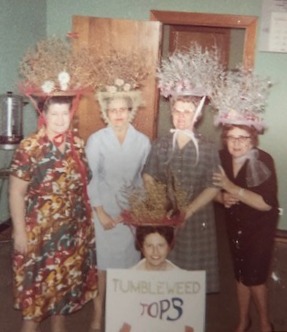
Bertha married in 1924, and Emma in 1945. Their lives would take them in different directions. Berthaâs husband, Paul, was a mechanic, and the couple operated filling stations and garages while living in Missouri and in Texas. In 1929, the Johnsons moved back to Kansas, and in 1934, Bertha and her only child, Don, moved in with her parents. It was at this point in time that Berthaâs career in the food industry began. She went to work at the Tumbleweed CafĂŠ on East Highway 50. This cafĂŠ was located where Lakin Automotive now stands. Bertha later left for Omaha, Neb. to attend beauty school. Deciding that was not her calling, she returned to Lakin and went back to work at the Tumbleweed. It was the Dirty 30s, and those were hard years. Bertha recalled, âif we served 12 meals, we had had a good day.â
In the late 30s, Bertha went to Great Bend where she worked in a hotel coffee shop. From there, she went to California where she managed the soda fountain and lunch room in a Rexall Drugstore at Pasadena. In September of 1953, Bertha and Emmaâs father was struck by an automobile as he crossed the street to his home a block south of the Lakin depot. Mr. Walker was taken to the Kearny County hospital for treatment but died a few days later. Mrs. Walker went to California to live with Bertha but was very unhappy and homesick. Bertha brought her mother back to Lakin and stayed.
In 1954, Bertha purchased the restaurant equipment of Everett Wagoner and opened shop in the 66 Cafe. This business was in the west side of the Phillips 66 building on US 50 which sat where Valley Tire is now located. Emmaâs husband, Frank, was in the oilfield industry. Because of his job, the Musgroves had lived various places including Oklahoma and Kansas, but in 1957, Emma joined her older sister in the restaurant business at Lakin. Emâs daughter, Sandy, with her smiling face and genuine enthusiasm was a regular fixture in the cafes.
In October of 1958, Bertha took over management of the Red Crown which was located in the service station that once sat on the corner where Caseyâs is now located. Em continued to manage the â66â CafĂŠ, but it wasnât long before the sisters were working under the same roof again. In 1961, Bert and Em moved out of the Standard station and into the new and spacious Red Crown CafĂŠ building just a stoneâs throw away to the east. At their grand opening on March 28, 1961, Bert and Em served up chicken pot pie dinners for only 65 cents.
Frank Stewart owned the Red Crown building, and eventually offered to sell it to the sisters, but Bert and Em needed time to mull it over. Stewart ending up selling the building to someone else. The Walker Sisters made the move to Main Street in 1964 where they operated the Downtown CafĂŠ at 119 S. Main until 1975.
That wasnât the end of the sistersâ cooking days though. They were both members of the First Baptist Church and Golden Agers where their tasty vittles were enjoyed at many a covered dish dinner. But their talents extended beyond the kitchen. Emma was a gifted painter, and two of her paintings now belong to the Kearny County Historical Society. Bertha was an expert quilter and a member of the Senior Centerâs quilting group for many years. Her handiwork graced many quilts, and this writer considers herself fortunate to have been gifted some of Berthaâs work.
Emma Walker Musgrove died at Lakin unexpectedly on June 10, 1984, of an apparent heart attack, and Bertha Walker Johnson passed away April 7, 2000, at the High Plains Retirement Village. The Walker sisters left an undeniable mark on their community. The museum was gifted a wonderful collection of black and white photos, most of them taken inside the 66 CafĂŠ when Bert and Em were running the business. Next week, in lieu of an article, we will be sharing with you several of those photos which contain some familiar faces.


SOURCES: Digginâ Up Bones by Betty Barnes; History of Kearny County Vol. I; Kearny Senior Center Newsletter November 1982; Ancestry.com; archives of The Lakin Independent; and Museum archives.
After Lakin won back the county seat from Hartland, not only did several Hartland residents move here, but several Hartland buildings were moved to Lakin as well. In November of 1894, the Kearny County Advocate reported that Captain J.H. Leeman had contracted with carpenters J.B. Harbolt & Adam Heiland to disassemble one of the businesses houses at Hartland and rebuild it for a hotel on two lots on the west corner of South Main Street and Railroad Avenue in Lakin. Leeman had previously been the proprietor of the Buffalo House at Hartland, but that hotel burned down in November of 1893, and Leeman was eager to get back into the hospitality business. The contractors pushed work on Leemanâs new hotel, and the Lakin House was opened that Christmas when Leeman treated a group of 25 to a turkey dinner. The Lakin House was advertised as one of the âmost home-like and commodious Hotels in Western Kansas.â With the depot only a short distance away, the hotelâs location was perfect.

The Lakin House underwent changes in management several times and even housed the Kearny County Courthouse from 1895 to 1899. Then, in November 1901, James (Jim) Gibson purchased the property. Later that same month, Gibson also took a wife when he married Mary Ellen Nash, the eldest daughter of John and Mary Ann Nash. The English-born Gibson, a resident of Kearny County since 1894, was congenial and favorably known about town, and his new wife was quite the cook.

Jim Gibson thoroughly renovated the Lakin House. The enterprise was advertised as having the best food and prompt service with new carpets, furniture, bedding and âeverything that goes to make its patrons a comfortable home.â In 1905, Gibson added a laundry room, and in April 1906, he changed the name of his enterprise to the Gibson House. Later that year, work began on a two-story concrete block addition to the north of the wooden structures. This addition opened in early 1907 and added âsome ten rooms on the second floor for the accommodation of the traveling publicâ with the lower floor holding a billiard room and reading room. The culinary department of the hotel was located in a rear room, and there was even a barber shop in connection with the hotel.


The Gibson was a popular resort for commercial travelers, and game dinners (when in season) were one of the Gibsonâs special features. Jim was an ardent sportsman and usually attended to killing the game himself. The Gibson was also frequented by big land companies who liked to bring their eastern patrons there to be fed. âThe Gibson House always fills the bill. The land agent knows what a good dinner will do for a prospective buyer and if he can work him through one of Lady Gibsonâs meals just before showing him a fine quarter, he is sure of a sale,â The Advocate claimed in a January 1911 issue. âEverybody who comes to Lakin will remember the meals and tell easterners of the way they were served in that town of Lakin.â
According to The Advocate, James Gibson never tired of making improvements in and around his popular house. In 1907, The Investigator reported that Gibson was going to sink a soft water well, âand in case of fire his facilities for subduing the flames will be of the best.â At that time, the Gibson House advertised as the only modern equipped hotel in Kearny County with steam heat and soft water.

At least three fires occurred at the Gibson. In October of 1903, Mrs. Gibsonâs hands were severely burned when she grabbed a lamp that had caught fire and exploded as she threw it outside. She was heralded for her quick action which was believed to have saved the hotel and possibly the town. In March of 1908, a small fire burned a hole through the roof of the Gibson. Then, on the evening of Saturday, September 27, 1913, Lakinâs fire bell rang out alerting residents that the Gibson House was ablaze. Lakinâs fire department responded promptly, and in a few minutes, citizens from all parts of town were helping fight the flames. All but one of the hotel guests were two blocks away attending a performance at Snowâs Opera House. When the alarm sounded, everyone left the opera house, including the actors, to help fight the fire and save what furniture they could. Still, in a very short time, the wooden frame part of the Gibson House was reduced to ashes, and the cement building was left a total wreck. For a while, it looked as if the Eyman store next door would also burn, but the fire department saved it. However, all the stock and fixtures were carried out into the street.
Almost all of the furniture that was on the hotelâs ground floor was saved, but everything in the upper rooms burned. The only clothing that Jim and Mary Ellen saved was what they were wearing. Pool tables, chairs, tables, dishes, and other assorted items were strewn from the depot to the Kearny County Bank on the opposite end of the block. According to the papers, a big rain which had preceded the fire Friday night and into Saturday, along with calm winds, was all that kept Lakinâs Main street from going down in flames. The origin of the fire was unknown, but the supposition was that it started from the explosion of a kerosene lamp.
On October 24, 1913, the Advocate reported that Gibson was repairing the cement block building, and in November, the paper reported that H.H. Tipton had purchased the property. Gibson re-opened his billiard and pool room in another location, but the following June, he and his wife moved to Lamar, Colo. where they reportedly had secured a billiard hall, barber shop and home. Â As for the old Gibson building, the structure still stands at 119 South Main. It has had a myriad of proprietors and businesses pass through it over the years, including hotels, eateries, and bars/recreation rooms. While many may recognize it as the former location of CJâs Pawn Shop, long-time residents will remember it best as the Downtown CafĂŠ. The building is currently owned by Kelly Ramos and undergoing repairs and renovations.
SOURCES: âDigginâ Up Bonesâ by Betty Barnes; History of Kearny County Vols. I & II; archives of The Advocate, Investigator, Hartland Herald, Hartland Times, Dodge City Globe, Hutchinson News and Topeka Capital-Journal; and Museum archives.
Nearly 37 years as the areaâs wildlife officer provided Bruce Peters with more than a few tales. Lakin was quite a change for Peters when he came here in October of 1966 to work for the Kansas Forestry, Fish and Game Commission. After nine months as a security guard at the State Office Building in Topeka, Bruce found that he really liked the open spaces, the Arkansas River and the sand hills. Lake McKinney was like a wonderful jewel. With roughly 3,000 surface acres of water, the lake provided a winter home for some 250,000 to 300,000 ducks, a few geese and sandhill cranes. Peters worked with the U.S. Fish and Wildlife Service his first three winters to band at least 1,000 mallards. He said that it was cold hard work, but getting to handle so many ducks was âquite neat.â
One of Bruceâs more amusing stories was about a group of fishermen who had come to fish for channel cat in Ray Popeâs pay-fishing ponds southwest of Deerfield. The men arrived shortly after lunch, and the fish were really biting. Soon the men had a nice string of catfish, more than they had planned to buy. They paid Ray and prepared to return to Garden City, but on the way to Deerfield, they realized what time it was and how much time that they still had to fish. So they made their way to Lake McKinney, put their strings of fish in the lake, and started fishing again.
âI was checking fishermen along the dam when I encountered them,â Bruce said. âThey couldnât wait to show me their catfish. I soon realized that they had an over limit of nice channel catfish. I asked to see their fishing licenses and then asked them about the fish. They tried to keep straight faces, but I soon tumbled that something was going on. They finally broke out in laughter and showed me their bill of sale Ray had given them.â
When department biologists wanted to release wild turkeys, they contacted Bruce, and he thought the river bottoms in Hamilton and Kearny counties would be ideal. He was invited to help set up drop nets in the Liberal area too. âWe soon had limited numbers of turkeys in these counties. They did well for several years.â
When Peters came here, Southwest Kansas was the pheasant capital of Kansas, and a motel room was nearly impossible to find in early November on opening weekend. âWe were at that time an area that hunted mainly small game so most everyone went out to hunt on the opening day. We had bob white quail and blue quail, and prairie chicks were found in the edge of sand hills.â
Four-hour NRA Hunter Safety Classes were held, and local sportsmen needed these classes if they hunted in Colorado. In 1973, hunter safety became mandatory in Kansas for hunters born after July 1, 1957. Peters taught hunter education to multiple generations.
About 1979, the forestry part was dropped, and the fish and game commission was combined with Kansas Park Authority to become the Kansas Department of Wildlife and Parks. Bruce said this was a trying time for many officers as they were then cross-trained as police officers to work in the state parks. âI loved wildlife law enforcement but didnât care for the park shifts and being a police officer.â This practice was eventually discontinued so that wildlife officers and park officers are separate entities.
In 1982, Bruce was honored as the Spikar-Safari Club International Wildlife Officer of the Year for the State of Kansas. He had been recommended for the award for his work in getting the Beymer Park Water Recreation Area developed.
Bruce noticed that hunter numbers began to decline around 1980. He said many sportsmen âjust put their shotguns awayâ and those who did hunt moved away from hunting small game to hunting deer. He attributed the changes to more restrictions and less water fowl. âIt was no longer considered really âInâ to be a hunter.â
Around 1990, the Greater Canada Geese project was started, and many nesting boxes were placed near water areas. Eventually several thousand geese wintered in the Lake McKinney area. In the fall of 1995, Bruce was allowed a collection permit to shoot Sand Hill Cranes and collected 33 of them. These birds were used to secure data that would later help Kansas establish a Sand Hill Crane Season. Going into 2000, the area was in a drought. Wildlife numbers were down, and Beymer Park was the only public water in Petersâ coverage area that still had fish.
Bruce retired from his duties with the Kansas Department of Wildlife and Parks in June 2003. During his tenure, some unusual wildlife visited the area including a moose that spent some time in Grant County and an alligator at the Ulysses Golf Course. The gator was taken to several schools before Bruce took it to the Great Bend Zoo. A small black bear moved through southwest Kansas one summer, coming into the state near Elkhart, moving northeast to just north of Ulysses. Bruce tracked the bear which was spotted along HWY 25 nine miles south of Lakin and seen 10 miles north of town a few days later. The bear moved further north toward Leoti where it turned west and was last sited in Kiowa County, Colorado. Bruce even trapped a Golden Eagle south of Syracuse that had killed several small piglets, and he took the eagle to Lee Richardson Zoo where it lived for several years before being released back into the wild. Peters relocated several species, including over 400 skunks, and he showed many of the different wild animals that he picked up. âIf I was at a cafĂŠ or quick shop with a bunch of people around the truck, I probably had some critter for everyone to look at.â


This article was gleamed from a collection of stories that Bruce Peters wrote in the early 2000s for The Lakin Independent and Kearny County Historical Society. Bruce was a KCHS member, and his wife, Linda, has served as an officer for many years and currently serves as president of the organization. After Bruceâs recent passing on July 19, a memorial was established in his name at the Kearny County Museum.