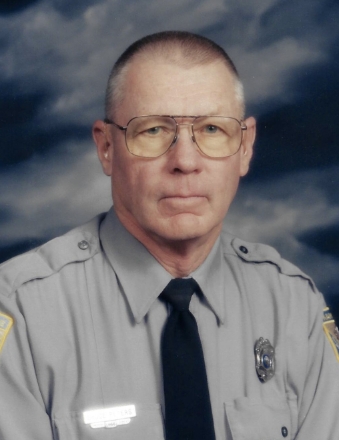
 Nearly 37 years as the area’s wildlife officer provided Bruce Peters with more than a few tales. Lakin was quite a change for Peters when he came here in October of 1966 to work for the Kansas Forestry, Fish and Game Commission. After nine months as a security guard at the State Office Building in Topeka, Bruce found that he really liked the open spaces, the Arkansas River and the sand hills. Lake McKinney was like a wonderful jewel. With roughly 3,000 surface acres of water, the lake provided a winter home for some 250,000 to 300,000 ducks, a few geese and sandhill cranes. Peters worked with the U.S. Fish and Wildlife Service his first three winters to band at least 1,000 mallards. He said that it was cold hard work, but getting to handle so many ducks was “quite neat.”
One of Bruce’s more amusing stories was about a group of fishermen who had come to fish for channel cat in Ray Pope’s pay-fishing ponds southwest of Deerfield. The men arrived shortly after lunch, and the fish were really biting. Soon the men had a nice string of catfish, more than they had planned to buy. They paid Ray and prepared to return to Garden City, but on the way to Deerfield, they realized what time it was and how much time that they still had to fish. So they made their way to Lake McKinney, put their strings of fish in the lake, and started fishing again.
“I was checking fishermen along the dam when I encountered them,” Bruce said. “They couldn’t wait to show me their catfish. I soon realized that they had an over limit of nice channel catfish. I asked to see their fishing licenses and then asked them about the fish. They tried to keep straight faces, but I soon tumbled that something was going on. They finally broke out in laughter and showed me their bill of sale Ray had given them.”
When department biologists wanted to release wild turkeys, they contacted Bruce, and he thought the river bottoms in Hamilton and Kearny counties would be ideal. He was invited to help set up drop nets in the Liberal area too. “We soon had limited numbers of turkeys in these counties. They did well for several years.”
When Peters came here, Southwest Kansas was the pheasant capital of Kansas, and a motel room was nearly impossible to find in early November on opening weekend. “We were at that time an area that hunted mainly small game so most everyone went out to hunt on the opening day. We had bob white quail and blue quail, and prairie chicks were found in the edge of sand hills.”
Four-hour NRA Hunter Safety Classes were held, and local sportsmen needed these classes if they hunted in Colorado. In 1973, hunter safety became mandatory in Kansas for hunters born after July 1, 1957. Peters taught hunter education to multiple generations.
About 1979, the forestry part was dropped, and the fish and game commission was combined with Kansas Park Authority to become the Kansas Department of Wildlife and Parks. Bruce said this was a trying time for many officers as they were then cross-trained as police officers to work in the state parks. “I loved wildlife law enforcement but didn’t care for the park shifts and being a police officer.” This practice was eventually discontinued so that wildlife officers and park officers are separate entities.
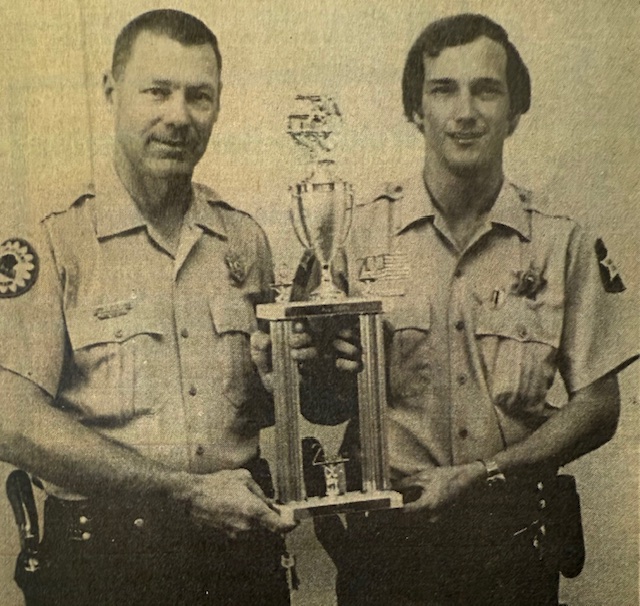
In 1982, Bruce was honored as the Spikar-Safari Club International Wildlife Officer of the Year for the State of Kansas. He had been recommended for the award for his work in getting the Beymer Park Water Recreation Area developed.
Bruce noticed that hunter numbers began to decline around 1980. He said many sportsmen “just put their shotguns away” and those who did hunt moved away from hunting small game to hunting deer. He attributed the changes to more restrictions and less water fowl. “It was no longer considered really “In” to be a hunter.”
Around 1990, the Greater Canada Geese project was started, and many nesting boxes were placed near water areas. Eventually several thousand geese wintered in the Lake McKinney area. In the fall of 1995, Bruce was allowed a collection permit to shoot Sand Hill Cranes and collected 33 of them. These birds were used to secure data that would later help Kansas establish a Sand Hill Crane Season. Going into 2000, the area was in a drought. Wildlife numbers were down, and Beymer Park was the only public water in Peters’ coverage area that still had fish.
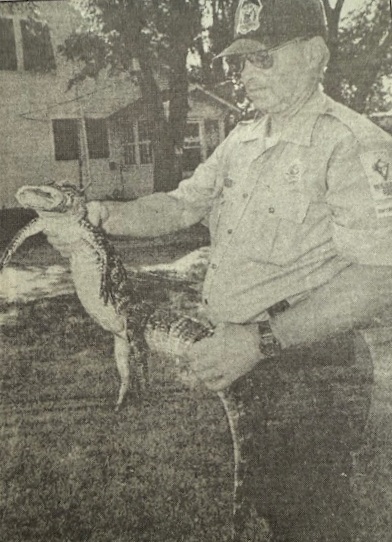
Bruce retired from his duties with the Kansas Department of Wildlife and Parks in June 2003. During his tenure, some unusual wildlife visited the area including a moose that spent some time in Grant County and an alligator at the Ulysses Golf Course. The gator was taken to several schools before Bruce took it to the Great Bend Zoo. A small black bear moved through southwest Kansas one summer, coming into the state near Elkhart, moving northeast to just north of Ulysses. Bruce tracked the bear which was spotted along HWY 25 nine miles south of Lakin and seen 10 miles north of town a few days later. The bear moved further north toward Leoti where it turned west and was last sited in Kiowa County, Colorado. Bruce even trapped a Golden Eagle south of Syracuse that had killed several small piglets, and he took the eagle to Lee Richardson Zoo where it lived for several years before being released back into the wild. Peters relocated several species, including over 400 skunks, and he showed many of the different wild animals that he picked up. “If I was at a café or quick shop with a bunch of people around the truck, I probably had some critter for everyone to look at.”
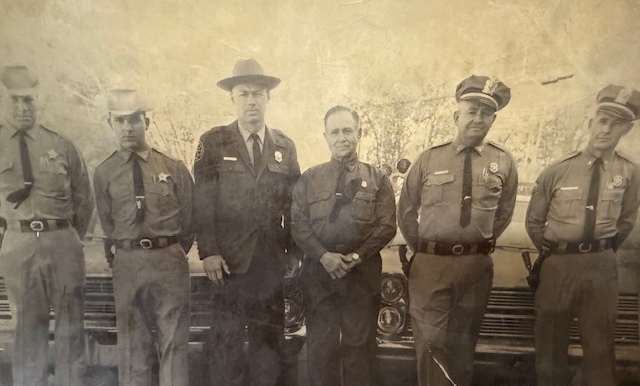
This article was gleamed from a collection of stories that Bruce Peters wrote in the early 2000s for The Lakin Independent and Kearny County Historical Society. Bruce was a KCHS member, and his wife, Linda, has served as an officer for many years and currently serves as president of the organization. After Bruce’s recent passing on July 19, a memorial was established in his name at the Kearny County Museum.