(This story was written by the late Helen Kysar and appeared in the December 7, 1975 Methodist LIFE. Helen Grusing Kysar was born in 1906 at Salem, Oregon, the daughter of John and Anna Grusing. She moved with her family to Kearny County as a child, and after graduating from Lakin High School, she attended Fort Hays State University. Helen taught school in Kearny County before marrying Preston Kysar in 1930. After a brief time in Ellis County, they moved back to the Lydia area in Kearny County and then into Lakin in 1971. Helen was a member of the Lydia United Methodist Church in rural Kearny County and attended the Lakin United Methodist Church after moving into town. She died at the age of 96 on Christmas Day 2002.)

Even though the times were hard and the going was rough in the early days on the plains, nearly twenty-five miles from town, there are many fond memories for me to remember. As I think back and remember how scant were the things which we now take for granted, it would seem we could not be as happy as children are today. But they were as happy (maybe, more so) than today. And, of course, Christmas time was the happiest time of the year.
One of the things that stands out in my memory of Christmas on the plains was the Christmas program at the small country church. The Christmas program was always on Christmas Eve. The church building set rather alone on the prairie and it seemed as if it could gather all the coldness there was to spare of the whole neighborhood. A large pot-bellied stove stood in the center of the building. When the day before Christmas arrived, my father would start the fire early in the morning so that the whole building could be warmed through and not have to have such a hot fire in the center of the room with the outer edges of the room freezing cold.
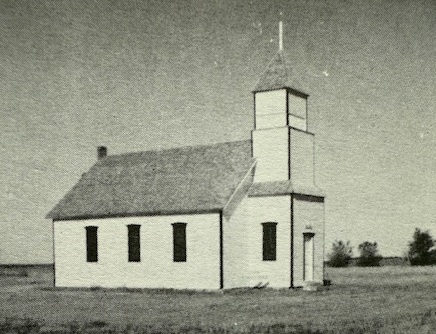
There would always be a tall Christmas tree decorated with a few beautiful ornaments (how they acquired them, I do not know), yards and yards of strung popcorn and real candles. While the candles were lit, two young men stood behind the tree equipped with long sticks, the tips covered with cotton. A bucket of water stood nearby. In case a candle burned down or caught the tree afire, the cotton tipped stick would be plunged hastily in the water and snuff out the candle. How beautiful was that tree to welcome the people in! Two kerosene hanging-lamps hanging from the tall ceiling and six bracket lamps on the walls, one at each window, added to the cheeriness and warmth of the welcome.
Because there was no other place to go, everybody went to church. The families came in lumber wagons and spring wagons, the father and mother and maybe a youngster or two on the front seat. Hay was put in the wagon bed and the rest of the children would sit on the hay with comforters put over them to keep them warm. The horses were tied to the long hitching rails near the church during the program and the comforters were put on their backs to keep them warm.
The Christmas programs were similar to today although in those days literature and program books were scarce and many times the recitations by the children were verses from the Bible pertaining to the birth of Christ. I remember one evening very distinctly when the whole program consisted of songs and reciting Bible verses. I was reciting some verses from Luke 2 in front of the Christmas tree when suddenly my father who was sitting in the front pew motioned to the boys behind the tree that a candle had gone rampant. I was just sure my hair had caught on fire, or worse yet, that my beautiful new ribbon bow on my hair was afire. I almost forgot what I was to say. Strangely, the next words were “Fear not -.” The songs sung to the accompaniment of a pump organ were some of the very songs we sing today. Always the program ended with all singing the song, “Silent Night.” How happy we children would be because we knew that now was the time we would get our sacks of candy and nuts and maybe an orange. This being the only time that we would ever get candy, it was a great expectation for us. Every one present got a sack, handed out from wash boilers carried around by two young men.
Even though the years have passed and times have changed very much, it always has been the same Christmas spirit and the same story of Jesus’ birth.