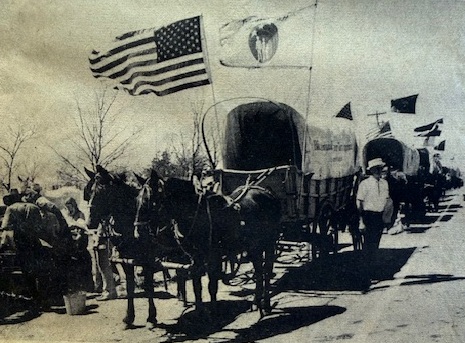
In celebration of the nation’s 200th birthday in 1976, Americans across the country took part in a very unique road trip, the Bicentennial Wagon Train Pilgrimage to Valley Forge, Pennsylvania. Described as a replay of history in reverse, five trains of covered wagons crossed the country from West to East adhering as closely as possible to original pioneer trails and wagon routes. The event was sponsored and planned by the Bicentennial Commission of Pennsylvania which provided an authentic Conestoga or prairie schooner for each state as well as a Pennsylvanian Conestoga and chuck wagon to accompany each of the main caravans. Citizens were also encouraged to join the trek on horseback or in their own wagons for all or part of the journey.
When the covered wagons made evening camp, singers, dancers and musicians in buckskins and ginghams entertained with ballads, reels and other early American songs and dances. Reenactments and local celebrations in towns along the routes also took place.
A caravan of four covered wagons kicked off the first leg of their journey at the Rose Bowl Parade in Pasadena, CA, on New Year’s Day. The train traveled through Arizona, New Mexico and Colorado, picking up official wagons from each of those states along with several privately owned wagons and numerous riders on horseback. The train arrived at Coolidge, KS April 5 and was joined by a prairie schooner representing Kansas.
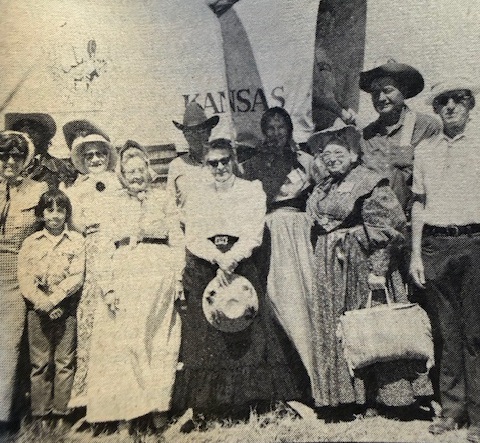
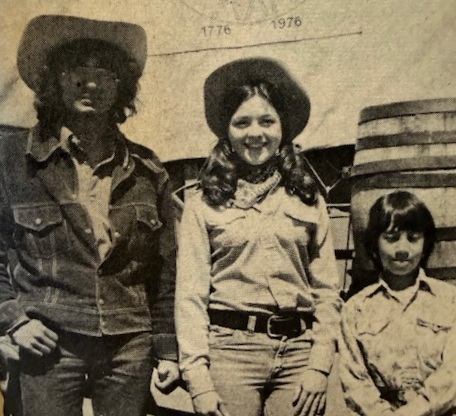
The wagons rolled into Kearny County shortly before noon on April 7. They stopped for a short noonday repast and were greeted by the official nine-member welcoming committee. Also present were Lakin students Sonja Smith and Rob Jaeger and Deerfield student Pete Ramirez. Smith won the local Bicentennial essay contest for high school students while Jaeger and Ramirez won the poster contests for grade schoolers. These three were invited by the wagon master to ride in the wagons to Loucks Park.
Elsie Heisinger joined the group at Kendall, and Dick Grusing, driving his wagon loaded with the local folks, welcomed Jack Pepper who kept the entire wagon train entertained with his guitar playing and singing as they made their way the last 12 miles. Twenty wagons and some 75 to 100 trail riders were in the train when it arrived.
A crowd estimated at over 500 persons greeted the wagoneers as they entered Loucks Park and the rodeo grounds. The Lakin High School marching band, dressed in full uniform, played while the wagons made their circle for the night’s encampment.
The job of feeding around 225 hungry wagon train members, workers and visiting dignitaries began about 5 p.m. The meal was prepared by volunteers with the Kearny County Saddle Club donating and barbecuing the beef. Some 35 pounds of pinto beans grown in Wichita County and donated by Bryant Holmes of the Leoti Standard were consumed along with gallons of potato salad and pans of piping hot cornbread made by USD 215 lunchroom cooks. Karen Burden was chairman of the committee to arrange a reception, overnight stay, and a place to present the show put on by the troupe traveling with the wagon train.
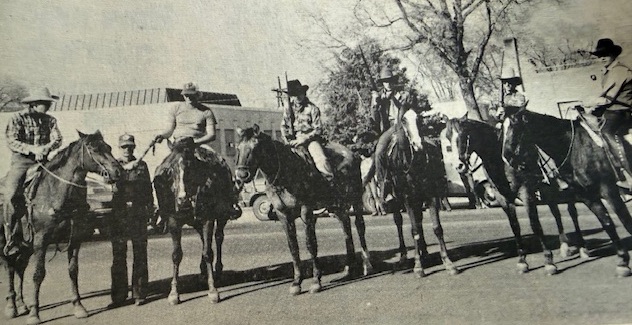
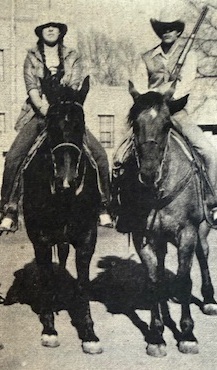
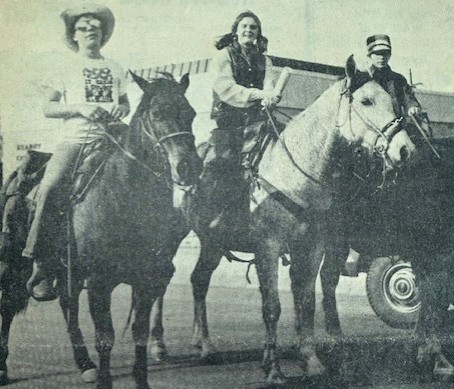
Also as part of the festivities, Pony Express riders presented scrolls bearing the names of Deerfield and Wichita and Grant county residents to the wagon master of the Bicentennial Wagon Train. These scrolls, Pledges of Rededication reaffirming the people’s belief in American principles, were relayed from rider to rider. Kearny County Saddle Club President Butch Anderson arranged the ride and coordinated the efforts of the Lakin riders with those of the Leoti Rough Riders Saddle Club and the Easy Riders Saddle Club of Ulysses. The transfer point for the Grant county group was the Menno Road. Kearny County riders making the run from Menno Road to Lakin were Bret Tate, Wade Berlier, James Davis and John Moore. Brian Dumler, Tammy Hammons, Troy Hammons, Jack Coyne and Neil Schibbelhut rode the route from the Wichita-Kearny County line, and Gary Patton, Teal Burrows and Bill Jennings brought the Deerfield scrolls to Lakin.
The Bicentennial Wagon Train had special meaning for all of Kansas. As it traversed the Santa Fe Trail, the old gateway to the southwest, the prairie schooners and Conestogas were reminiscent of early Kansans coming from the east to settle a new land. The wagoneers were experienced trail riders and teamsters. Students, craftsmen, professional people, housewives and even some grandparents joined the train in the spirit of patriotism. The train crossed into Missouri May 5, and a few days later met up with more wagons from the Oregon Trail wagon train. They were loaded onto river barges and floated to Pittsburgh by way of the Missouri, Mississippi and Ohio rivers. All the caravans that were spaced across the US converged at Valley Forge for an encampment and Bicentennial festivities July 4th.
SOURCES: Ford Presidential Library; Museum archives; and archives of The Lakin Independent, South Pasadena Journal, Philadelphia Inquirer, Kansas City Star and Wichita Eagle. Photo credits: Vivian Fletcher Fankhauser and Lakin Independent.