In 1848, Ireland was in the grip of the Great Famine, a devastating seven-year period of disease and mass starvation. James Mullany was born amid all this suffering at County Sligo in the northwest part of the country. He was one of 11 children born to Anthony and Catherine (Bolan) Mullany. Following poor harvests in the early 1860s, the Emerald Isle was on the brink of another famine, and over 80,000 people emigrated from there in the first seven months of 1863. Still but a teenager, young James set his sights on the New World. He joined some of his neighbors aboard the Adriatic and sailed to the United States in search of fortune. After landing in New York, Mullany made his way to his older sister, Mary McNellis, who was living in Iowa.
At the tender age of 16, James enlisted in Company K of the Eleventh Minnesota Volunteer Infantry. This infantry patrolled the Tennessee/Kentucky state line during the Civil War to protect the Louisville & Nashville Railroad against Confederate guerrillas. James was serving with his comrades in Sumner County, Tennessee when the news of General Lee’s surrender reached the regiment. He continued with his command in the South until the summer of 1865 when he received an honorable discharge at Fort Snelling, MN.
James visited several of the southern states after that time and finally settled in Arkansas where he raised cotton and married Alice Williams, a native of Alabama, in 1871. Life was not kind to the young couple. In 1872, Alice gave birth to twins, but both died the following year. Three more children were born to the union. A son died at the age of two and a daughter at the age of 11. Alice died in 1885. James and his only surviving child, a daughter named Lulu, then moved to Wayne County, Iowa, but Mullany was not satisfied with his future prospects there. Encouraged by his sister who was already living in Kearny County, the nearly penniless Irishman came here with Lulu in 1887. For a few months, he worked as a railroad section hand, receiving $1.10 a day. Later, James worked on a farm for which he received board and $20 a month. Then he clerked for O’Loughlin & Weber.
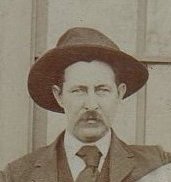
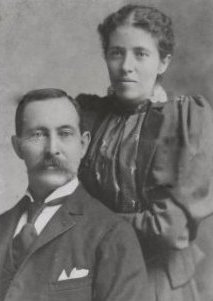
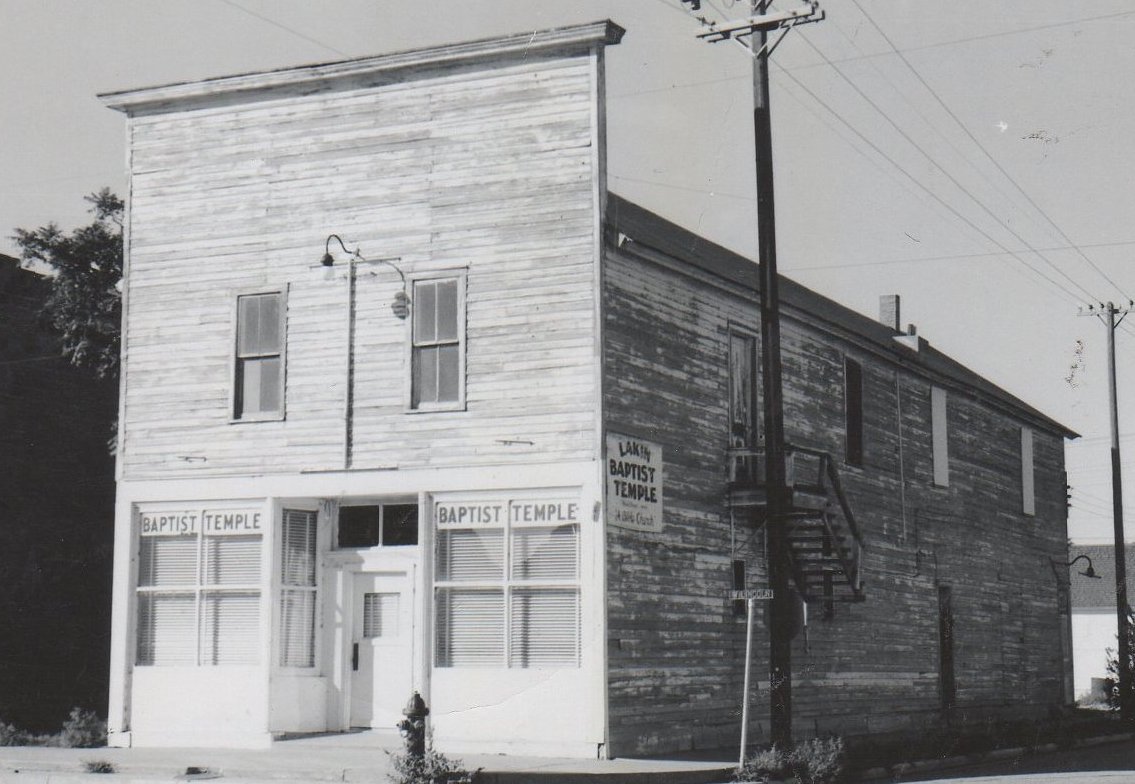
Mullany served as the clerk of Lakin Township before being elected Clerk of the District Court in November of 1892. In May of 1897, he married Maggie Nash, the “bright, pretty and amiable” daughter of John Keating and Mary Ann Nash. Following his second term as District Court Clerk, Mullany returned to work for O’Loughlin & Weber before moving to Garden City to be the head clerk for Knox’s grocery. Sons Anthony Glen and James ”Babe” Verne were born during this time. In 1901, Mullany moved back to Lakin after forming a partnership with his niece’s husband, J.C. Hart, a former Santa Fe Railroad agent. The two men purchased E.S. Snow’s complete stock of dry goods and groceries and opened Hart & Mullany on the southwest corner of Main and Lincoln.
Early in 1906, Hart disposed of his interest in the company, and James took on his son-in-law, Steve Houser, as a partner. Houser had resided here for years, according to The Advocate’s announcement regarding the new firm. Six years later, Mullany & Houser sold out their entire stock of groceries to A.G. Campbell. Subsequently, James was elected as Register of Deeds. His wife died in 1915, and at the end of Mullany’s second term, he returned to the mercantile trade. Mullany & Sons rapidly built up an extensive and lucrative business, but in 1918, the entire stock was sold to the Equity Exchange citing Mullany’s desire to take it easy for a while. The Irish-born merchant didn’t retire completely though. He filled in at the Equity, Campbell Mercantile and Nash Brothers which was owned by his brother-in-law, Jack Nash. Mullany was also active in the GAR, veterans’ affairs, and Democratic party. He even served on the City Council and was mayor at one time.
After retirement, James began spending winters in California with his daughter and family, and he went to live with Lulu permanently in 1922. He passed away from pneumonia in 1938. His remains were laid to rest at Holy Cross Cemetery, a graveyard in San Diego which was dedicated for the exclusive use of Roman Catholics. Fortune comes in many forms, and James Mullany found his as a husband, father, prosperous merchant, respected official, and “one of the very best citizens of Kearny county.”
SOURCES: History of Kearny County Vol. I & II; A Standard History of Kansas and Kansans by William E. Connelley; Diggin’ Up Bones by Betty Barnes; Ancestry.com; findagrave.com; Wikipedia; Museum archives and archives of The Lakin Independent, Advocate, Lakin Index, Investigator, Garden City Herald and Garden City Imprint.