On a Saturday night in August of 1892, four masked men held up a passenger train near Augusta, Kansas. As the train crossed a bridge one mile east of the Augusta depot, the engineer was startled by the sight of a masked man climbing down over the coal in the tender of the engine. The man shoved a revolver in the engineer’s face and commanded him to stop the train. A revolver was also aimed at the train’s fireman.
The engineer brought the train to a standstill, and accomplices in the rear uncoupled the Wells Fargo express car. Then the engineer was forced to pull ahead about a mile with the car and stop. While two of the robbers watched the crew of the locomotive, the others went to the express car door, demanded admittance and commenced shooting through the sides of the car where two more employees were barricading the door. The crewmen had no choice but to admit the masked men to the car where the safe was opened and ransacked. The robbers then made their escape into the surrounding woods.
Earlier in the week, the sheriff of Cowley County had been informed by a would-be fifth member of the gang that such a scheme was afoot. While the sheriff did not discover exactly when the robbery was to take place, he had a posse in waiting. As soon as he caught wind of the hold-up, he knew right where to put his hands on the robbers. He went to Douglass with several deputies where they surrounded the robbers’ homes and arrested Fred Livingston, A.A. Bailey, Rollin Moffat and Ezra Carter without a fight. Indisputable evidence of the men’s guilt in the form of masks and the money was found. The robbers were transported to the Winfield jail, and all of the stolen money except a few dollars was reportedly recovered. None of the men had ever held up a train before, but one paper reported that they had done their work like pros with the only mistake being that they captured the westbound Frisco instead of the eastbound which would have had a much larger amount of money onboard.
Now the names of Livingston, Bailey and Moffat probably bare no meaning to those who reside in Kearny County, but Ezra Carter just might ring a familiar bell. His father, John H. Carter, was the first man charged with keeping the peace in our area having been appointed undersheriff of Kearny Township in 1879 when what is now Kearny County was part of Ford County. What would possess the son of a lawman to get on the wrong side of the law?
The prosecuting officer entered into an agreement with the attorney for the defendants to prosecute only one of the men for train robbery. If there was a conviction, then the others were to plead guilty to larceny. If there was no conviction, then the others were to be set free. Ringleader Moffatt turned state’s evidence upon a promise that he would not be prosecuted, but Bailey, Livingston and Carter drew straws to see which would stand trial. As luck would have it, Ezra drew the long straw.
The trial, considered one of the hardest fought cases ever tried in Butler County court, lasted a week with the jury convicting Ezra to 14 years in the penitentiary while Bailey and Livingston were each given five. In 1895, the latter two were pardoned, but Carter’s request for a pardon was denied with the board of pardons claiming the case was a sort of “tails I win and heads you lose” scenario. Carter plead that he was guilty of no more serious a crime than the others and felt discriminated against. Then, in 1898, Kansas Governor Leedy commuted Carter’s sentence after Ezra produced affidavits to show that the other two men had robbed the train and that he only took a minor part in the crime.
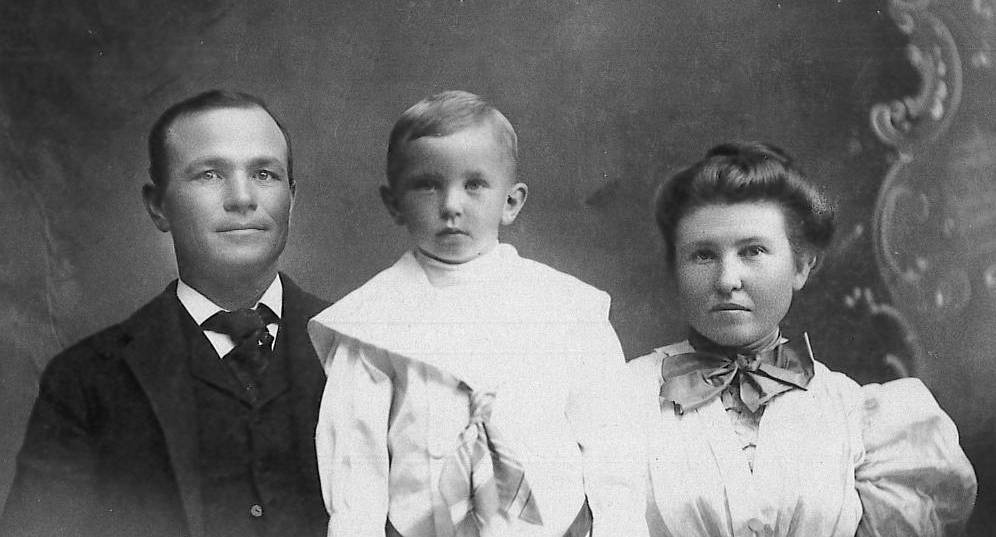
Carter made his way back to Kearny County, moved in with his father and began living the life of a reborn man. He was soon serving as director of the Lakin band and was elected county commissioner for District #1 in 1905. He married Grace McConnon, the daughter of another local lawman, in April of 1901, and the two welcomed sons in 1903 and 1908. But Ezra couldn’t completely escape his criminal past.
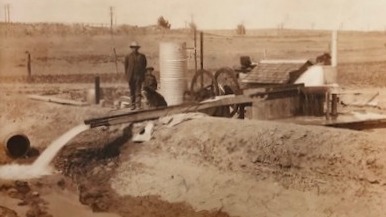
When seeking re-election in the county commissioner race, Ezra approached a neighboring farmer in the Hartland area by the name of George W. Clark to solicit Clark’s support. Clark told Ezra that “there were just as good men who had no penitentiary record.” The feud between the two men continued to brew and came to a head in December of 1910 when Clark hired a man to sink a well on his farm. That man employed Ezra Carter, but Clark ordered Ezra off his place with the warning that he would kill him if he returned. Ezra came back to the well with six others to work. Clark rode from his house up to where the men were working. When about 75 yards from them, Clark, without saying a word, turned and rode back to the house about 400 yards away. Witnesses reported that Carter said Clark was probably going to his house to get his gun and shoot him. That is indeed what happened. Clark returned to the men, and ordered Carter to leave. Ezra jumped behind another man for protection and reportedly said, “I’ll go” and “Don’t shoot.” But when Ezra stuck his head out, a deadly shot struck his skull, and Clark rode away without saying another word. He was captured later that evening.
Clark’s case was the first murder trial in Kearny County. Both he and Ezra had many partisan friends, and after the jury had been out for more than 24 hours, the verdict was returned. Clark was found not guilty by reason of insanity and sentenced to the wing for the criminally insane in the state penitentiary at Lansing. Clark was the first person to be sent to the asylum, but the Topeka State Journal reported that prison officials said Clark’s mind was normal from the time he was received there. In 1914, Clark escaped while clearing brush on an island in the Missouri river. He was located in Heavener, Oklahoma but refused to be returned to Kansas. Since Clark was not convicted of murder, he could not be classed as a fugitive from justice and could only be arrested while within the state of Kansas. Nine years after his escape, Clark died near his home in Heavener from uranic poisoning. Ironically, the Heavener Ledger reported that Clark, like Ezra Carter, had also been living the life of a reborn man, was considered upright in his business dealings, and was popular among all who knew him.
SOURCES: Archives of the Kearny County Advocate, Junction City Weekly, The Evening Kansan, Rock Island Daily Argus, Harrisburg Telegraph, Kansas City Journal, Topeka Capital-Journal, Topeka State Journal, Heavener Ledger, and Leavenworth Times with special thanks to Charlotte Carter Isaacs.