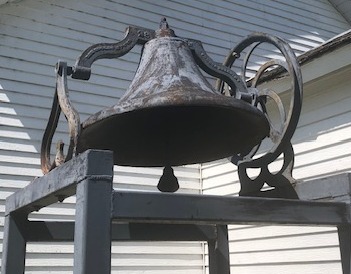
The Kearny County Historical Society was organized Nov. 26, 1957 by a number of persons who were interested in preserving the history of Kearny County. Spearheaded by their president, Mrs. Virginia Pierce Hicks, this small group had a vision that has led to the release of two volumes of History of Kearny County, the preservation of the Deerfield Texaco Station, and to the museum complex which is home to the oldest house in Lakin, Columbia one-room school house, the Lakin depot, 12-sided barn, machinery building, and main museum building with annex.
Hundreds of visitors and school children come through the museum door each year, eager to learn about history and see artifacts that offer a glimpse into the lives of those who came before us. Our buildings are overflowing with many fine artifacts, most of which way have been generously donated. We have files upon files filled with historical information, archives of the local papers, and offer research services for those interested in learning more about their families or historical events. Few rural museums have as much to offer as does ours. We are forever indebted to our benefactors, the 16 charter members of the KCHS, and the many dedicated volunteers, board members and employees who came before us and shared their time and talents to make the museum what it is today.
You too can be a part of the Kearny County Historical Society. We encourage you to join us on Saturday evening, May 6, for our annual meeting at the Deerfield Community Center. In addition to learning more about our organization and projects, you will be treated to a delicious brisket meal and program on the Arkansas River given by Hannes Zacharias.
You will need to reserve your spot by calling the Museum at 620-355-7448 by 3 p.m. Friday, April 28. There is no charge for this special event, and we would love to have you as our guest!
If you cannot attend the annual meeting but are interested in becoming a member of the historical society, a mere $20 will pay for a lifetime membership. If you like the articles that have been appearing in the newspaper, you are sure to enjoy our newsletter which is mailed quarterly to our members. With your membership, you will also have the satisfaction of knowing that you are helping preserve our precious past and educating future generations.


Multiple generations of the Tate family have called Lakin home since 1885. They have excelled in the fields of law, business, ranching, agriculture, medicine and more, but a common denominator has been their commitment to making this community better. That is a legacy that began in the spring of 1885 when George H. Tate Sr. arrived here from Chesterfield, Illinois. Accompanied by his 14-year-old son, George Jr. (Harry), the elder Tate had been advised by his doctor to move to a drier climate, and Lakin fit the bill. In July of 1885, he commenced to build a frame store building to house a general hardware and mercantile business on the west side of South Main Street. By the end of August, Tate had a partner, Noell E. Farrar, and the firm of Tate & Farrar opened with a line of groceries, flour, feed, clothing, and more. George purchased Farrar’s interest less than a month later and continued a successful business with son Harry by his side. The following spring, Mr. Tate returned to Illinois to move his wife, Susannah, and their eight other children to Lakin.
Tate’s firm enjoyed a large business serving local customers and those from surrounding counties. When Lakin lost the county seat in 1889 and drought and nation-wide depression set in, three general stores closed their doors, but two remained – John O’Loughlin’s and Geo. H. Tate’s. Sons Harry, John and Sidney assisted their father in the family business while daughter Elizabeth had charge of the dry goods department. The family also conducted a freighting business to Ulysses and maintained a store in Deerfield for a number of years. Harry, John and Sid took turns hauling supplies there several times a week until this business was sold in 1902 to Sam Corbett and Fred Sowers.
Due to his ever-increasing business, George added on to his Lakin store more than once. Then, in November of 1906, the building was pulled out into the street to continue doing business while a substantial brick replacement was under construction. The grand opening in the new building, Lakin’s largest at the time, was celebrated in the spring of 1907 with Tate’s offering dry goods, groceries, clothing, hats, caps, boots, shoes, hardware, Queensware, flour, feed, harnesses and even the buggy to get the shopping haul home.
George Tate’s business was significant to the citizens and economy of Lakin, but he and Susannah contributed to the community in other ways as well. George was on the city council and served stints as mayor and treasurer. A veteran of the Civil War, he was a charter member and very active in the local chapter of the Grand Army of the Republic (G.A.R.) He served on various committees in the early years working towards improvements in this southwest Kansas town. Mrs. Tate was one of Lakin’s Christian workers, opening her home to prayer meetings and serving on the Ladies Aid Society. The Women’s Christian Temperance Union flourished due mainly to her many years of service as the organization’s president.
After George’s death in 1917, the management of the store fell to George Jr.
When he died in 1944, his sons Cecil and Roland continued to operate the store. In March of 1946, the brothers announced that they had sold the store to Mr. and Mrs. Howard Brehm owing to the pressure of other business. Currently used for storage, the building has housed a number of grocery stores through the years including Brehms, Quality Food Market, Fisher’s IGA, Don’s Jack & Jill, Connie’s Food Center, and Carter’s Jack & Jill.


SOURCES: “Pioneering Tate Family Celebrates 100 Years in Kearny County” written by Florence Tate Fletcher for the Lakin Independent July 18, 1985; archives of The Advocate; Lakin Investigator and Lakin Independent; Diggin’ Up Bones by Betty Barnes; History of Kearny Co. Vol. I & II; and museum archives.
When Lakin secured the county seat in 1894, some of the homes and business houses in Hartland were relocated here. As the climatic and economic conditions steadily improved, Lakin’s population again began to grow. By October of 1906, the town was in the middle of another building boom. Among the buildings erected at this time were the Kearny County Bank and the Lakin State Bank.
The Kearny County Bank had been organized February 1, 1888, and was located in the Spivey and Holmes Building on the southeast corner of Main and Waterman. This set-up worked well for the bank until the building also began housing county officers and the court house in 1899. Eventually the county needed more space, and the news broke in March of 1906 that bank officials had decided to erect a new building across the street on the west side of Main.
By the end of January 1907, the fixtures of the Kearny County Bank were all in place, and the safe had been installed in the handsome building which featured red pressed brick with white accents. The only obstacle preventing the bank from moving into the new quarters was the arrival of the office furniture. The official move took place in February. Besides being headquarters for the bank, the building had several offices on the first and second floors. A suite of rooms was occupied by the real estate and insurance business of E.R. Thorpe and Charles Loucks, and dentist J.H. Rardon’s office was on the second floor.

Catty-corner from this location was the site chosen for the Lakin State Bank which was chartered in March of 1906. Although the Kearny County Bank had about a four-month head start on construction, Lakin State Bank was the first to move into their new facility. The move took place Christmas 1906. Made of cement stone with steel ceilings and attractive metal cornices, the building committee spared no expense in making the building up-to-the-minute in every respect. The bank was situated in the first room on the first floor with Kansas Real Estate and Abstract Company in the second room. A third room was initially used as a board room for the directors. The first suite of rooms on the second floor were occupied by attorneys A.R. Hetzer and H.O. Trinkle, and the Kearny County Advocate moved into the second suite on the upper story with editor C.N. Walls sleeping next door to the printing office. The basement was leased to C.H. Sanford of Garden City and used as a café, but that business was short-lived. The Advocate was removed from the top story and relocated in the basement in August 1907.

The ownership and control of both banks remained in Kearny County from the dates of their origin until May of 1946 when officials of the Garden National Bank acquired majority control of the banks, consolidated them and liquidated the Lakin State Bank. The new institution continued under the name of Kearny County Bank, carrying on business in the same location. In 1955, majority control of the bank was returned to local hands when the investor group of Dan Ratzlaff, J.R. Hutton and Clyde Beymer, Jr. acquired the shares controlled by the Garden National Bank owners. A new building was erected in 1962 two blocks north.
The old Kearny County and Lakin State bank buildings still stand and have housed many businesses throughout the years from pawn shops to beauty shops and insurance agents to computer wizards. Bri’s Burritos is currently stationed in the former Kearny County Bank building while Bryant Chiropractic operates out of the Lakin State Bank location. The upstairs offices in both buildings have been converted into apartments, and the entrance to the basement on the south side of the Lakin State Bank building was filled in with concrete many moons ago.
SOURCES: “We’re 100 Years Old” written by Clyde Beymer, Jr. for the Jan. 28, 1988 Lakin Independent; Archives of The Advocate and Lakin Investigator from 1906 through 1909; May 17, 1946 Lakin Independent; History of Kearny County Vol. 1; and museum archives.
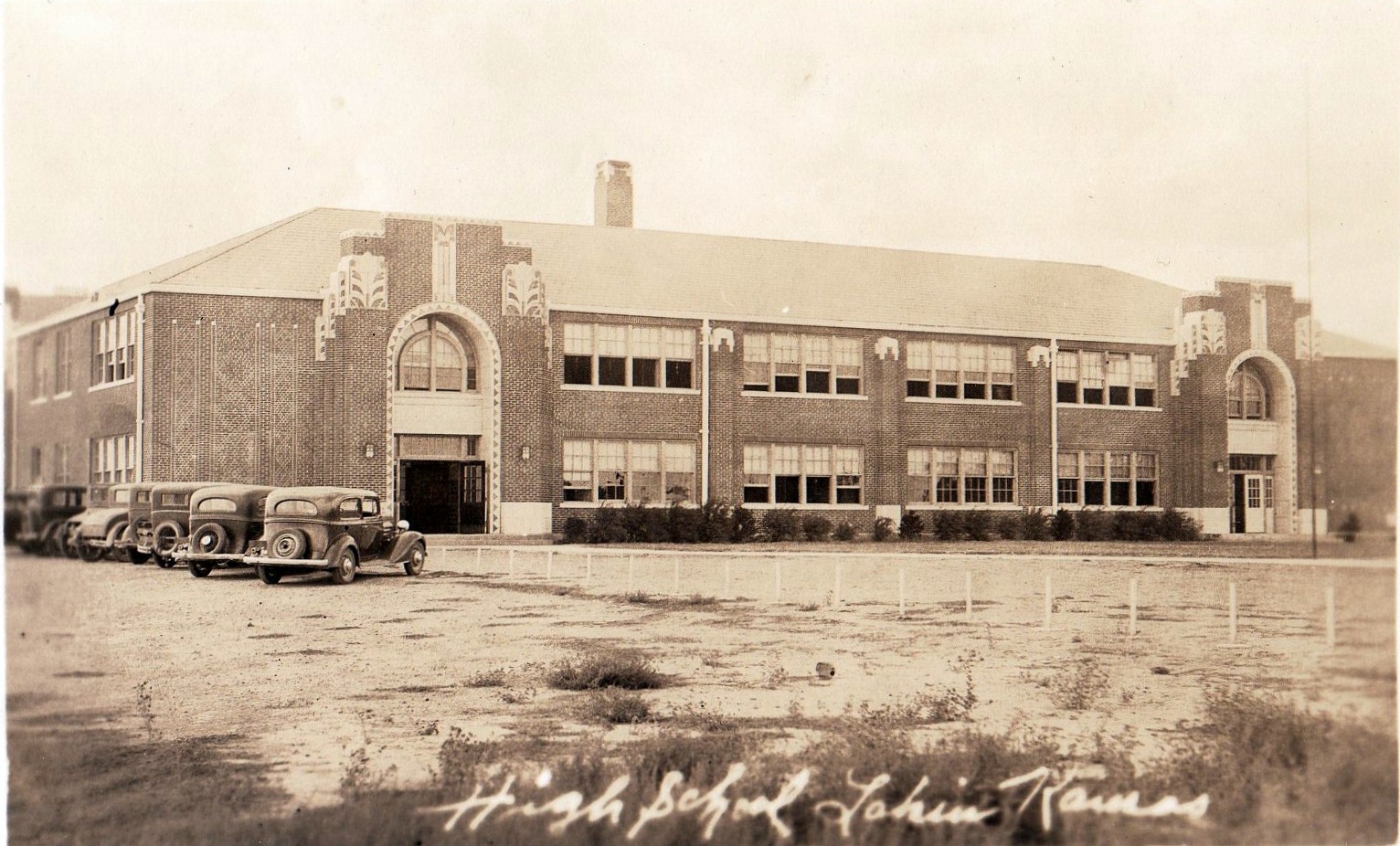
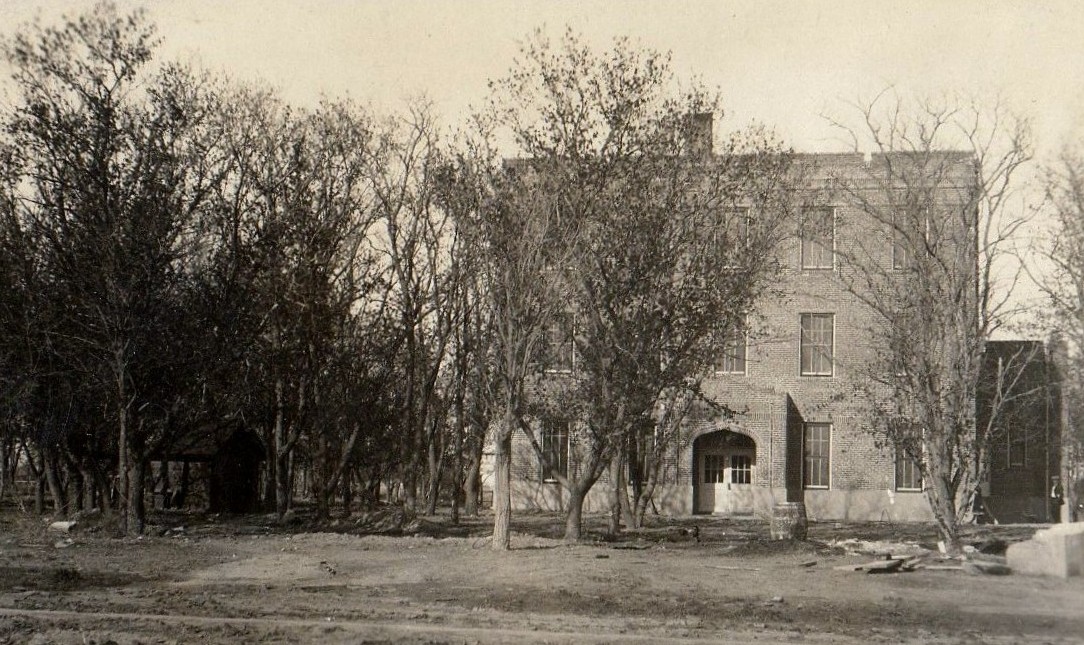
Knowing that an investment in education pays the best dividends, Kansans invested early on in the education of their young folk. Two hundred school districts were organized in 1884, and among them was School District No. 3 of Finney County. This district included the east half of present-day Kearny County. On Kansas Day 1884, a new town hall was christened on the east side of Lakin’s Main Street. The hall was used as a school, church, and community gathering place, but by the end of 1885, it became ever apparent that the building would very soon be too small to accommodate the ever-growing population of young people.
An election was called to vote bonds to construct a modern school building and passed unanimously. The contract was let in April 1886 to W.J. Hobson of St. Joe, Mo. for $9,500. Designed by E.J. Eckel of St. Joe, Mo., “It will be an ornament to the town and a credit to the people who so cheerfully assumed the responsibility of providing such excellent facilities for the education of our youth.” Construction commenced immediately in the center of Block 50 with a completion goal set for August 25th of that year. The cornerstone was placed in a grand celebration on July 5 that included orators and speakers, ladies on horseback in red, white and blue, a basket dinner, baseball game, lofty tumbling performance by the Fat Men’s Club, fireworks, and pony, foot and sack races.
Among the speakers was A.B. Boylan, director of the board of education. “A few slight years have elapsed since this all was the range of the buffalo, antelope, and the wild horse. Little did I think when I first took up my abode on this then wilderness of a prairie that I would be called upon such an occasion, but so it is.” Boylan closed with this sentiment that still rings true today, “It is necessary that our children still have the advantage of education that they may understand the constitution of the United States, that they may form a more perfect union, establish justice, insure domestic tranquility, provide for the common defense, promote the general welfare, and secure the blessings of liberty to themselves and their posterity.”
Thirteen days later, the school building was hit by a tornado. The north side was blown down, delaying completion until late October. School opened Monday, November 1, 1886 with four teachers and an enrollment of about 80 pupils. D.D. Davidson was the superintendent.
Three of the school’s four rooms were fitted for school use. Primary grades 1,2 and 3 were together while the intermediate grades of 4,5 and 6 were in another room. High school was considered grades 7, 8 and freshmen. The fourth room was unfurnished and became known as the “Lodge Room” for local fraternities of the Masons, I.O.O.F., Knights of Pythias, Modern Woodmen, Knights and Ladies of Security, and others.
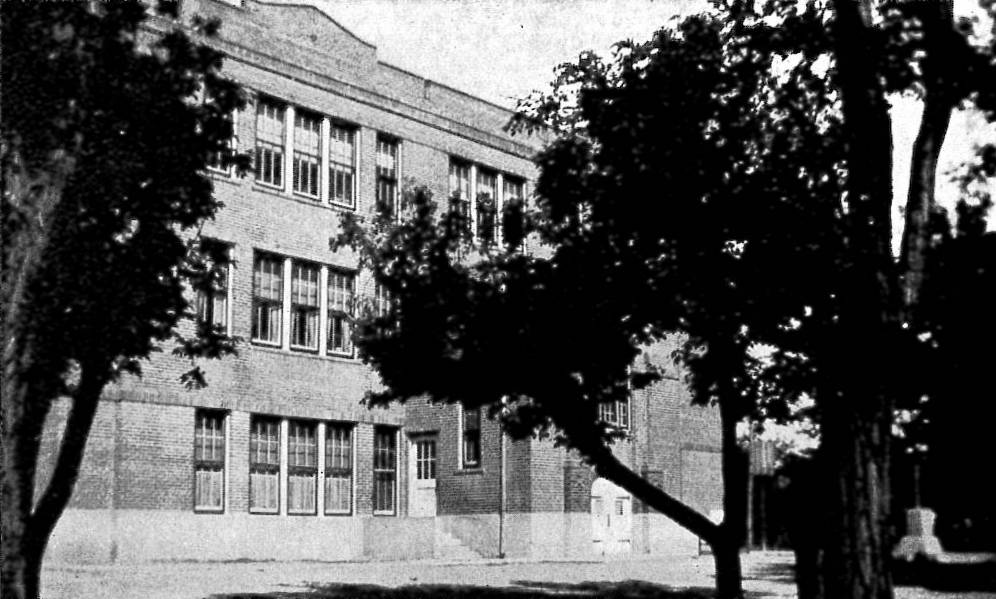
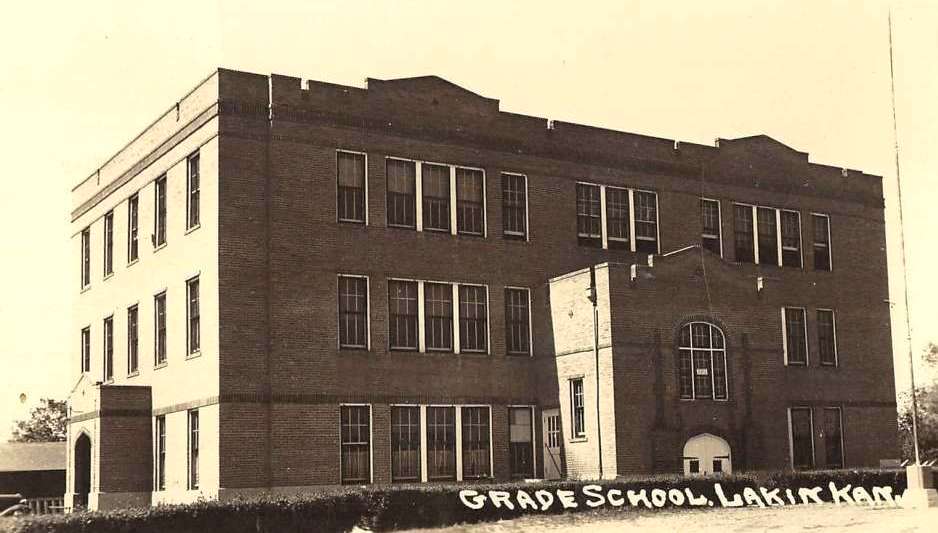
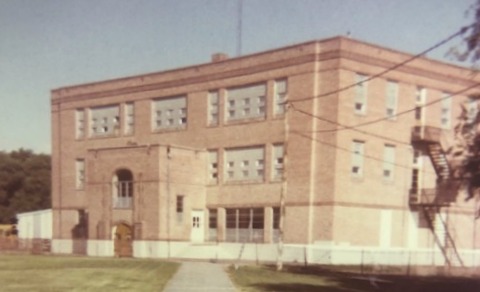
An addition of two large rooms was completed in 1912, one upstairs for an assembly room and a room downstairs for the primary grades. The basement was also added to, and a new furnace was installed. Inspections in 1919 revealed that the stone foundation on the original part of the building had deteriorated and was becoming unstable. Architects recommended that building a new school would be more cost-effective than repairing the old one, and in May of 1920, the walls of the 1886 building were laid to the ground.

SOURCES: Dec. 12, 1884 Smith County Bulletin; 1885 and 1886 archives of The Advocate; May 23, 1919 Advocate; May 7, 1920 Lakin Independent; History of Kearny County, Kansas Vol. 1; and museum archives.
When Governor Martin declared Lakin as the temporary seat of Kearney County in 1888, the former City Restaurant building on Lot 7 in Block 6 was rented for $15 per month to house the court house and county officers. The building had been erected by H.C. Robinson in 1885 and sat just southeast of Lakin’s Town Hall. When a tornado struck Lakin in July of 1886, the town hall was thrown from its foundation and demolished. Portions of the hall’s roof and building were hurled against the restaurant, but Robinson’s building survived the tempest. Soon after the building was rented by the commissioners, a stone vault was constructed at the back of the building to protect the county’s records. Rock for the vault was brought from quarries northeast of Kendall.
After Lakin lost the county seat election in 1889, Hartland’s Kearney House was rented as the court house. The hotel was a grand two-story structure that had been built for $3,500 in 1886 and was located just north of Hartland’s depot. Originally operated by the Bowen Bros., the hotel changed hands several times. L.E. Williams was the proprietor at the time of the January 1894 courthouse fire and sued county commissioners for negligence. In February of 1897, the Finney County District Court found the commissioners guilty as they had violated their lease by allowing the Kearney House to be occupied by a person who was not a county officer. There had also been hay, straw and other combustibles stored in unoccupied rooms of the building, and the hall door had been left open. The assessed damages came to $1,200. County commissioners appealed, and the verdict was reversed in July of 1899. The case then went to the Supreme Court which overturned the verdict. In July of 1900, county warrants were drawn for $1,674.34 and paid out to Williams.
After the Kearney House burnt, county commissioners rented a building in Hartland commonly known as the Jones building to house county offices. The two-story structure was just south of Hartland’s post office, and monthly rent was $15. This was a considerable savings as rent at the Kearney House had been $40 per month.
After the special county seat election in June of 1894, court offices were moved back to Lakin in the south side of what was commonly called the Spivey & Holmes building. Located on the southeast corner of Main and Waterman, this two-story building was opened in May of 1886 and had several office spaces. Holmes Hall, a large hall on the second floor that had been used as a community gathering place, was converted into a court room. The Kearny County Bank occupied the north part of the building.
By spring of 1895, county officials had grown weary of the condition of the Spivey & Holmes building and claimed that county records were being damaged whenever a rain shower or dust storm hurled across the prairie. Besides that, monthly rent was $105. J.H. Leeman had torn down his Hartland hotel and rebuilt it in Lakin on the west corner of South Main and Railroad Avenue. Renamed the Lakin House, Leeman offered up the building as a location for the court house in the fall of 1895, and commissioners accepted Leeman’s proposition for $40 per month. The court house remained at this location until 1899. At that time, the court house was moved back to the Spivey & Holmes building where county offices occupied the greater portion of the structure. Though remodeled several times during its existence, this building eventually became too small to house the court house.
American Legion members became the driving force behind the building of a new court house, circulating petitions to start a building fund and urging commissioners to purchase the block where the current court house stands. A federal public works grant of $31,5000 helped fund the construction, with remaining costs met locally. The court house was completed in August of 1939 at an original construction cost of $70,000. This amount excluded the jail and library additions which were completed in 1964 and 1973, respectively.
An estimated 3,500 people converged on Lakin when the court house and Highway K-25 South were dedicated in September 1939. The highly anticipated dedication day was full of activities with the highlight of the day being an address on the court house steps by Kansas Governor Payne Ratner. The joyous celebration was a rarity in a decade plagued by dust storms and the Great Depression.
“This dedicatory ceremony is a tribute to the progressiveness of those who made the building and the day possible,” Gov. Ratner said. “It seems to me the occasion should also be regarded as a time for dedicating our efforts toward better government—county, state, and national. It should be a time of inspiration, directing us to better citizenship, to greater fields of endeavor, and to larger and more useful lives.” Dr. Grant Hastings, chairman of the festivities, joked that the occasion was the first time a governor had visited Lakin outside of an election year.


SOURCES: Archives of the Kearny County Coyote, Lakin Investigator, Lakin Index, Pioneer Democrat, Kearny County Advocate, and Lakin Independent; History of Kearny County Vol. I and II; and museum archives.


Sources: Ethnic Heritage Studies Hannah A. Rosebrook: Community Journalist/Local Historian; Diggin’ Up Bones by Betty Barnes; History of Kearny County Kansas Vols. I & II; The Kearny County Kernels by Monte Canfield, Sr.; Methodist Life, Lakin Independent, and museum archives.